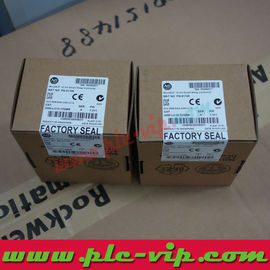
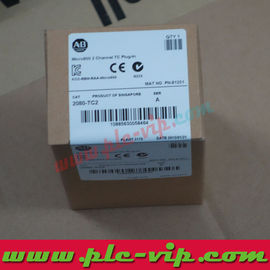
Allen Bradley Micro800 2085-OF4 / 2085OF4
-
-
Large Image :
Allen Bradley Micro800 2085-OF4 / 2085OF4
|
Product Details:
| Place of Origin: |
Made in SINGAPORE |
| Brand Name: |
PLC Module |
| Certification: |
All goods we supply are 100% original factory sealed with 1 year warranty! |
| Model Number: |
Allen Bradley Micro800 2085-OF4 / 2085OF4 |
Payment & Shipping Terms:
| Minimum Order Quantity: |
1 /PCS |
| Price: |
$179.00 (USD/PCS) |
| Packaging Details: |
100% original new |
| Delivery Time: |
IN STOCK; 4-6 weeks for ordering |
| Payment Terms: |
T/T, Paypal and Western Union. |
| Supply Ability: |
5 PCS |
|
Detailed Product Description
 2085-OF4 Rockwell Micro800 4 Channel 12 Bit Analog Output Module
Category:
PLCs, Power Supplies & I/Os
Manufacturer:
Rockwell
Group:
Micro800 2085 expansion I/O
2085-OF4 is a 4-channel analog output module in the Micro800 expansion line. It drives four analog actuators, typically a proportional valve and a variable speed drive reference, at 12 bits.
Field wiring lands on the removable terminal block (RTB). The RTB can be unplugged with the wiring in place, which is the reason a failed module can be swapped without re-terminating a panel.
Product Specifications 2085-OF4 (PDF)
Catalog number |
2085-OF4 |
Product type |
4-channel analog output module |
Points / channels |
4 channels |
Signal |
0-10 V DC, 0-20 mA |
Isolation |
Isolated, field wiring to controller |
Backplane current, 5 V DC |
Not published |
Dimensions, H x W x D |
Not published |
Temperature rating |
Not published |
Lifecycle status |
Active |
UPC |
Not published |
Country of origin |
Not published |
Terminal block |
Removable terminal block (RTB) |
Attribute values above are reproduced from the manufacturer's product data. For the authoritative technical record see Rockwell publications 2080-UM003 (module specifications) and Rockwell literature library (installation instructions). Certification details, with certificate and file numbers, are listed in the FAQ below.
What the module adds to a Micro800 controller
2085-OF4 is a 4-channel analog output module in the Micro800 expansion line. It drives four analog actuators, typically a proportional valve and a variable speed drive reference, at 12 bits.
It mounts to the right of a Micro810, Micro820, Micro830, Micro850 or Micro870 controller and is addressed by its position in the expansion chain, so the slot order in the project has to match the physical order.
Signal and channel count are fixed by the catalog number: 4 channels, 0-10 V DC, 0-20 mA.
Wiring on the removable terminal block
Field wiring lands on the removable terminal block (RTB). The RTB can be unplugged with the wiring in place, which is the reason a failed module can be swapped without re-terminating a panel.
The output range is selected per channel in software; the wiring has to match the selected type.
Size the conductors and the torque to the module data sheet; the RTB screws are hand-tightened, not driven with a power tool.
Expansion bus, module order and power
Module order matters: the expansion chain is scanned in physical order, and the bus is ended with a terminator. 12 bits on the output side is one step below the 14-bit input cards, and that is the published resolution, not a configuration limit.
Backplane draw is Not published. Add every module in the chain before deciding on the controller power budget.
Dimensions, ratings and lifecycle
Rockwell lists this catalog number as Active.
Dimensions are Not published and the rated ambient is Not published.
UPC is Not published, country of origin Not published.
Buying and swapping a module
Check that the module comes with its RTB. A module sold without the terminal block is not a drop-in swap, whatever the price difference.
Confirm the catalog number against the project: the 2085 line separates sink from source transistor outputs and AC input from DC input by catalog number only.
An analog output card is the module most often damaged by a shorted field loop, so a spare is worth holding.
FAQ — 2085-OF4
What does 2085-OF4 do?
4-channel analog output module: 4 channels, 0-10 V DC, 0-20 mA.
Where does 2085-OF4 mount?
To the right of a Micro800 controller, in the expansion chain, connected through the 2085 bus.
How much backplane current does 2085-OF4 draw?
Not published.
What are the dimensions of 2085-OF4?
Not published, rated Not published.
Is 2085-OF4 a current Rockwell product?
Rockwell lists it as Active.
Data sources. Descriptions, channel counts and analog ranges come from the Micro800 expansion I/O manual 2080-UM003; the 120 V and 240 V input ranges, off-state limits, filter time and bus current come from 2085-IN005; physical and lifecycle data come from the Rockwell product page for the catalog number. Any attribute these publications do not print is marked Not published. Any attribute a publication does not print is marked Not published rather than taken from a distributor page. Catalog number, packaging and stock status are the stock record of this listing.
2085-OF4: 4 channel isolated analog output expansion module
2085-OF4 is a 4 channel isolated analog output expansion module in the Micro800 system, and the analog specification rows below are the published values for this catalog number, including the drift and overload rows that are usually omitted.
| Specification | Value |
|---|
| Catalog number | 2085-OF4, 4 channel 12 bit isolated voltage and current output expansion module |
| Number of outputs | 4, isolated |
| Resolution | 12 bits unipolar, 11 bits plus sign bipolar; 2.56 mV per count unipolar, 5.13 mV per count bipolar, 5.13 microamps per count on current |
| Data format | Left justified, 16 bit twos complement |
| Step response to 63 percent | 2 ms |
| Conversion rate | 2 ms per channel maximum |
| Output ranges, current | 4 to 20 mA default, 0 to 20 mA, user configurable; 0 mA until the module is configured |
| Output ranges, voltage | Plus or minus 10V, 0 to 10V, user configurable |
| Current load on voltage output | 3 mA maximum |
| Resistive load on milliamp output | 15 to 500 Ohm at 24V DC |
| Absolute accuracy | 0.133 percent of full scale on voltage, 0.425 percent of full scale on current, or better, at 25 degrees C |
| Accuracy drift with temperature | 0.0045 percent of full scale per degree C on voltage; 0.0069 percent per degree C on current |
| Variant | 2085-OF4K is the conformally coated version |
| Source | 2080-TD001 Micro800 technical data, analog output expansion I/O specifications |
Five point one three microamps per count on the current output is one part in about four thousand of a twenty milliamp span, and the published accuracy is four hundred and twenty five thousandths of a percent of full scale plus drift. A drive reference that needs more than that needs a different module class.
The resistive load window of fifteen to five hundred ohms at twenty four volts is the loop budget. A positioner with a high input impedance sits at the top of that window, and a device outside it needs an interposing converter rather than a longer cable.
Resolution, accuracy, drift and update rate are kept separate on this page because they answer different questions. Where the source publishes a range that depends on the filter setting or the enabled channel count, the range is reproduced rather than collapsed to one number.
Sensor type coverage on a temperature module is a list, not a guarantee of accuracy. The published accuracy range spans the whole list, so the actual error for one thermocouple type has to be read from the type specific table rather than from the headline.
Overload tolerance is a commissioning feature. Thirty volts or thirty two milliamps continuous on one channel at a time is what protects the module from a miswired transmitter during a loop check, and it is also a warning that the protection is per channel rather than per module.
Accuracy figures published at twenty five degrees are laboratory figures. The drift per degree is what the panel actually sees, and a cabinet that runs twenty degrees above ambient multiplies the drift into a real error that belongs in the loop calculation.
Current loops are the default for a reason. Four to twenty milliamps survives voltage drop on a long cable and it has a live zero, so a broken wire reads as an under-range value rather than as zero percent of the process, and that difference is what lets the program detect a fault.
Factory calibration with no customer calibration supported is a statement about the service model. The module is replaced rather than trimmed, and a spare belongs on the shelf if the process cannot wait for a shipment.
Data format matters at the programming boundary. Left justified sixteen bit twos complement means the raw value occupies the high bits and the low bits are padding, and a scaling block that assumes right justification produces a value sixteen times too small.
Input impedance separates the two terminals completely. A voltage input above one megaohm barely loads the source, while a current input below one hundred ohms is the burden resistor, and connecting a four to twenty milliamp transmitter to the voltage terminal is a wiring error that reads as a saturated value.
The resistive load window on a milliamp output is the voltage budget of the loop. Fifteen to five hundred ohms at twenty four volts means the loop can carry a reasonable field impedance, and a device outside that window needs a different output or an interposing converter.
An analog channel is specified by four numbers that have to agree with each other: the resolution, the absolute accuracy, the drift with temperature and the update rate. A design that quotes only the resolution is quoting the smallest step the converter can produce, not the accuracy of the value it produces.
Fifty and sixty hertz rejection is the filter that decides how fast the channel can be. Enabling the rejection raises the settled response from a few milliseconds to hundreds, which is a fine trade for a temperature or a level, and an impossible one for a torque loop.
A plug-in analog module is a compromise on isolation and on channel count, and it is priced accordingly. Four non-isolated unipolar channels in a controller slot solve a small machine, and the same four channels in an isolated expansion module solve a panel with several supplies.
Bipolar and unipolar ranges change the resolution arithmetic. A twelve bit unipolar converter divides its span into four thousand and ninety six steps, and the same converter configured bipolar divides the same span into two thousand and forty eight steps on each side, which halves the step size claim.
Output channels hold zero until they are configured. A drive reference or a valve positioner that sees zero on a download is a safe behaviour, and a program that assumes the previous value is retained will be wrong after every power cycle.
Check the field device impedance against the fifteen to five hundred ohm window, and accept that the output is at zero until configured.