Category: PLCs, Power Supplies & I/Os
Manufacturer: Rockwell
Group: PLC Automation
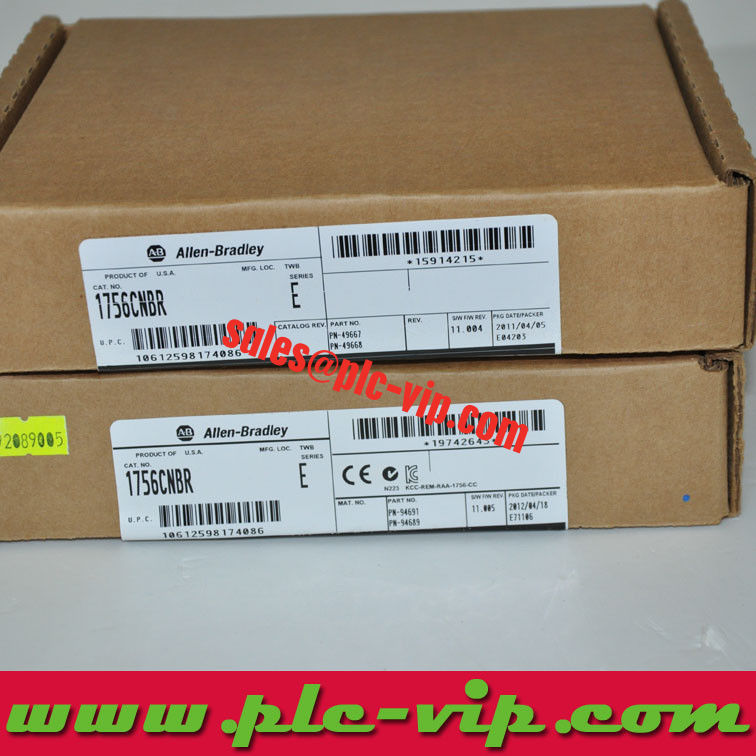
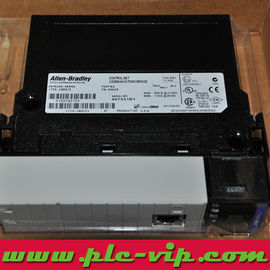
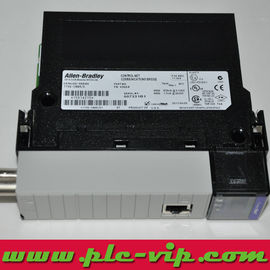
The 1756-CNBR (also written 1756CNBR) is the redundant member of the smaller ControlNet bridge pair for the ControlLogix 1756 platform: two ControlNet BNC ports at 5 Mbps, 40…48 Logix communication connections, chassis mounted and one slot wide. It keeps the modest connection budget of the CNB and adds a redundant trunk.
Table 22 publishes 40…48 Logix communication connections with 64 connections supported in total and 99 nodes, current draw 970 mA at 5.1 V DC, power dissipation 5.1 W and 17.4 BTU/hr, weight approximately 0.293 kg, isolation 30 V continuous basic insulation type tested at 500 V AC for 60 s, operating temperature 0…60 °C, T4, open-style. There is no front USB port.
| 1756-CN2 | ControlNet bridge, 1 BNC port, 128 Logix connections | IN STOCK |
| 1756-CN2R | Redundant ControlNet bridge, 2 BNC ports, 128 Logix connections | IN STOCK |
| 1756-CN2RXT | Redundant ControlNet bridge, -25...70 C, conformal coated | IN STOCK |
| 1756-CNB | ControlNet bridge, 1 BNC port, 40...48 Logix connections | IN STOCK |
| 1756-CNBR | Redundant ControlNet bridge, 2 BNC ports, 40...48 connections | IN STOCK |
Application | ControlNet |
Brand Name | Rockwell (Rockwell) |
Cat Num | 1756-CNBR |
Communication | ControlNet |
Display | Digital |
Enclosure | None (open-style) |
Interface | 2 ControlNet BNC (5 Mbps, redundant) |
Mounting | Chassis |
Number Of Channels | 2 |
Standard | CCC,CE,CSA,C-TICK,CUL,GOST,KC,MARINE,NRTL,RCM,UL
Vendor attribute list — the current Rockwell certification record, with certificate and file numbers, is in the FAQ. |
Sub Brand | ControlLogix |
Type | Communication Module |
UNSPSC | 32151705 |
Attribute values above are reproduced from the manufacturer's product data. For the authoritative technical record see Rockwell publications 1756-TD003 (module specifications) and 1756-UM001 (ControlLogix system user manual). Certification details, with certificate and file numbers, are listed in the FAQ below.
Where the module sits in a typical system
It suits a small but critical segment: two or three I/O racks that must stay on the network through a cable fault, where the full 128-connection bridge would be oversized. The 970 mA draw is the same as the CNB, so adding redundancy does not change the power budget.
The limit to plan around is the connection count, not the port count. 40…48 Logix connections are shared across both trunks, and 64 connections supported in total is the ceiling for the module.
Commissioning in five steps
- Set the node address on the module before it joins the segment — the ControlNet address is the module's identity on the wire, and two modules at the same address will not both come online.
- Use 1786-RG6 quad-shield coax with the published connectors and terminators; control the trunk length and the number of taps against the ControlNet planning rules, not by eye.
- Insert the module in any 1756 chassis slot; the published chassis are 1756-A4, A7, A10, A13 and A17 (1756-TD003 Table 22).
- Add the module to the I/O configuration in Studio 5000 and schedule the network — an unscheduled ControlNet segment carries no I/O regardless of the wiring.
- Read the indicators at power-up: a module that shows no network activity on a scheduled, terminated segment is an addressing or cabling fault before it is a module fault.
Diagnostics: status indicators
Three bi-colour indicators plus the alphanumeric display cover almost every commissioning fault, so most problems are resolved at the panel without a laptop.
| Indicator | State | Meaning and first action |
| OK | Flashing green | Power-up self-test in progress; wait for the solid state. |
| OK | Off | No chassis power at the slot, or the module failed its self-test. |
| ControlNet A / B | Green solid | The port is on the network and exchanging scheduled data. |
| ControlNet A / B | Flashing green | Connected but not scheduled, or not the keeper for that trunk. |
| ControlNet A / B | Flashing red | Duplicate node address or a configuration mismatch on that port. |
| ControlNet A / B | Off | No activity on that port: trunk unterminated, cable open, or the port unused. |
Indicator behaviour per Rockwell publication 1756-UM001 (ControlLogix System User Manual) and 1756-IN050.
Replacing a ControlNet segment
ControlNet is a legacy network in Rockwell's catalogue and the published migration is CNET-RM001, the ControlNet to EtherNet/IP Migration Reference Manual. The redundancy of two ControlNet trunks has an EtherNet/IP analogue in a device-level ring on an EN2TR, not in a direct exchange of part numbers.
For maintenance of an existing segment the CNBR is replaced by another CNBR, or by a CNB where the redundant trunk is no longer required. Draw stays at 970 mA in either case.
Which ControlLogix ControlNet module to specify
- 1756-CN2 — one BNC port, 128 Logix connections, 1.1 A at 5.1 V DC, 3 mA at 24 V DC. The standard bridge for a single ControlNet segment.
- 1756-CN2R — two BNC ports for a redundant trunk, same 128 Logix connections, 1.3 A at 5.1 V DC. Three connections are reserved for redundant control.
- 1756-CN2RXT — the redundant module in the XT range, -25…+70 °C, 1.3 A at 5.1 V DC, wired to 1786-RG6 quad-shield coax.
- 1756-CNB — one BNC port, 40…48 Logix connections, 970 mA at 5.1 V DC. The smaller bridge for a short segment.
- 1756-CNBR — two BNC ports, 40…48 Logix connections, 970 mA at 5.1 V DC. Redundancy at the lower connection count.
- 1756-EN2T / EN2TR — not ControlNet parts: the EtherNet/IP equivalent when the network itself is being replaced.
FAQ — ControlLogix 1756-CNBR / 1756CNBR Redundant ControlNet Module
What does the CNBR add over the CNB?
A second ControlNet BNC port for a redundant trunk, at the same 970 mA and 5.1 W and the same 40…48 Logix communication connections (1756-TD003 Table 22). The connection budget is shared across both trunks; it is not doubled.
How many connections does it support in total?
40…48 Logix communication connections with 64 connections supported in total, and up to 99 nodes on the network (Table 22). Scheduled racks and drives are counted against that figure when the segment is scheduled.
What is the power and thermal load?
970 mA at 5.1 V DC, 5.1 W and 17.4 BTU/hr, one slot wide, approximately 0.293 kg (Table 22). Identical to the CNB, so a redundancy upgrade on the same chassis does not need a new supply calculation.
Does it accept a USB programming cable?
No. Table 22 lists no USB port for the CNB or CNBR. Local work is done through the controller or over the network.
What are its environmental limits and certifications?
Operating 0…60 °C; isolation 30 V continuous basic insulation type tested at 500 V AC for 60 s; T4; open-style (Table 22). Certifications per Table 6: c-UL-us UL E65584 and Class I Division 2 UL E194810, CSA LR54689C and LR69960C, CE to 2014/30/EU, RCM, ATEX II 3 G Ex ec IIC T4 Gc, UKEX UL22UKEX2604X, UKCA, IECEx UL 22.0063X, FM Class I Division 2, KC, ODVA and CCC 2020122309111998.
Which chassis and cable types are approved?
Any slot of 1756-A4, A7, A10, A13 or A17 (Table 22), wired with 1786-RG6 quad-shield coax and the published taps and terminators. Redundancy is a property of the trunk pair, so both trunks are cabled and terminated to the same rules.
Can it run a segment larger than the CNB?
No. Both publish 40…48 Logix connections and 64 supported in total; a segment that outgrows that budget needs the CN2 or CN2R, which publish 128 Logix connections and 131 supported.
Data sources. Technical values on this page come from Rockwell publications 1756-TD003 (ControlLogix Communication Modules Specifications), 1756-UM001 (ControlLogix System User Manual) and CNET-RM001 (ControlNet to EtherNet/IP Migration Reference Manual) and the manufacturer's product page for 1756-CNBR. Values re-checked 15 November 2026.