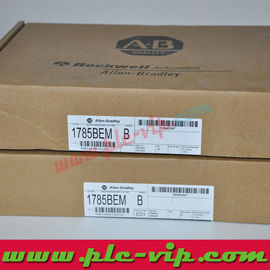
Detailed Product Description
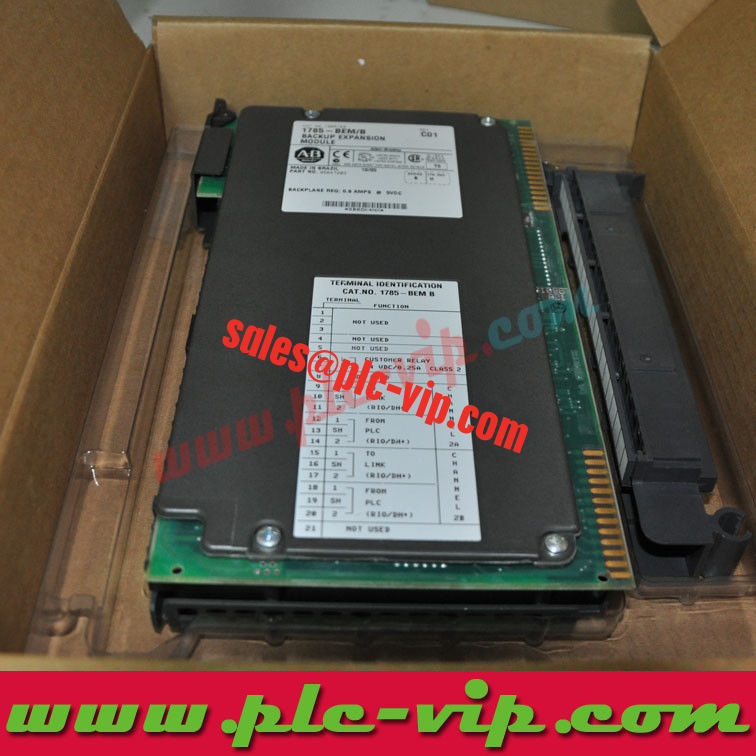
 1785-ME16 Rockwell PLC-5 16 K Word EEPROM Memory Cartridge
Category:
PLCs, Power Supplies & I/Os
Manufacturer:
Rockwell
Group:
Bulletin 1785 · PLC-5 controllers, memory and accessories
1785-ME16 is the 16 K word EEPROM cartridge Rockwell lists for the PLC-5/11 and PLC-5/20 processors.
The cartridge fits the processor's memory cartridge socket and is read at power-up when the processor is configured to load from EEPROM.
| 1785-ACC5LA |
PLC-5 accessory kit |
IN STOCK |
| 1785-ACC5LB |
PLC-5 accessory kit |
IN STOCK |
| 1785-CHBM |
ControlNet backup cartridge |
IN STOCK |
| 1785-ENET |
PLC-5 Ethernet interface module |
IN STOCK |
| 1785-L26B |
PLC-5/26 protected processor, 16 K words |
IN STOCK |
| 1785-L40C15 |
PLC-5 ControlNet 1.5 processor, 48 K words |
IN STOCK |
| 1785-L40C |
PLC-5 ControlNet 1.25 processor, 48 K words |
IN STOCK |
| 1785-L46C15 |
PLC-5/46C ControlNet 1.5 protected processor |
IN STOCK |
| 1785-L40E |
PLC-5/40E Ethernet processor, 48 K words |
IN STOCK |
| 1785-L60B |
PLC-5/60 processor, 64 K words |
IN STOCK |
| 1785-L60L |
PLC-5/60L processor with extended local I/O |
IN STOCK |
| 1785-L80C |
PLC-5 ControlNet 1.25 processor, 100 K words |
IN STOCK |
| 1785-L80B |
PLC-5/80 processor, 100 K words |
IN STOCK |
| 1785-L80C15 |
PLC-5 ControlNet 1.5 processor, 100 K words |
IN STOCK |
| 1785-L80E |
PLC-5/80E Ethernet processor, 100 K words |
IN STOCK |
| 1785-L86B |
PLC-5/86 protected processor, 100 K words |
IN STOCK |
| 1785-M100 |
100 K word memory module |
IN STOCK |
| 1785-ME16 |
16 K word EEPROM memory cartridge |
IN STOCK |
| 1785-ME32 |
32 K word EEPROM memory cartridge |
IN STOCK |
| 1785-ME64 |
64 K word EEPROM memory cartridge |
IN STOCK |
| 1785-RC |
Relay cartridge, edit and force monitoring |
IN STOCK |
Product Specifications 1785-ME16 (PDF)
Catalog number |
1785-ME16 |
Product type |
PLC-5 EEPROM memory cartridge |
Storage capacity |
16 K |
Used with |
PLC-5/11 and PLC-5/20 processors |
Lifecycle status |
Discontinued |
Discontinued date |
30 September 2021 |
Replacement category |
Engineering Replacement |
UPC |
612598126149 |
Country of origin |
United States of America |
Attribute values above are reproduced from the manufacturer's product data. For the authoritative technical record see the Rockwell literature library and the module-specific publication named in the technical data section above.
ControlNet or DH+ channels and memory
1785-ME16 is the 16 K word EEPROM cartridge Rockwell lists for the PLC-5/11 and PLC-5/20 processors.
Its purpose is program backup: the EEPROM image can reload a controller after a battery loss without a programming terminal on site.
Installing it in a PLC-5 chassis
The cartridge fits the processor's memory cartridge socket and is read at power-up when the processor is configured to load from EEPROM.
Because it is EEPROM and not RAM, the stored image survives without battery support; the controller battery only protects the working RAM copy.
Lifecycle and replacement
Rockwell lists 1785-ME16 as Discontinued as of 30 September 2021, replacement category Engineering Replacement.
New cartridges are gone; a used cartridge carries a program image from someone else's machine, so it must be erased and re-burned before use.
Where these are still in use
Cartridges are still bought where a PLC-5 has to be restarted by a maintenance technician without a laptop, for example on remote pumping stations and small packaging lines.
They are also bought as a cheap way to keep a validated program image on the shelf next to the panel.
Buying a used unit
Check that the cartridge has not been write-protected and that the label still matches the processor model; a 16 K cartridge in a /20 is the correct pairing.
Ask whether the cartridge was removed from a working processor: a clean removal is a good sign, a cartridge pulled with the socket damaged is not.
FAQ — 1785-ME16
What is 1785-ME16?
A 16 K word EEPROM memory cartridge for PLC-5/11 and PLC-5/20 processors.
Is it still sold new?
No. Rockwell lists it as Discontinued as of 30 September 2021.
Does the cartridge need a battery?
No. EEPROM retains the image without battery support.
Can I reuse a cartridge from another machine?
Only after erasing and re-burning the image.
What should I verify before buying?
Capacity marking, processor pairing and that the socket contacts are clean.
Data sources. Memory, I/O and channel figures come from the PLC-5 system specification table in 1785-UM012; lifecycle dates and UPC codes come from the Rockwell product page for the catalog number. Anything neither source prints is marked Not published. Any attribute a publication does not print is marked Not published rather than taken from a distributor page. Catalog number, packaging and stock status are the stock record of this listing.
1785-ME16: PLC-5 EEPROM memory module, 16 K words
1785-ME16 is the PLC-5 EEPROM memory module, 16 K words in the PLC-5 support and interface group. Memory cards back up the program, the relay cartridge provides a hardwired contact, and the sidecar puts a DH+ controller onto Ethernet.
| Attribute | Value |
| Catalog number | 1785-ME16 |
| Product type | PLC-5 EEPROM memory module, 16 K words |
| Family | PLC-5, bulletin 1785 |
| Type | EEPROM memory card that plugs into the controller memory module slot |
| Capacity | 16 K words of user program storage |
| Status code | S:68 reports 1 when this card is installed |
| Fits controllers with | 8,192 or 16,384 words of user memory, that is PLC-5/11 and PLC-5/20 class |
| Load rule | The target controller needs user memory equal to or larger than the memory used on the source controller |
| I/O racks of target | 4 racks for PLC-5/11 and PLC-5/20, so the card can be loaded to that class |
| Restore effect | Restoring to bad controller memory sets the controller date and time to the values saved with the card |
| Cross family | A card burned on a ControlNet PLC-5 cannot be loaded to a non ControlNet controller |
| Source | 1785-UM012D-EN-P, Enhanced and Ethernet PLC-5 controllers |
Sixteen thousand words is the smallest card that still covers a PLC-5/11 or PLC-5/20 program with room to spare, and the loading rules are what the selection turns on: the target controller has to offer at least the user memory that was in use when the card was burned. A 16 K card written on a 5/20 will load to another 5/20 or to a larger controller, but a card written on a 5/40 with a 30 K program will not load here.
Three facts from 1785-UM012D set the boundary for this part: the card slot reports its contents in S:68, the loading rules are set by user memory and I/O racks rather than by the card alone, and ControlNet and non ControlNet cards never cross.
The published controller limits that decide whether this part is the right one are 8,192 words on the PLC-5/11, 16,384 on the PLC-5/20, 32,768 on the PLC-5/30, 65,536 on the PLC-5/40 and 102,400 on the PLC-5/80, with a rack ceiling of 4, 4, 8, 16 and 24 respectively.
The transceiver catalogue is small and specific: 1785-TR10BT for twisted pair, 1785-TR10BF for optical, 1785-TR10B2 for thin wire and 1785-TR10B5 for thick wire, with the 5810 series thin and thick wire parts as the older equivalents. Transceiver cables come in 2.0 m and 15.0 m lengths, and the kits pair a transceiver with one of those cables.
An EEPROM card is a program backup device, not extra working memory. The program is saved to the card from the programming software while the controller runs, and the card is then loaded back into controller memory after a battery failure or a memory fault. Nothing executes from the card, so the controller user memory still decides what program size is possible.
Firmware is the second boundary. A card saved on a series D revision B controller cannot be loaded to a controller with earlier firmware, and the same applies to cards saved on series E revision A and series E revision B. Older cards move forward freely, newer cards do not move back.
The memory module goes into the slot marked on the controller, and the module is keyed so that it seats in one orientation only. On a live panel the card is fitted with the chassis powered down, because the controller reads the card type at power up and a hot insertion leaves the status word reporting the previous device.
Rack numbering is octal and the range depends on the model: 00 to 03 on the PLC-5/11, PLC-5/20 and PLC-5/20E, 00 to 07 on the PLC-5/30, 00 to 17 on the PLC-5/40, PLC-5/40L and PLC-5/40E, and 00 to 27 on the PLC-5/60, PLC-5/60L, PLC-5/80 and PLC-5/80E. A 32-point module consumes rack numbers as the adapter allocates the remaining groups.
The user memory figures behind that rule are 8,192 words on the PLC-5/11, 16,384 on the PLC-5/20, 32,768 on the PLC-5/30, 65,536 on the PLC-5/40 and 102,400 on the PLC-5/80. Those are the numbers to compare against the program size before a card is carried from one machine to another as a quick fix.
The controller reports what is in the slot through S:68. Code 0 means no card, 1 is 1785-ME16, 2 is 1785-ME32, 3 is 1785-ME64, 4 is the 100 K card, 5 is 1785-CHBM and 6 is 1785-RC. Codes 7 to 15 are reserved, so an unexpected value is a fault indication rather than an unknown card.
Multihop messaging is the feature that lets a PLC-5 reach a ControlLogix processor through a 1756-ENET module and out through a 1756-DHRIO. It requires a series E revision D controller or later and a series B or later sidecar, plus RSLogix 5 release 3.2 or later, and the routing table in the DHRIO is configured from the Gateway software.
The restore path has one behaviour worth writing into the maintenance procedure. If the controller memory is bad, restoring from the card also sets the controller date and time to the date and time that were saved with the card. If the controller memory is still valid, the current date and time are kept. A historian that timestamps events will show the difference.
The battery behind all of this is the 1770-XYC, which contains 0.65 grams of lithium. On the PLC-5/11, PLC-5/20 and PLC-5/20E the published life is 256 days at 60 degrees C with the power off 100 percent of the time and 1.4 years at 50 percent, or 2 years and 4 years at 25 degrees C. The larger processors are shorter: 84 and 150 days at 60 degrees C, 1 year and 1.2 years at 25 degrees C.
Ethernet on this generation is 10 Mbps and the physical layer is whatever 802.3 media the site already has: thick wire 10Base5, thin wire 10Base2, twisted pair 10Base-T, fiber or broadband. The controller port is a 15-pin AUI connector, so the media choice is made by the transceiver rather than by the controller.
The programming port on these controllers is channel 0, a 25-pin D-shell serial port that supports RS-232C and RS-423 and is RS-422A compatible. Its pin assignment is printed on the side label of the controller, and the RS-422A use assumes no termination resistors with the distance and rate reduced to RS-423 limits.
ControlNet is a hard boundary. A card burned on a ControlNet PLC-5 cannot be loaded to a non ControlNet controller, and a card burned on a non ControlNet controller cannot be loaded to a ControlNet PLC-5. The two families look identical at the card slot, so this rule is the one that ruins a weekend if it is missed.
Two fault codes cover the card itself. Code 82 means an illegal cartridge type for the selected operation and also appears when the controller has no memory module at all, and code 85 means the memory module is bad. A successful upload sets S:1/10, which is the bit to check after a save rather than the programmer screen.
A DH+ channel and a remote I/O channel are the same physical port on these controllers, and the three pin ports are configured for remote I/O scanner, remote I/O adapter or DH+ communication. Changing that configuration after commissioning changes the addresses of everything downstream, so the mode belongs in the as built drawing.
Before ordering any memory or interface part for a PLC-5, confirm the processor catalog number, the series and firmware revision, and check the label on the card itself against the catalog number on the drawing before the part is fitted.