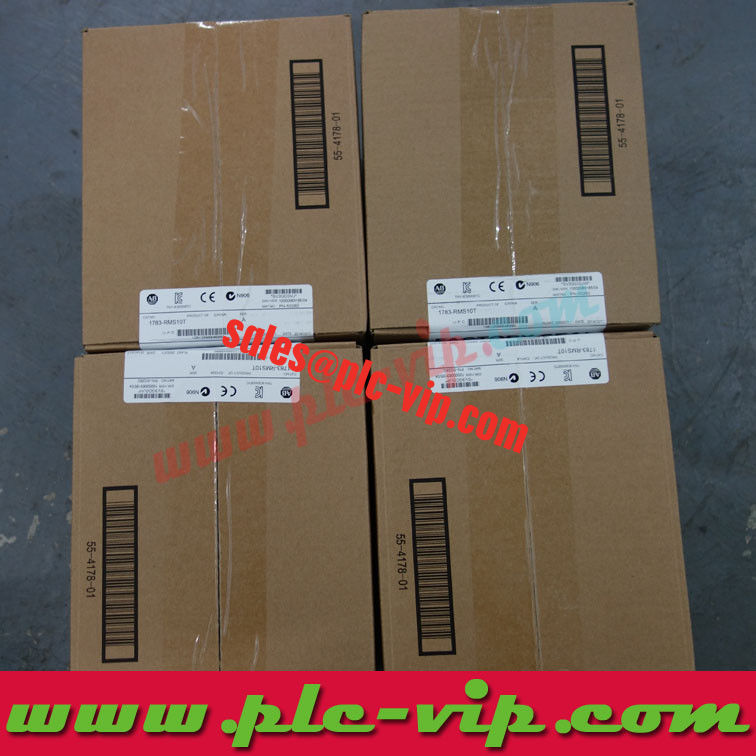
Allen Bradley PLC 1783-SFP100FX / 1783-SFP100FX
-
-
Large Image :
Allen Bradley PLC 1783-SFP100FX / 1783-SFP100FX
|
Product Details:
| Place of Origin: |
Made in USA |
| Brand Name: |
PLC Module |
| Certification: |
All goods we supply are 100% original factory sealed with 1 year warranty! |
| Model Number: |
Allen Bradley PLC 1783-SFP100FX / 1783-SFP100FX |
Payment & Shipping Terms:
| Minimum Order Quantity: |
1 /PCS |
| Price: |
$278.00 (USD/PCS) |
| Packaging Details: |
100% original new |
| Delivery Time: |
IN STOCK; 4-6 weeks for ordering |
| Payment Terms: |
Paypal, T/T and Western Union. |
| Supply Ability: |
5 PCS |
|
Detailed Product Description
 1783-SFP100FX Rockwell Stratix 100FX SFP Transceiver
Category:
PLCs, Power Supplies & I/Os
Manufacturer:
Rockwell
Group:
Stratix 5700 / 8000 / 8300 / 2000 · 1783
1783-SFP100FX is a Stratix fibre SFP transceiver: 100BASE-FX multimode fibre at 1310 nm.
It is the part that turns an empty SFP cage on a Stratix switch into a working fibre link — and the part most often replaced after a lightning season.
| 1783-BMS20CL |
Stratix 5700, 20 ports, 16 copper + 2 combo + 2 SFP |
IN STOCK |
| 1783-BMS20CGP |
Stratix 5700, 20 ports, gigabit combo |
IN STOCK |
| 1783-BMS20CGL |
Stratix 5700, 20 ports, gigabit combo, Lite firmware |
IN STOCK |
| 1783-BMS20CGPK |
Stratix 5700, 20 ports, gigabit combo, kit |
IN STOCK |
| 1783-BMS06TA |
Stratix 5700, 6 copper ports |
IN STOCK |
| 1783-BMS06TL |
Stratix 5700, 6 copper ports, Lite firmware |
IN STOCK |
| 1783-BMS06TGA |
Stratix 5700, 4 copper + 2 gigabit copper |
IN STOCK |
| 1783-BMS06SA |
Stratix 5700, 4 copper + 2 SFP |
IN STOCK |
| 1783-BMS06SL |
Stratix 5700, 4 copper + 2 SFP, Lite firmware |
IN STOCK |
| 1783-BMS06SGA |
Stratix 5700, 4 copper + 2 gigabit SFP |
IN STOCK |
| 1783-BMS06SGL |
Stratix 5700, 4 copper + 2 gigabit SFP, Lite firmware |
IN STOCK |
| 1783-MS06T |
Stratix 8000, 6 port chassis |
IN STOCK |
| 1783-MS10T |
Stratix 8000, 10 port chassis |
IN STOCK |
| 1783-RMS06T |
Stratix 8300, 6 port layer 3 |
IN STOCK |
| 1783-RMS10T |
Stratix 8300, 10 port layer 3 |
IN STOCK |
| 1783-EMS04T |
Stratix 6000, 4 port managed |
IN STOCK |
| 1783-MX08T |
Stratix 8000 copper 8 port expansion |
IN STOCK |
| 1783-MX08F |
Stratix 8000 fibre 8 port expansion |
IN STOCK |
| 1783-MCF |
Stratix 8000 CompactFlash spare card |
IN STOCK |
| 1783-RMCF |
Stratix 8300 CompactFlash spare card |
IN STOCK |
| 1783-ETAP |
EtherNet/IP tap, 3 copper ports |
IN STOCK |
| 1783-ETAP2F |
EtherNet/IP tap, 1 copper + 2 fibre |
IN STOCK |
| 1783-SFP100FX |
100FX multimode SFP, 2 km |
IN STOCK |
| 1783-SFP100LX |
100LX singlemode SFP, 10 km |
IN STOCK |
| 1783-SFP1GSX |
1000SX multimode SFP, 550 m |
IN STOCK |
| 1783-SFP1GLX |
1000LX singlemode SFP, 10 km |
IN STOCK |
| 1783-US8T |
Stratix 2000, 8 copper ports, unmanaged |
IN STOCK |
| 1783-US03T01F |
Stratix 2000, 3 copper + 1 fibre, unmanaged |
IN STOCK |
Product Specifications 1783-SFP100FX (PDF)
Catalog number |
1783-SFP100FX |
Description |
Stratix fibre SFP transceiver |
Optical type |
100BASE-FX multimode fibre |
Wavelength |
1310 nm |
Connector |
Dual LC |
Reach |
2 km |
Fibre |
62.5/125 µm, 500 MHz/km |
Digital optical monitoring |
Supported |
Estimated lead time |
45 days |
Lifecycle status |
Active |
Warranty |
1 year standard |
Publication |
1783-UM011 |
Attribute values above are reproduced from the manufacturer's product data. For the authoritative technical record see Rockwell publications 1783-UM011 (module specifications) and Rockwell literature library (installation instructions). Certification details, with certificate and file numbers, are listed in the FAQ below.
Optics
100BASE-FX multimode fibre, 1310 nm, Dual LC connector, rated reach 2 km over 62.5/125 µm, 500 MHz/km.
The reach figure assumes the specified fibre. A link that works at 300 m on multimode will not work at 2 km because the switch negotiated something — the optic sets the distance, not the port.
Matching the far end
Both ends have to be the same optical type. A 100BASE-FX multimode SFP will not link to a 100BASE-LX singlemode port, whatever the connector looks like.
Keep a record of which cage holds which optic. Two identical switches with mixed SFPs is the most common cause of a link nobody can explain.
Digital optical monitoring
DOM exposes transmit power, receive power and temperature to the switch diagnostics, which turns a marginal link into a measured problem.
Use it before swapping hardware: a receive level 6 dB down on one port is usually the patch lead, not the transceiver.
Availability
Lifecycle status Active with a published estimated lead time of 45 days. These are orderable new, unlike the switches they plug into.
Because the transceiver outlives the chassis, buying new SFPs for a discontinued Stratix 5700 is normal practice — the switch is the scarce part.
Related parts
Stratix 5700 (1783-BMS…) and Stratix 8000/8300 chassis carry the cages; 1783-MX08F is the fibre expansion module for the 8000.
1783-SFP100FX and 1783-SFP100LX are the 100 Mbit pair; 1783-SFP1GSX and 1783-SFP1GLX the gigabit pair.
FAQ — 1783-SFP100FX
What fibre does 1783-SFP100FX need?
100BASE-FX multimode fibre over 62.5/125 µm, 500 MHz/km.
What reach does 1783-SFP100FX support?
2 km
What connector does 1783-SFP100FX use?
Dual LC
Is 1783-SFP100FX still orderable?
Yes. Lifecycle status Active, estimated lead time 45 days.
Can 1783-SFP100FX be mixed with another SFP type?
No. Both ends of the link must be the same optical type.
Data sources. Optical type, wavelength, connector, fibre core and reach come from the Rockwell product page of this catalog number. Any attribute a publication does not print is marked Not published rather than taken from a distributor page. Catalog number, packaging and stock status are the stock record of this listing.
1783-SFP100FX: 100BASE-FX multimode SFP
1783-SFP100FX is part of the Stratix industrial Ethernet range from Allen-Bradley, and this page carries the figures from the Rockwell technical data so that a cabinet can be sized and a spare ordered without going back to a distributor datasheet.
| Specification | Value |
|---|
| Standard | 100BASE-FX, multimode fiber |
| Connector | Dual LC |
| Wavelength | 1310 nm |
| Fiber and length | 50/125 or 62.5/125 micron at 500 MHz km, up to 2 km (6562 ft) |
| Transmit power | -14 dBm maximum to -20 dBm minimum |
| Receive power | -14 dBm maximum to -31 dBm minimum |
| Diagnostics | Digital optical monitoring supported |
| Temperature class | Industrial, -40 to 85 degrees C per the temperature table in the same publication |
| Source | 1783-TD002D-EN-P, May 2023 |
An SFP is a link budget in a plug, and the two columns that decide whether a link works are the transmit window and the receive window, not the headline distance. The published ranges here are the ones to subtract connector, splice and aging margin from, and a link that only works at the maximum published distance is a link that will drop out in summer.
The port rule catches more orders than any other detail in this range: a Gigabit SFP works only in a Gigabit slot or a combo port, and a Fast Ethernet SFP will not train in a Gigabit slot. Matching the optic to the switch suffix before the purchase order is cheaper than matching it afterwards.
Where the Rockwell table prints a maximum rather than a typical value, this page keeps the maximum, because a power budget built on typical numbers fails on the coldest morning of the year rather than on the day it was designed.
An unmanaged switch has no address and no configuration, so it either forwards frames or it does not. That is a feature in a machine cell where nobody wants a config file to restore after a controller swap, and it is a liability in a line where someone needs to know which port dropped a packet.
On 1783-SFP100FX conformal coating is a suffix rather than a separate product, and it matters in washdown or sulfur bearing atmospheres. Where a cabinet sits in a food plant or near a rubber process, the coated variant is the one to quote, because condensation on an uncoated board is a failure that shows up months later.
Commissioning a switch takes an afternoon the first time and twenty minutes afterwards: address it, set the ring or the redundant path, confirm the port counters stay clean under load, and record the firmware revision on the as-built drawing. The failures that survive to production are almost always a duplicate address or a loop nobody documented.
On 1783-SFP100FX the 24V DC input is Class 2 or SELV, which is what allows a cabinet to feed them from the same distribution as the PLC without a separate transformer. Where a site still runs 24V AC, that option exists on the unmanaged range and disappears on the managed ones, and the difference is worth checking before a retrofit order is placed.
Precision time is a separate question from data. IEEE 1588 CIP Sync is what lets a controller timestamp an input at the switch edge rather than at the scanner, and only the Full firmware variants carry it. If an application needs coordinated motion or sequence of events, the Lite part on the shelf will not do the job.
Temperature is quoted at the surrounding air rather than at the board, and the 60 degrees C ceiling on the managed units is lower than the 70 degrees C that the FLEX Ex and most I/O families allow. A cabinet that was designed around an I/O module rating will need a thermal review before a switch is added at the top of the rail.
A switch that has been in a cabinet for eight years is usually still electrically sound and functionally obsolete. The practical question at replacement time is whether the firmware can still be managed by the current tool, and a unit that cannot be reached by the engineering software is a unit that will be replaced on failure rather than on schedule.
A managed switch adds the diagnostics that make a network debuggable: port level counters, spanning tree, and in the Stratix range a Device Level Ring that survives a single cable break. The catalog suffix tells you whether that firmware is present, and a Lite unit is not upgradeable into a Full one by flashing it. For 1783-SFP100FX the suffix is the only reliable statement of which firmware set ships.
Every one of these units, 1783-SFP100FX included, is open style, which means it belongs in an enclosure with a pollution degree 2 environment. The IP30 rating protects against fingers and tools, not against water, and a switch mounted on an open panel in a wet area is a warranty claim waiting to happen.
Cybersecurity hardening starts at the switch, not at the firewall. Disabling unused ports, changing the default credentials, and keeping the management interface off the plant backbone are the three steps that close most findings in an industrial network assessment, and none of them require a licence.
Ethernet ports are rated for Category 5e cable at minimum, and the connector is the IEC 60603-7 RJ45 that every industrial patch cord already uses. Where a cabinet is wired with older Category 5 cable, the link will usually train at 100 Mbps but the error counters will climb, which is why the cable class is printed next to the port table.
For 1783-SFP100FX the NAT variants exist for the machine builder who must hand over a cell with a fixed internal address scheme. A configurable NAT router lets the same internal IP plan be reused on every machine while the plant side sees a different address, which removes an entire class of commissioning arguments.
Spare parts strategy on a switch is driven by firmware, not by hardware. A Lite spare cannot replace a Full unit in a ring that depends on CIP Sync, so the stocking list should carry the suffix rather than the base number, and the label on the failed unit is the authority.
In a plant network the switch, 1783-SFP100FX included, is usually the part that gets blamed last and fails first, because it sits between a drive that trips and a controller that logs nothing. Keeping the port count, the supply range and the temperature rating on the page means a maintenance engineer can replace a unit without opening a drawing set.
Match the optic to the switch port type, subtract connector and splice loss from the published budget before quoting a distance, and specify the industrial temperature marked part for any cabinet that runs outside a comfortable range.