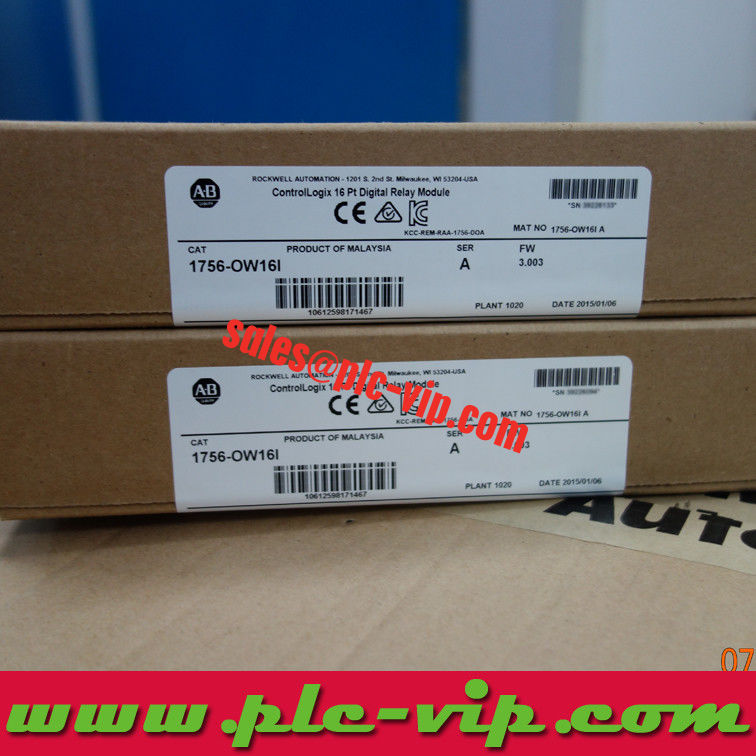
Category:
PLCs, Power Supplies & I/Os
Manufacturer:
Rockwell
Group:
PLC Automation
The 1756-ON8 (also written 1756ON8) is the ControlLogix 24 V AC output module: eight triac outputs in two groups of four, 2 A per point, operating from a 24 V AC supply at 47…63 Hz.
It is the module for panels that distribute 24 V AC rather than 24 V DC — machine builders in markets where the control voltage is a 24 V AC transformer tap, and retrofit work on equipment that already runs AC pilot devices.
1756-ON8 |
8 triac outputs, 24 V AC, 2 A per point |
In stock |
1756-OA8 |
8 AC outputs, 74…264 V AC |
In stock |
1756-OA16 |
16 AC outputs, 74…264 V AC |
In stock |
1756-OW16I |
16 isolated relay contacts |
In stock |
1756-OX8I |
8 changeover relay pairs |
In stock |
Application |
24 V AC triac output |
Brand Name |
Rockwell (Rockwell) |
Cat Num |
1756-ON8 |
Type |
Digital AC output module |
Sub Brand |
ControlLogix |
Mounting |
1756 ControlLogix chassis |
Number Of Channels |
8 (4 points/group) |
Output Type |
Triac, 24 V AC 50/60 Hz |
Operating Voltage |
10…30 V AC above 50 mA; 16…30 V AC below 50 mA |
Current Per Point |
2 A |
Pilot Duty |
DC-13/SQ, module maximum 5 A at 30 °C / 4 A at 60 °C |
Surge Current |
20 A for 43 ms per point |
Output Delay |
9.3 ms at 60 Hz, 11 ms at 50 Hz |
Backplane Current |
200 mA at 5.1 V DC, 2 mA at 24 V DC |
Operating Temperature |
0…60 °C (32…140 °F) |
Storage Temperature |
-40…85 °C (-40…185 °F) |
Vibration |
2 g at 10…500 Hz |
Shock |
30 g operating and non-operating |
Attribute values above are reproduced from the manufacturer's product data. For the authoritative technical record see Rockwell publications 1756-TD003 (module specifications) and 1756-IN050 (installation instructions). Certification details, with certificate and file numbers, are listed in the FAQ below.
Where a 24 V AC output module sits in the panel
A triac output is the AC equivalent of a solid-state DC output: no contact to wear, no arc, and a switching time measured in milliseconds rather than microseconds. On 24 V AC pilot duty — contactor coils, solenoid valves, small AC relays — that is exactly the right trade.
The supply window is the detail that decides whether a circuit works. The module publishes two ranges: 10…30 V AC for loads above 50 mA and 16…30 V AC for loads below it. A 24 V AC transformer that sags to 18 V under load sits inside both windows, a 12 V AC tap does not sit inside the low-current one, and the field symptom is a device that picks up cold and drops out warm.
Current is grouped. Four points share a group and the module maximum is 5 A at 30 °C, 4 A at 60 °C. Eight points at 2 A each would be 16 A, which the module never carries — the per-point figure is a point rating, not a module rating, and the design has to stay inside both.
The surge rating of 20 A for 43 ms per point is what makes an AC contactor coil practical on this card. Coil inrush on 24 V AC is many times the sealed current, and a card rated only for steady state would nuisance-trip on every energisation.
Turn-on and turn-off are 9.3 ms at 60 Hz and 11 ms at 50 Hz — one half-cycle plus the zero-crossing wait. That is fine for a valve or a contactor, and too slow for any application that expects a semiconductor's microsecond response, which is why AC outputs are never used for fast counting or position latching.
There is no isolation between points within a group. Two groups of four, one shared L1 per group, so the electrical boundary that matters is the group line, and a load cannot be split across groups to gain current.
Commissioning in five checks
- Match the low-current window before wiring. The module publishes 10…30 V AC for loads above 50 mA but 16…30 V AC below 50 mA — a small pilot relay on a 12 V AC supply will not hold reliably even though the higher-current rating suggests it should.
- Count the per-module limit, not just the per-point limit. Two amps per point sounds generous until four points share a group and the module maximum is 5 A at 30 °C, falling to 4 A at 60 °C.
- Check the off-state leakage into the load. A triac output has a minimum holding current; a load that draws too little can stay on after the command is removed, and the fix is a bleed resistor or a different module, not a software change.
- Allow for the 9.3 ms turn-on and turn-off at 60 Hz. It is fast enough for contactor control and too slow for any application that expects a semiconductor's microsecond response.
- Confirm the group wiring. Four points per group with a shared L1 feed means the group boundary is a real electrical boundary; splitting a load across two groups to gain current is not possible.
Holding current, grouping and the supply window
The published supply window, group current and surge rating decide whether an AC output behaves; the indicator only confirms the command reached the module.
| Indicator |
State |
Meaning and first action |
| OUT 0…7 |
Will not pick up |
Check the supply window: 10…30 V AC above 50 mA, 16…30 V AC below 50 mA. |
| OUT 0…7 |
Drops when several points run together |
Module maximum is 5 A at 30 °C and 4 A at 60 °C; count the group, not the point. |
| OK |
Green |
Module operating normally. |
| Timing |
9.3 / 11 ms |
Published turn-on and turn-off at 60 Hz / 50 Hz; a slow response is the design, not a fault. |
Output and environmental ratings per Rockwell publication 1756-TD002N-EN-E; power dissipation and terminal block rows are published as a table image and are not restated here and 1756-IN050.
Replacing a 24 V AC output module
A triac that stays on after the command is removed is usually a minimum-load problem, not a failed output. Check the load current against the holding requirement before ordering a replacement module.
A group that dies all at once points at the group feed or the shared L1 terminal, not four independent triacs. Inspect the terminal block before the card.
Match the replacement to the group count. An OA8 substitutes only if the field voltage is moved to 74…264 V AC; a 24 V AC circuit needs the ON8.
Which AC output module to specify
- 1756-ON8 — eight 24 V AC outputs in four-point groups, 2 A per point.
- 1756-OA8 — the 74…264 V AC eight-point output for mains-voltage loads.
- 1756-OA16 — sixteen AC outputs where the group count matters more than current.
- 1756-OW16I — isolated relay contacts when the load is DC or mixed.
- 1756-OX8I — eight changeover relay pairs for interlocking circuits.
FAQ — 1756-ON8 / 1756ON8 24V AC Output Module
What is the 1756-ON8?
A ControlLogix 24 V AC output module with 8 triac outputs in 4-point groups.
What is the operating voltage range?
10…30 V AC for loads above 50 mA, and 16…30 V AC for loads below 50 mA, at 47…63 Hz.
What current can each point carry?
2 A per point, with a module maximum of 5 A at 30 °C and 4 A at 60 °C.
How much surge current does it allow?
20 A for 43 ms per point.
What is the output delay?
9.3 ms at 60 Hz and 11 ms at 50 Hz, off-to-on and on-to-off.
What does it draw from the backplane?
200 mA at 5.1 V DC and 2 mA at 24 V DC.
What are the environmental limits?
0…60 °C operating, -40…85 °C storage, 5…95% relative humidity non-condensing, 2 g vibration at 10…500 Hz, 30 g shock.
Why does an output stay on after the command is removed?
The load draws less than the triac holding current; add a bleed load or use a relay output module.
Data sources. Technical values on this page come from Rockwell publications 1756-TD002N (1756 ControlLogix I/O Modules Specifications, November 2021) - 1756-ON8 technical, environmental and certification data; 1756-UM058 (ControlLogix Digital I/O Modules User Manual) and the manufacturer's product page for 1756-ON8. Values re-checked 16 November 2026.