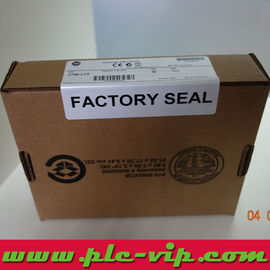
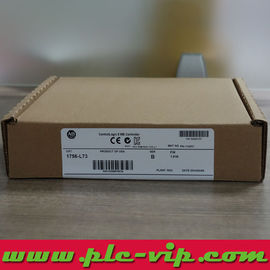
Category:
PLCs, Power Supplies & I/Os
Manufacturer:
Rockwell
Group:
PLC Automation
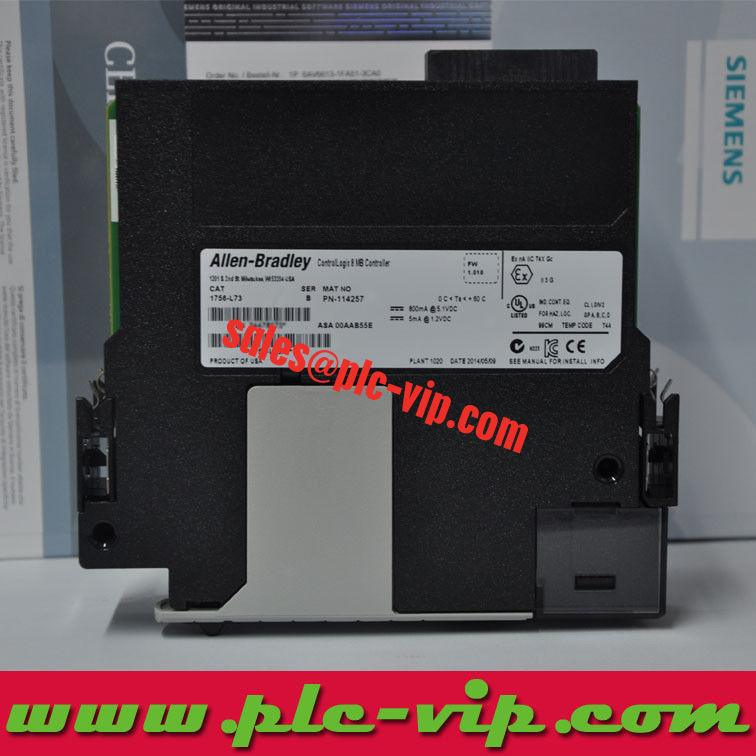
The 1756-L63 (also written 1756L63) is the 8 MB controller of the ControlLogix 5560 range and the one most installed ControlLogix racks were built around: one chassis slot, one RS-232 serial port, backplane access to every communication and I/O module in the rack. Rockwell lists it as discontinued since 1 June 2017 under the functional replacement category.
Published figures: 8 MB of user memory, 478 KB of I/O memory, 128,000 digital and 4,000 analogue I/O points as maximums, 32 tasks with 100 programs per task, and 250 controller connections (1756-TD001S). Current draw is 1200 mA at 5.1 V DC plus 14 mA at 24 V DC, dissipating 3.5 W and 11.9 BTU/hr, one slot wide; isolation is 30 V continuous basic insulation from the RS-232 port to the system, compliant and tested to IEC/UL 61010-1.
Application |
Programmable Logic Controller |
Brand Name |
Rockwell (Rockwell) |
Cat Num |
1756-L63 |
Communication |
Backplane (EtherNet/IP, ControlNet, DeviceNet, DH+, Remote I/O, SERCOS) |
Display |
Indicators (OK, RUN, I/O, FORCE, BATTERY, RS-232) |
Enclosure |
None (open-style) |
Interface |
1 RS-232 serial port |
Mounting |
Chassis |
Number Of Channels |
1 |
Standard |
CCC,CE,CSA,C-TICK,CUL,GOST,KC,MARINE,NRTL,RCM,UL
Vendor attribute list — the current Rockwell certification record, with certificate and file numbers, is in the FAQ. |
Sub Brand |
ControlLogix |
Type |
Controller |
UNSPSC |
32151705 |
Attribute values above are reproduced from the manufacturer's product data. For the authoritative technical record see Rockwell publications 1756-TD003 (module specifications) and 1756-UM001 (ControlLogix controller user manual). Certification details, with certificate and file numbers, are listed in the FAQ below.
Where the module sits in a typical system
8 MB carries a full line: a large tag set, several process areas, SERCOS motion, and the edit headroom that commissioning always consumes. It is the memory size that makes the 5560 controller usable as a cell controller rather than a single-machine controller.
The constraint that catches designs out is the connection count, not the memory. 250 connections cover every I/O module, every produced and consumed tag, and every HMI session, so a rack with two panels and a wide tag exchange reaches the limit while the program still fits comfortably.
Commissioning in five steps
- Confirm the controller and chassis are on a supply that covers 1200 mA at 5.1 V DC plus 14 mA at 24 V DC, and that the battery is the one the series needs — 1756-BA1, BA1M or BATA for Series A, 1756-BA2 for Series B.
- Set the serial port before the first download: DF1 full duplex at the project's own settings is the default path for a programming terminal, and the port is RS-232 through a 1756-CP3 or 1747-CP3 cable.
- Load firmware that the project was written for, then download. A 5560 controller at an older revision rejects a project built at a newer one, so the revision is checked first.
- Insert the controller in any chassis slot — it is not restricted to slot 0 — and start the chassis before the I/O modules are expected online.
- Read the indicators after the first power-up: OK, RUN, I/O, FORCE, BATTERY and RS-232. A red I/O indicator with a running program is a module that did not come online, not a controller fault.
Diagnostics: status indicators
Three bi-colour indicators plus the alphanumeric display cover almost every commissioning fault, so most problems are resolved at the panel without a laptop.
| Indicator |
State |
Meaning and first action |
| OK |
Flashing green |
Power-up self-test in progress; wait for solid. |
| OK |
Red |
Major fault or self-test failure. Read the fault in the project before any restart. |
| RUN |
Green solid |
Program running. |
| RUN |
Red |
Major fault latched; the program is stopped. |
| I/O |
Green solid |
All configured I/O modules are communicating. |
| I/O |
Flashing green |
One or more configured modules are not responding. |
| I/O |
Red |
Faulted I/O connection; the program may still be running. |
| FORCE |
Amber |
Forces enabled — a live wiring check is not valid while this is lit. |
| BATTERY |
Red |
Battery low or missing; the project in RAM is not protected across a power cycle. |
| RS-232 |
Green flashing |
Serial activity on the programming port. |
Indicator behaviour per Rockwell publication 1756-UM001 (ControlLogix 5570 and 5560 Controllers User Manual) and 1756-IN050.
Replacing a 1756-ENBT
Rockwell discontinued the 1756-L63 on 1 June 2017, replacement category functional replacement. The direct successor family is the 5570: 1756-L71E, L72E, L73E, and the XT equivalents. Above it the 5580 L8xE controllers add USB, embedded Ethernet, CIP Security and packet rates several times higher.
The swap changes the program, not just the part: the serial port becomes USB plus Ethernet, the memory is re-sized, and every integrated-motion axis group is re-verified. On a running line the work is planned as an outage, not as a module change.
Which ControlLogix 5560 controller to specify
- 1756-L61 — 2 MB user memory. Smallest 5560 controller; enough for a line with a few I/O modules and no motion.
- 1756-L62 — 4 MB. One step up; the usual choice where a 2 MB program left no room for edits.
- 1756-L63 — 8 MB. The workhorse of the 5560 range, and the one most installed bases are built around.
- 1756-L65 — 32 MB. Largest 5560 memory; scan time for a project in this controller can be slower than the same project in the smaller 5560 models.
- 1756-L63XT — the 5560 controller in the XT range, for -25…+70 °C panels.
- 1756-L71 / L72 / L73 (5570) — the current family, 1 MB to 32 MB with USB and higher packet rates. The functional replacement path from the 5560 controllers.
FAQ — ControlLogix 1756-L63 / 1756L63 8 MB Controller
How much user memory does the 1756-L63 have?
8 MB of user memory with 478 KB of I/O memory, and maximums of 128,000 digital and 4,000 analogue I/O points (1756-TD001S, ControlLogix 5560 Controllers). Optional non-volatile storage is the 1784-CF128 at 128 MB.
Is the 1756-L63 discontinued?
Yes — Rockwell lists the discontinuation date as 1 June 2017, replacement category functional replacement. The current families are the 5570 (L71E/L72E/L73E) and 5580 (L81E…L85E).
Does it support SERCOS and EtherNet/IP motion?
Both, through modules in the chassis: a SERCOS interface module, the analogue options (encoder, LDT and SSI inputs), or Integrated Motion on the EtherNet/IP network. The controller itself carries one RS-232 port only; motion traffic goes over the backplane to a communication module.
How many connections can it hold?
250 controller connections (1756-TD001S). Everything the controller talks to — I/O modules, produced and consumed tags, HMI and programming sessions — is counted inside that 250.
What is its backplane draw and thermal load?
1200 mA at 5.1 V DC and 14 mA at 24 V DC, 3.5 W and 11.9 BTU/hr, one slot wide (1756-TD001S). The 1200 mA is the dominant number when an eight-slot chassis is budgeted.
Which battery and firmware level does it need?
Series A uses 1756-BA1, BA1M or BATA; Series B uses the 1756-BA2 lithium battery (0.50 g). Firmware has to match the project revision — a 5560 controller at an older revision will not accept a project built at a newer one.
What are the environmental limits and certifications?
Operating 0…60 °C, storage -40…85 °C, 5…95% RH non-condensing, 2 g vibration at 10…500 Hz, 30 g and 50 g shock, CISPR 11 Class A, ESD 6 kV contact and 8 kV air, radiated RF 10 V/m 80…2000 MHz and 3 V/m 2000…2700 MHz, EFT ±4 kV at 5 kHz and surge ±2 kV line-earth (1756-TD001S). Certifications: c-UL-us UL E65584/E194810, CSA LR54689C/LR69960C, CE 2004/108/EC, RCM, ATEX 94/9/EC II 3 G Ex nA IIC T4 X under LCIE01ATEX6020X, KC, FM Class I Division 2.
Which chassis and power supplies are approved for it?
1756-A4, A7, A10, A13 or A17, any slot, one slot wide. Standard supplies 1756-PA50, PA72, PA75, PB50, PB72, PB75; redundant 1756-PA75R, PB75R, PSCA2. Temperature codes T4A (North America) and T4 (IEC), open-style enclosure.
Data sources. Technical values on this page come from Rockwell publications 1756-TD001 (ControlLogix and GuardLogix Controller Specifications) and 1756-UM001 (ControlLogix 5570 and 5560 Controllers User Manual) and the manufacturer's product page for 1756-L63. Values re-checked 15 November 2026.