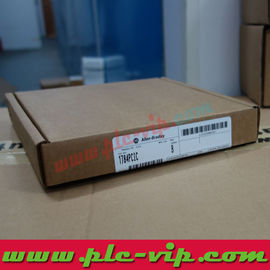
Allen Bradley PLC 1784-PCIC / 1784PCIC
-
-
Large Image :
Allen Bradley PLC 1784-PCIC / 1784PCIC
|
Product Details:
| Place of Origin: |
Made in USA |
| Brand Name: |
PLC Module |
| Certification: |
All goods we supply are 100% original factory sealed with 1 year warranty! |
| Model Number: |
Allen Bradley PLC 1784-PCIC / 1784PCIC |
Payment & Shipping Terms:
| Minimum Order Quantity: |
1 /PCS |
| Price: |
$1148.00 (USD/PCS) |
| Packaging Details: |
100% original new |
| Delivery Time: |
IN STOCK; 4-6 weeks for ordering |
| Payment Terms: |
Paypal, T/T and Western Union. |
| Supply Ability: |
10 PCS |
|
Detailed Product Description
 1784-PCIC Rockwell ControlNet PCI Card Redundant Media
Category:
PLCs, Power Supplies & I/Os
Manufacturer:
Rockwell
Group:
Bulletin 1784 · PC interface cards and cables
1784-PCIC is the redundant media version of the ControlNet PCI card: two channels, A and B, with their own status indication on the bracket.
Indicators are module status plus channel A and channel B; supply comes from the PCI bus slot.
Product Specifications 1784-PCIC (PDF)
Catalog number |
1784-PCIC |
Product type |
ControlNet PCI PC communications card |
Description |
ControlNet PCI bus interface, redundant media |
Lifecycle status |
Discontinued September 30, 2021 |
Replacement category |
No planned RA replacement |
UPC |
612598173792 |
Indicators |
Module status, channel A and channel B |
Supply |
PCI bus slot |
Country of origin |
United States of America |
Repairable |
Repairable or replaceable |
Publication |
Rockwell literature library |
Attribute values above are reproduced from the manufacturer's product data. For the authoritative technical record see Rockwell publications Rockwell literature library (module specifications) and Rockwell literature library (installation instructions). Certification details, with certificate and file numbers, are listed in the FAQ below.
What it connects
1784-PCIC is the redundant media version of the ControlNet PCI card: two channels, A and B, with their own status indication on the bracket.
On a redundant ControlNet segment the card keeps both media alive and moves traffic to the surviving channel when one fails; the A and B LEDs are how that behaviour is verified on site.
Interface and cabling
Redundancy at the card is only half the story — the taps and the trunk have to be built as two media as well, or the second channel has nothing to fall back to.
Lifecycle and replacement
Discontinued September 30, 2021, no planned Rockwell replacement. It is the last of the PCI ControlNet cards to be withdrawn.
Existing redundant segments still need this exact card type: a single channel card is not a substitute where the application expects media redundancy.
Where these are still in use
Redundant ControlNet segments driven from a PC: process lines where a media fault must not stop the application.
Test and commissioning stations that have to check channel A and channel B separately.
Buying a used unit
Confirm both channels report at power-up — a card with one dead channel is not a redundant card and should not be priced as one.
Ask which media the seller last ran it on and whether both A and B were live at the time.
FAQ — 1784-PCIC
What does 1784-PCIC connect?
1784-PCIC is the redundant media version of the ControlNet PCI card: two channels, A and B, with their own status indication on the bracket.
Is 1784-PCIC still available from Rockwell?
No. Discontinued September 30, 2021, no planned Rockwell replacement.
What replaces 1784-PCIC?
No planned Rockwell replacement is named; a single channel card does not preserve redundancy.
Where does 1784-PCIC sit in the system?
Redundant ControlNet segments driven from a PC: process lines where a media fault must not stop the application.
What should I check before buying 1784-PCIC?
Both channel LEDs, not just module status.
Data sources. Product description, indicators, supply, UPC and lifecycle status come from the Rockwell product page of 1784-PCIC. Any attribute a publication does not print is marked Not published rather than taken from a distributor page. Catalog number, packaging and stock status are the stock record of this listing.
1784-PCIC: ControlNet universal PCI communication interface card
1784-PCIC is a ControlNet interface card that puts a personal computer on a ControlNet network as a programming terminal or as a SoftLogix node. The electrical, mechanical and environmental rows below are the published values for this card family, and the two exclusions that decide whether it will work at all are stated as published.
| Specification | Value |
|---|
| PCI local bus | Compliant to PCI revision 2.2; compatible with 5V and 3.3V slots, 32 bit and 64 bit slots and PCI-X slots; not compatible with PCI Express |
| Mechanical form factor | Universal PCI 32 bit short card, 10.7 cm (4.2 in) by 16.5 cm (6.5 in) |
| Power requirements | 5V DC, 700 mA maximum, Class 2 |
| Power dissipation | 3.5 W |
| Isolation voltage | 50V continuous withstand rating; tested to withstand 600V for 60 s |
| Wiring category | Category 2 on the communications ports |
| Operating temperature | 0 to 55 degrees C, measured within the PCI slot |
| Storage temperature | Minus 40 to plus 85 degrees C |
| Relative humidity | 5 to 95 percent, non-condensing |
| Vibration | 2 g at 10 to 500 Hz, operating |
| Operating shock | 30 g |
| Non-operating shock | 50 g |
| Emissions | CISPR 11 Group 1 Class A |
| ESD immunity | 6 kV contact discharge, 8 kV air discharge |
| Radiated RF immunity | 10V/m with 1 kHz sine wave 80 percent AM from 80 MHz to 2000 MHz |
| EFT/B immunity | Plus or minus 2 kV at 5 kHz on communications ports |
| Surge transient immunity | Plus or minus 2 kV line to earth common mode on communications ports |
| Conducted RF immunity | 10Vrms with 1 kHz sine wave 80 percent AM from 150 kHz to 80 MHz |
| Enclosure type rating | None, open style |
| Driver compatibility | Windows XP with Service Pack 1 or later, Windows 2000 with Service Pack 4 or later, Windows 98, Windows Me |
| Software compatibility | RSLinx software version 2.42.00 or later |
| Source | 1784-IN003 ControlNet Universal PCI Communication Interface Card installation instructions, specifications chapter |
Both catalog numbers are covered by the same installation instructions, and the manual states that installation is identical for the two. Differences between them are therefore not asserted on this page; the published electrical and environmental rows apply to the card family.
The PCI Express exclusion is the row that matters most in practice. A PCI Express slot accepts the card mechanically in some chassis and provides no bus, so the card is never enumerated and the fault looks like a dead card.
Rows on this page are reproduced from the installation instructions for this card family. Where the publication states that two catalog numbers share one installation procedure, the shared rows are given once and differences are not inferred.
Wiring category two on the communications ports is the published installation classification, and it decides the cable separation from power conductors. A terminal that is wired into a cabinet without that separation works on the bench and fails in the field.
A programming terminal on a ControlNet network should be planned as a temporary node rather than as a permanent one. Permanent terminals consume addresses, require redundant media planning, and become a support dependency that outlives the machine.
Fifty volts continuous isolation tested to six hundred volts for sixty seconds is a modest isolation rating, and it is published for the communications port rather than for the whole card. A programming terminal connected to a ControlNet segment is not a safety barrier and should not be treated as one.
The card is recognised by the operating system as a PCI device and by RSLinx as a communication interface. Two different enumerations, two different failure modes: a card that is not seen by the operating system has a slot problem, and a card seen by the operating system but not by the driver has a software problem.
A ControlNet interface card in a PC is a programming terminal first and a network node second. The card occupies one node address on the network, and that address has to be unique or the terminal will collide with a controller and take the link down intermittently.
The operating temperature of zero to fifty five degrees is the temperature inside the PCI slot, not the ambient of the room. An industrial computer with poor internal airflow can exceed that while the room stays comfortable, and the card is the part that notices.
A faulted card is reported through the operating system event log where one exists, and through the card status indicator where it does not. Reading the event log before reseating the card is the difference between a ten minute fix and a wasted afternoon.
ControlNet supports redundant media, and the card has two channels for it. A single media installation leaves one channel disabled rather than absent, which is why the status indicator for a disabled channel reads off and looks like a fault to anyone who has not configured the network for redundancy.
Windows XP with service pack one, Windows 2000 with service pack four, Windows 98 and Windows Me is the published driver list, and RSLinx version two point four two or later is the software floor. A modern operating system is outside that list, which is why these cards now live in legacy support machines.
Network media faults and card faults look the same on the status indicator: flashing red. The published remedy for a flashing red channel is to check cables, connectors and terminators first, because the card is rarely the cause.
PCI revision 2.2 and compatibility with 5V, 3.3V, 32 bit, 64 bit and PCI-X slots is the published electrical envelope. The exclusion is PCI Express, and inserting the card into a PCI Express slot is a mechanical fit with no electrical function.
A short card at ten point seven by sixteen point five centimetres fits the compact chassis that were common when the card was current. Long cards in the same chassis block adjacent slots, and the short card is the reason two ControlNet cards can sit side by side.
ControlNet node addresses are set in software rather than on the card, which means the address follows the project and not the hardware. A card moved to another computer and not reconfigured keeps the old address, and that is the duplicate node that takes the link down.
Check the slot type before anything else, confirm the node address in software, and read the event log before reseating.