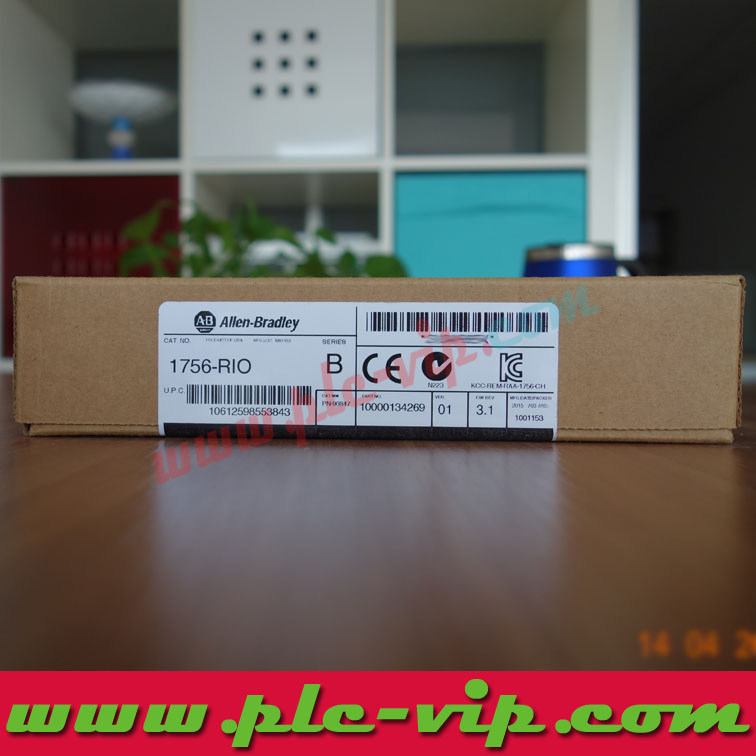
Category:
PLCs, Power Supplies & I/Os
Manufacturer:
Rockwell
Group:
PLC Automation
The 1756-RIO (also written 1756RIO) is the remote I/O module for the ControlLogix 1756 platform: one remote I/O port that can act as a scanner or as an adapter, chassis mounted and one slot wide. In scanner mode it owns 32 physical racks (0…76) in any combination of rack size and block transfers, with 10 scheduled I/O connections; in adapter mode the chassis presents itself as a remote I/O rack to another scanner.
Current draw is 450 mA at 5.1 V DC plus 5 mA at 24 V DC, dissipating 2.5 W and 8.5 BTU/hr. Isolation is 50 V continuous basic insulation from the remote I/O lines to the backplane, type tested at 500 V AC for 60 s (1756-TD003 Table 13). Operating temperature is 0…60 °C, and wiring category 2 applies on the remote I/O port.
Application |
Remote I/O |
Brand Name |
Rockwell (Rockwell) |
Cat Num |
1756-RIO |
Communication |
Remote I/O |
Display |
Digital |
Enclosure |
None (open-style) |
Interface |
1 Remote I/O port (scanner or adapter) |
Mounting |
Chassis |
Number Of Channels |
1 |
Standard |
CCC,CE,CSA,C-TICK,CUL,GOST,KC,MARINE,NRTL,RCM,UL
Vendor attribute list — the current Rockwell certification record, with certificate and file numbers, is in the FAQ. |
Sub Brand |
ControlLogix |
Type |
Communication Module |
UNSPSC |
32151705 |
Attribute values above are reproduced from the manufacturer's product data. For the authoritative technical record see Rockwell publications 1756-TD003 (module specifications) and 1756-UM001 (ControlLogix system user manual). Certification details, with certificate and file numbers, are listed in the FAQ below.
Where the module sits in a typical system
It fits two situations. A controller chassis that has to own an installed 1771 remote rack uses it as a scanner: 32 physical racks, any mix of rack size and block transfers, 10 scheduled I/O connections. A chassis that has to look like a remote rack to an existing PLC-5 scanner uses it as an adapter.
Both uses share the same wiring discipline: 1786-RG6 coax, correct termination, and rack numbers that do not overlap any other scanner on the link. A remote I/O link fails on addressing far more often than on hardware.
Commissioning in five steps
- Set the link parameters before the module joins the network: DH+ node address and baud rate, remote I/O rack assignment and starting quarter, or the SynchLink node role. A legacy link carries no traffic until these match the existing segment.
- Terminate and shield the trunk to the published rules — 1786-RG6 coax for remote I/O, Belden 9463 or equivalent for DH+, 200/230 µm HCS fibre with Versalink V-System connectors for SynchLink.
- Insert the module in any 1756 chassis slot; DHRIO and RIO use the standard 1756-A4 through A17 chassis, SYNCH the same range with the PA72/PA75/PB72/PB75/PC75/PH75 supplies.
- Add the module to the I/O configuration in Studio 5000 and, for remote I/O, schedule the racks and block transfers before the line is started.
- Read the indicators at power-up; on a terminated, addressed segment a dark status indicator is a configuration or wiring fault before it is a module fault.
Diagnostics: status indicators
Three bi-colour indicators plus the alphanumeric display cover almost every commissioning fault, so most problems are resolved at the panel without a laptop.
| Indicator |
State |
Meaning and first action |
| OK |
Flashing green |
Power-up self-test in progress; wait for the solid state. |
| OK |
Off |
No chassis power at the slot, or the module failed its self-test. |
| RIO |
Green solid |
The port is scanning or being scanned and data is exchanging. |
| RIO |
Flashing green |
Port active but not scheduled, or rack assignment not matching the segment. |
| RIO |
Flashing red |
Communication fault: rack overlap, block transfer fault, or a break in the trunk. |
| RIO |
Off |
No activity on the port: not configured, or the link is down. |
Indicator behaviour per Rockwell publication 1756-UM001 (ControlLogix System User Manual) and 1756-IN050.
Replacing a remote I/O link
No successor catalogue number is published for the 1756-RIO; the devices on the remote I/O link are what gets migrated when the link is retired, and that migration ends on EtherNet/IP, not on another remote I/O module.
Before buying a spare, confirm which role the panel actually uses — scanner or adapter. The two modes answer different wiring questions, and 10 scheduled I/O connections is the scanner ceiling published in Table 13.
Which ControlLogix DH+, remote I/O or SynchLink module to specify
- 1756-DHRIO — two ports, each selectable between Data Highway Plus and remote I/O. 850 mA at 5.1 V DC. The one module that covers both legacy links.
- 1756-RIO — one remote I/O port, scanner or adapter, 32 physical racks (0…76). 450 mA at 5.1 V DC.
- 1756-DH485 — DH-485 network communication for the 1756 chassis.
- 1756-SYNCH — SynchLink fibre, 5 Mbps at 650 nm, 50 µs frame period, 1200 mA at 5.1 V DC, 1…300 m over 200/230 µm HCS fibre.
- 1756-EN2T / 1756-EN2TR — the EtherNet/IP destination when a legacy link is being replaced rather than maintained.
FAQ — ControlLogix 1756-RIO / 1756RIO Remote I/O Module
What is the difference between the 1756-RIO and the 1756-DHRIO?
The RIO is remote I/O only, one port, and can act as scanner or adapter with 32 physical racks and 10 scheduled I/O connections. The DHRIO carries two ports, each selectable between DH+ and remote I/O, with 32 logical rack and 16 block transfer connections per channel (1756-TD003 Table 13).
Can it work as an adapter?
Yes. Table 13 lists the 1756-RIO as remote I/O scanner or adapter, which is what distinguishes it from the DHRIO's scanner-only remote I/O function. In adapter mode the chassis appears as a rack to the existing scanner.
How many racks can it scan?
32 physical racks, numbered 0…76, in any combination of rack size and block transfers, with 10 scheduled I/O connections (Table 13). The rack numbers must not overlap another scanner on the same link.
What is its current draw and isolation rating?
450 mA at 5.1 V DC and 5 mA at 24 V DC, 2.5 W and 8.5 BTU/hr. Isolation is 50 V continuous basic insulation from the remote I/O lines to the backplane, type tested at 500 V AC for 60 s (Table 13).
What are its environmental limits?
Operating 0…60 °C, storage -40…85 °C, 5…95% RH non-condensing, 2 g vibration at 10…500 Hz, 30 g operating and 50 g non-operating shock, CISPR 11 Class A, ESD 6 kV contact and 8 kV air, radiated RF immunity 10 V/m from 80…2000 MHz and 3 V/m from 2000…2700 MHz, EFT ±2 kV at 5 kHz, surge ±2 kV line-earth, conducted RF 10 V rms (Table 14).
Which certifications does it hold?
c-UL-us UL E65584 and Class I Division 2 UL E194810, CE to 2014/30/EU, RCM, UKEX UL22UKEX2604X, UKCA, IECEx UL 22.0063X, KC, Morocco and CCC 2020122309111998. Table 15 shows CSA and ATEX as not applicable to this module — a point worth checking against the panel's hazardous-area documentation before it is specified for a classified location.
Which chassis and cabling apply?
1756-A4, A7, A10, A13 or A17, one slot wide, with wiring category 2 on the remote I/O port (Table 13). The link is 1786-RG6 coax with the published terminators; the port is a single channel, so a redundant trunk is not available on this module.
Data sources. Technical values on this page come from Rockwell publications 1756-TD003 (ControlLogix Communication Modules Specifications) and 1756-UM001 (ControlLogix System User Manual) and the manufacturer's product page for 1756-RIO. Values re-checked 15 November 2026.