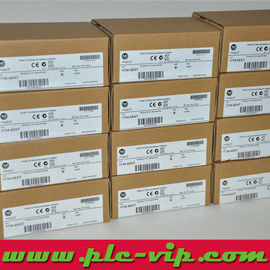
POINT I/O 1734-OA4 / 1734OA4 4-Point 120/220V AC Output Module
Category:
PLCs, Power Supplies & I/Os
Manufacturer:
Rockwell
Group:
POINT I/O Digital Output
The 1734-OA4 puts four 120/220V AC triac outputs in one POINT I/O slice, 750 mA per channel and 2.0 A for the module, with the same 74 to 264V AC window and 10 mA minimum load as the two-point version.
The module is the hotter of the two: 3.5 W at 264V AC and a 30% derating from 45 °C to 55 °C, which is the figure that decides how many channels can be loaded in a warm cabinet.
| 1734-OA2 |
2 triac AC outputs, 74...264V AC, 0.75 A per channel, 1.5 A per module |
IN STOCK |
| 1734-OA4 |
4 triac AC outputs, 74...264V AC, 0.75 A per channel, 2.0 A per module |
IN STOCK |
Product Specifications 1734-OA4 (PDF)
Outputs per module |
4, non-isolated, sourcing |
Output current rating |
2.0 A (750 mA per output, 2.0 A max per module) |
Current versus temperature |
2.0 A per module at 45 deg C, derate 30% to 1.4 A at 55 deg C |
On-state voltage, min |
74V AC |
On-state voltage, nominal |
120/220V AC |
On-state voltage, max |
264V AC |
On-state voltage drop, max |
1.0V @ 0.75 A |
On-state current, min per channel |
10 mA |
On-state current, max per channel |
750 mA |
Off-state leakage, max |
2.7 mA @ 264V AC |
Surge current |
16 A for 100 ms, repeatable every 10 s |
Turn-off time |
1/2 cycle |
POINTBus current, max |
75 mA @ 5V DC |
Isolation voltage |
240V (continuous), Reinforced Insulation, tested 3250V DC for 60 s, field side to system |
External AC supply |
120/220V AC at 60 Hz |
Terminal base screw torque |
0.8 Nm (7 lb-in) |
Dimensions, HxWxD |
56.0 x 12.0 x 75.5 mm |
Wiring category |
1 - on signal ports |
Temperature code |
T4 (North American) |
Operating temperature |
-20...55 °C |
Power dissipation, max |
3.5 W @ 264V AC |
Thermal dissipation, max |
11.9 BTU/hr @ 264V AC |
Weight, approx |
30.9 g |
Field wiring terminations |
0/1/2/3 - Channels 0/1/2/3, 4/5 - L2/N, 6/7 - L1 |
Indicators |
4 output status, module and network status |
Attribute values above are reproduced from the manufacturer's product data. For the authoritative technical record see Rockwell publications 1734-IN009-EN-E (module specifications) and 1734-UM001 (installation instructions). Certification details, with certificate and file numbers, are listed in the FAQ below.
Four channels on one AC supply
Terminals 0 to 3 are the four channels; 4 and 5 are L2/N and 6 and 7 are L1. All four loads share the same AC supply and return, so this module suits a bank of AC solenoids or four indicator lamps on one machine section, not a mix of 120V and 230V circuits.
Derating: 2.0 A at 45 °C, 1.4 A at 55 °C
A 30% derating is steep compared with the two-point module's 13%. Four channels at 0.5 A total 2.0 A and are at the limit at 45 °C; at 55 °C the same slice can only carry 1.4 A, so the practical loading is 0.35 A per channel. Design the load list against the cabinet temperature, not the data sheet headline.
Thermal and cabinet consequences
3.5 W, 11.9 BTU/hr, is the highest dissipation of the 1734 digital output modules. In a 12 mm-wide slice that is a real hot spot, and the enclosure temperature rise calculation must include it - which then feeds back into the derating above.
Leakage on four channels
2.7 mA at 264V AC per channel. With four channels on one base the total leakage into a connected load bank is more noticeable than on a two-point module, so small AC relays and neon lamps remain a poor fit; use 1734-OW4 for contact outputs.
Isolation and wiring rules
240V reinforced isolation tested at 3250V DC for 60 s separates the mains side from the POINTBus. Terminal base torque is 0.8 Nm and the base options are 1734-TB, 1734-TBS, 1734-TOP or 1734-TOPS; wiring category is 1 on signal ports.
FAQ — 1734-OA4
What load types can a 1734-OA2 switch?
The triac output is for AC loads between 10 mA and 750 mA per channel at 74 to 264V AC. Resistive and inductive AC loads such as solenoids, contactors and lamps work; the published on-state drop is 1.0V at 0.75 A and off-state leakage is 2.7 mA at 264V AC.
Why does the module have a derating curve?
Because the triac dissipates heat that depends on load current and ambient. 1734-OA2 carries 1.5 A total up to 50 deg C and derates linearly by 13% to 1.3 A at 55 deg C; 1734-OA4 carries 2.0 A up to 45 deg C and derates by 30% to 1.4 A at 55 deg C. A cabinet at 55 deg C cannot use the headline current rating.
Can these modules switch DC loads?
No. The output stage is a triac for AC only, with a 1/2 cycle turn-off. For DC loads use the sourcing 1734-OB family or the sinking 1734-OV family, or a 1734-OW relay module if isolation between the load circuit and the module is required.
What is the surge capability?
16 A for 100 ms, repeatable every 10 s, which covers the inrush of small AC solenoids and incandescent lamps. It does not cover a motor start every few seconds.
What isolation does the AC output provide?
240V continuous reinforced insulation, tested at 3250V DC for 60 s from field side to system - the highest test voltage in the 1734 digital family, which is why mains circuits can sit on the same slice as 24V DC I/O.
Is 1734-OA4 a drop-in replacement for 1734-OA2?
It fits the same bases and uses the same 74...264V AC window, but the module current rating and derating are different - 2.0 A at 45 deg C against 1.5 A at 50 deg C - and the terminal pattern changes from 2/3 no-connection to four channel terminals. Rewire the base rather than swapping the module in place.
Data sources. Technical values on this page come from Rockwell publication 1734-IN009-EN-E (POINT I/O 120V and 220V AC Output Modules, catalog numbers 1734-OA2, 1734-OA4, 1734-OA4K, Series C) and 1734-UM001 (POINT I/O Digital and Analog Modules User Manual). Any attribute the publication does not print is marked Not published rather than taken from a distributor page. Catalog number, packaging and stock status are the stock record of this listing.
Where 1734-OA4 sits in the POINT I/O line
The table reproduces the sibling list this page publishes, with each catalog number put in the class of module it is; the paragraph after it places this part in that ladder, and the arithmetic at the end uses this page's own POINTBus figure against the 1.0 A budget the adapters print.
| Catalog number | What the published line says | Class of module |
| 1734-OA2 | 2 triac AC outputs, 74...264V AC, 0.75 A per channel, 1.5 A per module | AC output, triac |
| 1734-OA4 | 4 triac AC outputs, 74...264V AC, 0.75 A per channel, 2.0 A per module | AC output, triac |
1734-OA4 is the four-channel half of the triac pair, and its module rating is the higher one: 2.0 A per module against 1.5 A on 1734-OA2, at the same 0.75 A per channel. The printed derating is steeper too, 30 percent from 2.0 A at 45 deg C to 1.4 A at 55 deg C.
At the 75 mA this module prints, the 1.0 A POINTBus carries 13 modules with nothing left over. A full 63-module rack of this module would be 4725 mA, 4.7 times the 1.0 A budget, so the 63-module figure is a slot count and the current is what decides how many expansion supplies go into the rack.
Two catalog numbers one digit apart often differ in exactly one published figure, and that figure is the one the specification is written around - which is why the ladder is worth reading as a table rather than as a list of options.
What the printed data does not carry: this page prints the sibling descriptions but not their POINTBus currents, so the 75 mA is the only draw in the table that can be used; and no page in this family states a maximum number of modules between two power supplies.
Source: Rockwell publication 1734-IN001 (POINT I/O module and adapter installation instructions) and the module specification tables published on these pages; the class column and the module count are read off the printed lines, not assumed.