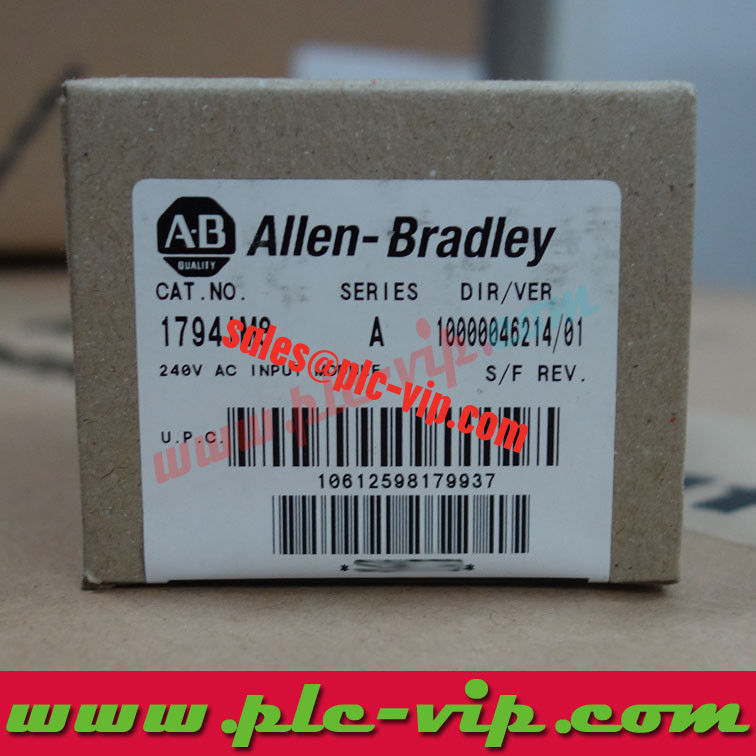
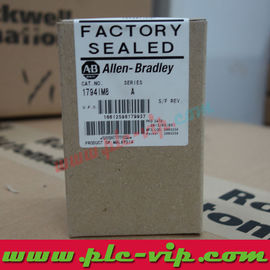
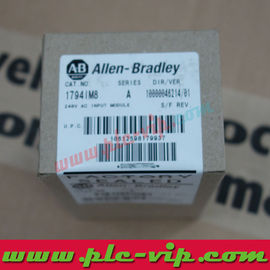
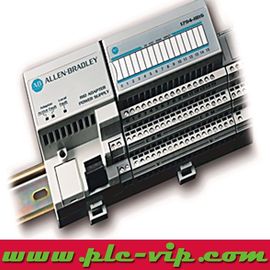
FLEX I/O 1794-IM8 / 1794IM8 8-Point 240V AC Input Module
Category:
PLCs, Power Supplies & I/Os
Manufacturer:
Rockwell
Group:
PLC I/O
The 1794-IM8 reads eight 240V AC inputs at 11 mA and 22.3 kOhm, with a 159V AC on threshold and a 40V AC off threshold — the card for mains-voltage control circuits.
It exists because a 240V panel does not want a 120V card in front of it: the threshold, the impedance and the creepage are sized for the higher line voltage from the start.
Product Specifications 1794-IM8 (PDF)
Application |
FLEX I/O digital input, 1794 terminal base |
Cat Num |
1794-IM8 |
Brand Name |
Rockwell |
Inputs |
8, AC |
Input voltage |
240V AC nominal |
On-state voltage |
159V AC minimum |
Off-state voltage |
40V AC maximum |
Input current |
11 mA at 240V AC |
Input impedance |
22.3 kOhm |
Isolation |
Field to system, type tested |
Power dissipation |
4.7 W (16.2 BTU/hr) |
Terminal base |
1794-TBN, -TBNK |
Attribute values above are reproduced from the manufacturer's product data. For the authoritative technical record see Rockwell publications 1794-DU001 (module specifications) and 1794-SG002 (installation instructions). Certification details, with certificate and file numbers, are listed in the FAQ below.
240V thresholds
159V AC minimum to read on sits below the 240V nominal by a wide margin, so a supply that sags to 180V still reads correctly.
40V AC maximum to read off means induced voltage from an adjacent 240V cable has to be substantial before a channel holds on.
11 mA at 240V AC with a 22.3 kOhm impedance is a light load on the switch, and the impedance roughly doubles compared with the 120V card because the voltage doubles.
Base and installation
1794-TBN and 1794-TBNK are the two bases published for this card; the K version adds knife disconnects at the terminals.
The fused-terminal base is the practical partner for a 240V input circuit, since the field wiring is protected at the base instead of by a remote fuse block.
Module replacement leaves the wiring in place because the terminals belong to the base, not to the card.
Set the key before insertion and press until the latch locks; forcing past the key bends FlexBus pins that are not repairable in the field.
Keep 240V field wiring in its own duct. The card is immune to what it is rated for, not to a 240V conductor laid along an unshielded analog cable.
Dissipation and panel heat
4.7 W (16.2 BTU/hr) is the module dissipation, which a closed cabinet has to remove along with the adapter and the output cards.
Eight channels draw a small fraction of that. The dissipation is the input stage and its dropping impedance, not the field current.
At 240V the dropping element sees more voltage than a 120V card's does, which is why the published figure is close to the 8-point 120V card and not lower.
Where 240V inputs are used
Mains-voltage control circuits where the panel switches 240V AC directly, common on European machinery and on older North American installations.
Motor starter auxiliary contacts on a 240V coil circuit, read directly with no relay interface.
Not a universal card. A 240V input card on a 120V circuit reads off; the two voltage classes are separate products, not a configurable range.
Not for safety functions. Inputs are control signals; no safety certification applies to them.
Commissioning
Measure the field voltage at the terminal before blaming a channel: 159V AC is the on threshold and a badly loaded circuit can fall below it.
Eight yellow LEDs show the filtered state of each channel; a lit LED with no bit in the controller points at the adapter mapping.
Test one channel at a time with the field device, then confirm the bit, then the program logic — three separate steps that separate field, mapping and code faults.
FAQ — 1794-IM8
How many inputs has the 1794-IM8?
Eight 240V AC inputs at 11 mA, 22.3 kOhm impedance.
What are the switching thresholds?
159V AC minimum to read on and 40V AC maximum to read off.
Which terminal bases are published for it?
1794-TBN and 1794-TBNK, the latter with knife disconnects.
Can it read a 120V AC circuit?
No. The on threshold is 159V AC, so a 120V circuit reads off; use the 1794-IA8 or 1794-IA16 for 120V.
What is its power dissipation?
4.7 W, equal to 16.2 BTU/hr.
Is there channel-to-channel isolation?
No. The card isolates the field side from the system side; channels share a common.
Data sources. Technical values on this page come from Rockwell publication 1794-SG002 (FLEX I/O Selection Guide, Table 7 and Table 10) and 1794-IN093. Any attribute the publication does not print is marked Not published rather than taken from a distributor page. Catalog number, packaging and stock status are the stock record of this listing.