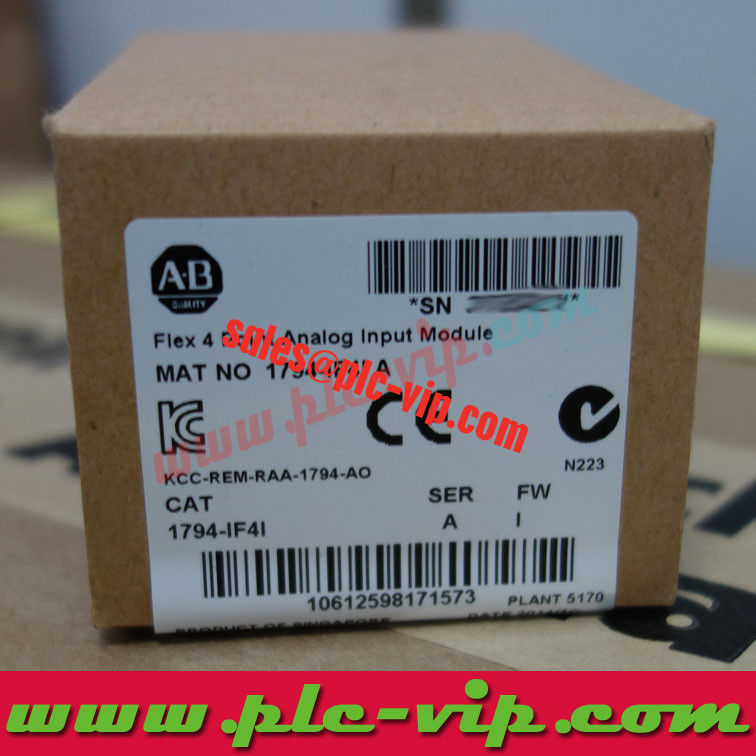
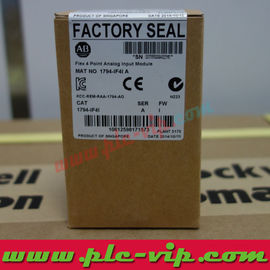
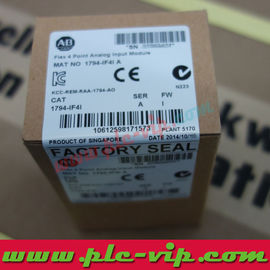
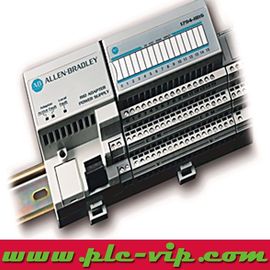
FLEX I/O 1794-IF4I / 1794IF4I Isolated 4-Channel Analog Input
Category:
PLCs, Power Supplies & I/Os
Manufacturer:
Rockwell
Group:
PLC I/O
The 1794-IF4I is a four-channel isolated analog input: channel-to-channel isolation, seven input ranges, sigma-delta conversion and four selectable filter frequencies.
Isolation is what buys the extra cost: four transmitters with four different ground references, or a thermocouple-grade signal sharing a panel with a 4...20 mA loop, can coexist on one card without a ground loop.
Product Specifications 1794-IF4I (PDF)
Application |
FLEX I/O isolated analog input, 1794 terminal base |
Cat Num |
1794-IF4I |
Brand Name |
Rockwell |
Channels |
4, channel-to-channel isolated, individually configurable |
Input ranges |
4...20 mA, 0...20 mA, +/-20 mA, +/-10V, 0...10V, +/-5V, 0...5V |
Resolution |
16 bits unipolar, 15 bits plus sign bipolar; 0.320/0.640 uA/cnt, 0.156/0.313 mV/cnt |
Input resistance |
<100 Ohm current, >10 MOhm voltage |
Conversion rate |
2.5, 5.0 or 7.5 ms, all channels |
Conversion type |
Sigma Delta |
Accuracy |
0.1% of full scale at 25 deg C |
External supply current |
55 mA at 24V DC |
Power dissipation |
2.0 W at 31.2V DC (6.9 BTU/hr) |
Operating temperature |
0...55 deg C |
Attribute values above are reproduced from the manufacturer's product data. For the authoritative technical record see Rockwell publications 1794-DU001 (module specifications) and 1794-SG002 (installation instructions). Certification details, with certificate and file numbers, are listed in the FAQ below.
Isolation and ranges
Channel-to-channel isolation is the defining feature; each input has its own reference, so a grounded transmitter on one channel does not compromise the next.
Seven ranges: 4...20 mA, 0...20 mA, +/-20 mA, +/-10V, 0...10V, +/-5V, 0...5V, configurable per channel.
16-bit unipolar resolution at 0.320 uA and 0.156 mV per count, halved in bipolar mode where the sign bit takes one bit of the word.
Input resistance below 100 Ohm on current and above 10 MOhm on voltage is the burden the loop and the source see.
Factory calibrated, with field calibration possible when a documented trace is needed.
Sigma-delta timing
2.5, 5.0 or 7.5 ms conversion for all channels is selectable, and the choice sets the filter behaviour rather than only the update rate.
Step response to 63% is 0.6 ms at a 1200 Hz conversion rate, 6.7 ms at 600 Hz, 13.4 ms at 300 Hz and 26.7 ms at 150 Hz.
Filter frequencies of 150, 300, 600 and 1200 Hz are the four selections; the lower the frequency, the better the rejection and the slower the response.
-3 dB at 12 Hz and -80 dB at 50 Hz at the 300 Hz rate is the published normal-mode rejection, which is why this card is used on noisy loops.
Supply and heat
55 mA at 24V DC is the module consumption, low for four isolated channels.
2.0 W at 31.2V DC (6.9 BTU/hr) is the heat, and the IF4IXT version publishes 6.8 BTU/hr at the same voltage.
0...55 deg C operating range on the standard version; the XT suffix is the one rated from -20 deg C.
No loop power from the card: a two-wire transmitter still needs its 24V supply, and the <100 Ohm input is its burden.
Field wiring
Channel-to-channel isolation lets each loop keep its own return, which is the practical answer to a panel with mixed grounded and floating sources.
Only one signal type per channel: voltage and current on the same terminal pair is a wiring error, regardless of the configured range.
1200 Hz is the fast setting and is not affected by the module-level parameters that apply to the 150, 300 and 600 Hz channels.
Shielded twisted pair and a return at the module remain the practice; isolation removes ground loops, not induced noise.
Where it fits
Mixed ground references — the case the non-isolated cards cannot handle.
Noisy loops that need 80 dB rejection at line frequency and can accept a 13 ms step response.
Four channels per card is the cost of isolation; a twelve-channel non-isolated card occupies the same slot for a third of the price.
Not for HART. The HART modem is in the 1794-IF8IH and 1794-IE8H, not here.
FAQ — 1794-IF4I
How many channels has the 1794-IF4I?
Four, each with channel-to-channel isolation and its own range selection.
What ranges are supported?
4...20 mA, 0...20 mA, +/-20 mA, +/-10V, 0...10V, +/-5V and 0...5V.
What is the resolution?
16 bits unipolar and 15 bits plus sign bipolar.
What conversion rates are available?
2.5, 5.0 or 7.5 ms for all channels, with 150, 300, 600 and 1200 Hz filter selections.
What accuracy is published?
0.1% of full scale at 25 deg C.
What is the operating temperature range?
0...55 deg C; the 1794-IF4IXT version is rated -20...70 deg C.
Data sources. Technical values on this page come from Rockwell publication 1794-SG002 (FLEX I/O Selection Guide, Table 19 and Table 23) and 1794-IN093. Any attribute the publication does not print is marked Not published rather than taken from a distributor page. Catalog number, packaging and stock status are the stock record of this listing.