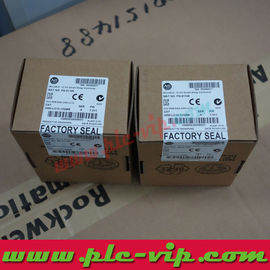
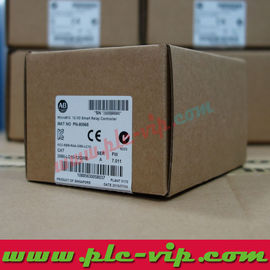
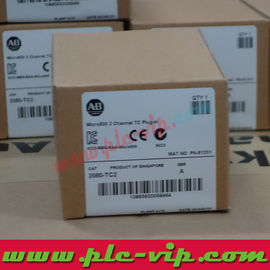
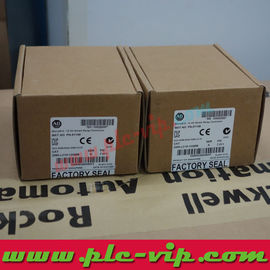
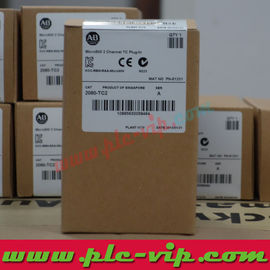
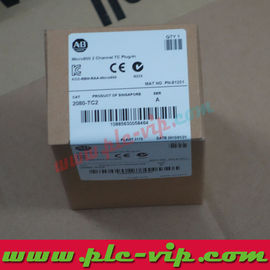
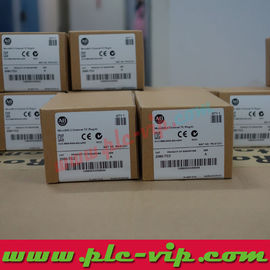
Allen Bradley Micro800 2080-OF2 / 2080OF2
-
-
Large Image :
Allen Bradley Micro800 2080-OF2 / 2080OF2
|
Product Details:
| Place of Origin: |
Made in SINGAPORE |
| Brand Name: |
PLC Module |
| Certification: |
All goods we supply are 100% original factory sealed with 1 year warranty! |
| Model Number: |
Allen Bradley Micro800 2080-OF2 / 2080OF2 |
Payment & Shipping Terms:
| Minimum Order Quantity: |
1 /PCS |
| Price: |
$85.00 (USD/PCS) |
| Packaging Details: |
100% original new |
| Delivery Time: |
IN STOCK; 4-6 weeks for ordering |
| Payment Terms: |
T/T, Paypal and Western Union. |
| Supply Ability: |
5 PCS |
|
Detailed Product Description
 2080-OF2 Rockwell Micro800 2 Channel Analog Output Plug-In
Category:
PLCs, Power Supplies & I/Os
Manufacturer:
Rockwell
Group:
Micro800 2080 plug-in modules
2080-OF2 is a 2-channel analog output plug-in the Bulletin 2080 Micro800 plug-in family. It gives a controller two analog references, typically a variable speed drive speed reference and a proportional valve command.
A plug-in module snaps into a slot on the controller itself, so the I/O count grows without adding a DIN rail footprint or an expansion bus module.
Product Specifications 2080-OF2 (PDF)
Catalog number |
2080-OF2 |
Product type |
2-channel analog output plug-in |
Channels / points |
2 channels |
Signal |
0-10 V DC, 0-20 mA, unipolar |
Isolation |
Non-isolated |
Resolution |
12-bit |
Controller compatibility |
Micro820, Micro830 and Micro850 plug-in slots; not supported on Micro810 |
Dimensions, H x W x D |
Per 2080-WD004 |
Temperature rating |
Per 2080-UM004 |
Lifecycle status |
Active |
UPC |
Not published |
Country of origin |
Not published |
Attribute values above are reproduced from the manufacturer's product data. For the authoritative technical record see Rockwell publications 2080-WD004 (module specifications) and 2080-UM004 (installation instructions). Certification details, with certificate and file numbers, are listed in the FAQ below.
What this plug-in adds to a Micro800 system
2080-OF2 is a 2-channel analog output plug-in the Bulletin 2080 Micro800 plug-in family. It gives a controller two analog references, typically a variable speed drive speed reference and a proportional valve command.
A plug-in module snaps into a slot on the controller itself, so the I/O count grows without adding a DIN rail footprint or an expansion bus module.
Channel count and signal type are fixed by the catalog number: 2 channels, 0-10 V DC, 0-20 mA, unipolar.
Controller compatibility and configuration
Micro820, Micro830 and Micro850 plug-in slots; not supported on Micro810
The module is configured in Connected Components Workbench, not by a hardware switch, so the project file has to match the module that is physically fitted.
Micro810 controllers have no plug-in slots at all; the Micro810 accessories take the USB or display port instead.
Wiring, isolation and channel setup
The module uses an 8-pin terminal block; pin A1 to A4 are the common returns and B1 to B4 carry VO-0, CO-0, VO-1 and CO-1.
Every plug-in this family is rated for the same panel environment, and the terminal block is the part that decides whether a swap is quick or not.
Isolation is Non-isolated. Where that matters, it is stated per model rather than assumed for the whole family.
Ratings, dimensions and lifecycle
Rockwell lists this catalog number as Active.
Dimensions are Per 2080-WD004, rated ambient Per 2080-UM004.
UPC is Not published, country of origin Not published.
Buying and fitting a used plug-in
A used plug-in is only worth fitting if the terminal block and the retaining clips are intact; the clips are what holds the module against vibration.
Match the catalog number exactly. The family contains pairs that differ only in sink versus source output or isolation, and the front label is the only reliable identifier once the box is gone.
Output range is selected in software. A drive reference wired to a voltage output will not work if the channel is configured for current.
FAQ — 2080-OF2
What does 2080-OF2 do?
2-channel analog output plug-in: 2 channels, 0-10 V DC, 0-20 mA, unipolar.
Which controllers accept 2080-OF2?
Micro820, Micro830 and Micro850 plug-in slots; not supported on Micro810
What is the resolution of 2080-OF2?
12-bit.
What are the dimensions of 2080-OF2?
Per 2080-WD004, rated Per 2080-UM004.
Is 2080-OF2 still available from Rockwell?
Rockwell lists it as Active.
Data sources. Module functions, channel counts and plug-in compatibility come from the Micro800 plug-in module manual 2080-UM004; analog ranges and resolution come from the wiring diagrams 2080-WD003 and 2080-WD004; accessory ratings come from 2080-IN001, 2080-IN010 and 2080-WD001; UPC, origin and lifecycle status come from the Rockwell product page for the catalog number. Anything those documents do not print is marked Not published. Any attribute a publication does not print is marked Not published rather than taken from a distributor page. Catalog number, packaging and stock status are the stock record of this listing.
2080-OF2: 2 channel unipolar analog output plug-in module
2080-OF2 is a 2 channel unipolar analog output plug-in module for the Micro800 controllers, and the specification rows below are the published values for this catalog number together with the two or three rows an engineer actually checks before ordering.
| Specification | Value |
|---|
| Catalog number | 2080-OF2, 2 channel non-isolated unipolar analog output plug-in module |
| Number of outputs | 2 unipolar, non-isolated |
| Voltage range | 0 to 10V DC |
| Current range | 0 to 20 mA |
| Resolution | 12 bits unipolar maximum |
| Output count range | 0 to 65535 |
| D to A conversion rate, all channels | 2.5 ms maximum |
| Step response to 63 percent | 5 ms |
| Voltage resistive load, min | 1 kOhm |
| Accuracy | Plus or minus 1 percent of full scale at 25 degrees C on both terminals |
| Non-linearity | Plus or minus 0.1 percent of full scale |
| Repeatability | Plus or minus 0.1 percent |
| Output error over full temperature range | Plus or minus 1.5 percent on voltage, plus or minus 2.0 percent on current, from minus 20 to plus 65 degrees C |
| Source | 2080-TD001 Micro800 technical data, analog output plug-in module specifications |
Twelve bits of resolution with one percent accuracy means the step size is four to five times finer than the certified accuracy. The commanded value can be set precisely and the delivered value cannot be certified to that precision, so a loop has to be tuned to the accuracy.
The output error over the full temperature range is one and a half percent on voltage and two percent on current, which is larger than the accuracy at twenty five degrees. A cabinet that runs warm should be designed to the temperature figure rather than to the headline accuracy.
Every row on this page is a published value for the catalog number named in the heading. Where the source prints a range, the range is reproduced; where the source is internally inconsistent, the inconsistency is described rather than resolved.
A four point module rated at half an amp steady and two amps for two seconds is quoting an inrush allowance, not a continuous load. A solenoid valve that draws two amps for one hundred milliseconds is inside the specification, and the same valve held energised is not.
A real time clock backed by a battery is a maintenance item with a date on it. Three and a half years from the date of manufacture at normal temperature and two and a half years at freezing is the shelf life statement, and a panel commissioned two years after delivery starts with half of it gone.
The on-state window is what the sensor has to deliver. Nine volts at two milliamps at the low end and thirty volts at five milliamps at the high end defines a band, and a sensor whose off-state leakage sits above one and a half milliamps will read as permanently on.
Temperature modules are specified by accuracy at twenty five degrees and by a cold junction error, and the second number is usually the larger of the two on a thermocouple channel. A one degree accuracy with a one point two degree cold junction error is not a one degree measurement.
A non-isolated module shares the controller reference, which is the cheapest way to add a channel and also the way that a ground loop enters the panel. Isolation is bought at the expansion module level and it is the reason those modules cost more per channel.
Eight to ten milliseconds of filter time on a plug-in input is a deliberate compromise. It rejects contact bounce on a pushbutton and it also rejects a two millisecond cam pulse, so a machine that needs to catch a short pulse needs the high speed counter module rather than a faster filter setting.
Common mode and normal mode rejection of one hundred and seventy decibels are the numbers that make a temperature reading stable next to a drive. Without them the channel reads the switching frequency rather than the process, and the filter in the program cannot recover it.
Sink and source is a wiring decision that has to be made against the sensor type rather than against the controller. A sourcing input expects the field device to switch the positive side, and a sinking output pulls the load to common, so a mixed panel needs the combination module and not two separate ones.
Combination modules exist because a two slot controller runs out of slots before it runs out of I/O. Four inputs and four outputs in one module is the same channel count as two separate modules, and it costs one slot instead of two, which is the entire argument.
Twelve bits of resolution on an analog output with one percent accuracy means the step size is finer than the accuracy by a factor of four or five. The commanded value can be set precisely and the delivered value cannot be certified to the same precision, and the loop has to be tuned to the second.
Input impedance between three and twelve volts is the lowest of the three bands, which is where a two wire sensor with a series resistor has to work. Above twelve volts the impedance rises again, and that non-monotonic curve is the reason a marginal sensor works at twenty four volts and fails at ten.
The RTD type list is long and the accuracy figure is a single number for the whole list. A ten ohm copper sensor and a thousand ohm platinum sensor do not behave alike, and the resolution in degrees follows the sensor rather than the module.
A plug-in module is bought for the slot, not for the function. Two slots on a Micro820 either take two analog inputs or two relay outputs or one of each, and that allocation is decided once at the panel design stage and then lives for the life of the machine.
Tune the loop to the one percent accuracy, and check the temperature range error before committing a cabinet.