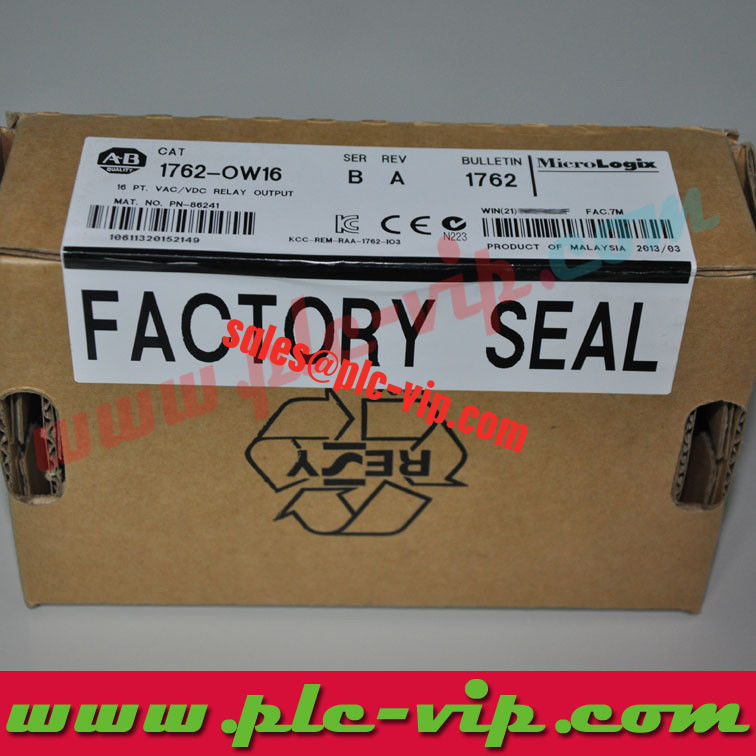
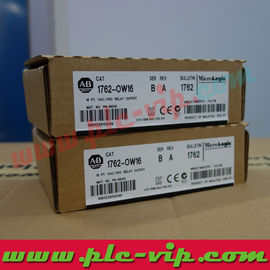
Allen Bradley PLC 1762-RPLDR2 / 1762RPLDR2
-
-
Large Image :
Allen Bradley PLC 1762-RPLDR2 / 1762RPLDR2
|
Product Details:
| Place of Origin: |
Made in MALAYSIA |
| Brand Name: |
PLC Module |
| Certification: |
All goods we supply are 100% original factory sealed with 1 year warranty! |
| Model Number: |
Allen Bradley PLC 1762-RPLDR2 / 1762RPLDR2 |
Payment & Shipping Terms:
| Minimum Order Quantity: |
1 /PCS |
| Price: |
$15.00 (USD/PCS) |
| Packaging Details: |
100% original new |
| Delivery Time: |
IN STOCK; 4-6 weeks for ordering |
| Payment Terms: |
Paypal, T/T and Western Union. |
| Supply Ability: |
10 PCS |
|
Detailed Product Description
 1762-RPLDR2 Rockwell MicroLogix 1200 replacement part
Category:
PLCs, Power Supplies & I/Os
Manufacturer:
Rockwell
Group:
MicroLogix 1200 / 1762
1762-RPLDR2 is the replacement part — Replacement part for the 1762 MicroLogix 1200 I/O system.
These accessories were the parts that turned a base 1200 brick into a controller with a clock, an archive and a replaceable terminal block. Some are still orderable, some are not, and the difference decides whether a panel can be repaired from stock.
Product Specifications 1762-RPLDR2 (PDF)
Catalog number |
1762-RPLDR2 |
Description |
Replacement part for the 1762 MicroLogix 1200 I/O system |
Used with |
MicroLogix 1200 controllers |
Class |
MicroLogix 1200 accessory |
Lifecycle status |
Active Mature |
UPC |
611320455830 |
Warranty |
1 year standard |
Publication |
1762-UM001 |
Attribute values above are reproduced from the manufacturer's product data. For the authoritative technical record see Rockwell publications 1762-UM001 (module specifications) and 1761-SG001 (installation instructions). Certification details, with certificate and file numbers, are listed in the FAQ below.
What it is for
Replacement part for the 1762 MicroLogix 1200 I/O system.
The memory module holds a copy of the program independently of the controller's Flash memory, so a replacement brick can be loaded without a laptop. The clock module keeps time across a power cycle for timestamped faults and time-based control.
The terminal base is the removable wiring block on a 40 point controller. It exists as a separate catalog number because a damaged block should not condemn the whole controller.
Fitting
Memory and clock modules fit into the controller's option slot; the combination module does both in one part, which is why 1762-MM1RTC exists alongside 1762-MM1 and 1762-RTC.
Replacing a terminal base means transferring the field wiring terminal by terminal. Photograph the block before removal — the labels are on the block, and a mixed-up block is a shorted input.
Availability and stocking
Lifecycle on the Rockwell product page: Active Mature. Where a lead time is published it is the estimated factory lead time, not shelf stock.
The accessories that are still active are worth keeping on the shelf: they are the difference between a ten-minute repair and a wait for delivery.
Buying a used unit
For discontinued accessories, condition matters more than price. A memory module with bent pins is scrap; a terminal base with heat damage has been overloaded and will fail again.
Check the catalog number against the controller's own option list before buying. A module that fits the slot but is not supported by the firmware will not configure.
Related parts
The rest of the 1200 accessory line — programming cables, the 1761-NET-AIC converter for DH-485 — is shared with the MicroLogix 1000 family. Panels that mix generations usually share those parts.
Controllers: 1762-L24 and 1762-L40 bricks, twelve catalog numbers in all, all discontinued between August and October 2021.
FAQ — 1762-RPLDR2
What is 1762-RPLDR2?
Replacement part for the 1762 MicroLogix 1200 I/O system.
Which controllers use 1762-RPLDR2?
MicroLogix 1200 controllers, 1762-L24 and 1762-L40.
Is 1762-RPLDR2 still available from Rockwell?
Lifecycle status: Active Mature.
Does the memory module replace the controller program memory?
No. It holds an archive copy; the controller still runs from its own Flash memory.
Can a terminal base be replaced in the field?
Yes, but transfer the wiring one terminal at a time and photograph it first.
Data sources. Function and part identity come from the Rockwell product page of the catalog number; slot and archive behaviour follows 1762-UM001. Any attribute a publication does not print is marked Not published rather than taken from a distributor page. Catalog number, packaging and stock status are the stock record of this listing.
1762-RPLDR2: 1762-RPLDR2, I/O module door kit
1762-RPLDR2 is a published replacement part for the MicroLogix system. Replacement parts are specified by a description line rather than by a data sheet, so the rows below reproduce that line exactly, including the quantities, because the quantity is the part of the specification that gets ordered wrong.
| Specification | Value |
|---|
| Catalog number | 1762-RPLDR2, I/O module door kit |
| Contents | Two expansion I/O doors and two communication bus doors |
| Function | Replaces the doors that cover the expansion I/O modules and the communication bus connectors |
| Fits | MicroLogix 1200 system, expansion I/O assemblies |
| Related parts in the same list | 1762-RPLRTB40 terminal block kit, 1762-RPLDIN2 DIN rail latches, 1762-RPLTLBL2 terminal label kit |
| Publication | 1761-SG001 MicroLogix selection guide, select replacement parts section |
| Lifecycle | Bulletin 1762 MicroLogix 1200 controllers were discontinued by Rockwell Automation as of August 2021 |
| Source | 1761-SG001D-EN-P replacement parts list and Rockwell Automation product lifecycle notice for Bulletin 1762 |
Two expansion I/O doors and two communication bus doors in one kit is a set of four. The doors are the only thing covering the terminals and the bus connectors, and one missing door is enough to leave a side of the assembly exposed.
The door carries nothing electrical, and it carries the terminal label. Without it the mapping from terminal number to I/O address is only in the drawing, and that is how a wire ends up one position off during a repair.
Rows on this page are reproduced from the replacement parts list of the MicroLogix selection guide. Dimensions, materials and environmental ratings are not published for these items in that document and are therefore not stated here.
Double row terminals exist because forty points do not fit on one row at the width the controller occupies. Rows are numbered in a sequence that wraps, and landing a wire one position off puts an output on a different function than the drawing says.
Replacement parts are catalogued because these controllers are installed in numbers and are no longer sold. A discontinued controller is not a controller without spares; it is a controller whose spares all come from one list, and that list is the difference between a repair and a retrofit.
Documentation for a replacement part is a page in a selection guide rather than a manual. The description line is the specification, and reading it literally is what prevents ordering a single block for a two block requirement.
A terminal block is a mechanical part with an electrical rating, and the rating belongs to the controller rather than to the block. The block has to match the terminal pitch, the retention clips and the wire gauge range of the frame it is fitted to, and that is what the catalog number guarantees.
Holding a spare block and a spare door kit costs less than a day of downtime on a line, and the decision is made once rather than at the moment of failure. The parts are small, they do not expire, and they are the only items that turn a failed controller back into a working one without a rewire.
The catalog number covers a kit of two blocks, not one. Twenty five points on a double row for one section and twenty nine points on a double row for the other is what a forty point controller needs, and ordering one block leaves half the controller unwired.
The door kit covers both the expansion I/O doors and the communication bus doors, in a set of two of each. Losing one of the four is losing the protection on one side of the assembly, and the kit exists because that happens.
Part numbers on this list are shared across families where the mechanical interface is identical. That is not the same as interchangeability of the whole controller, and the distinction matters when a buyer assumes the block catalog number implies the controller is the same shape.
The same replacement block serves the MicroLogix 1200 forty point controllers and the MicroLogix 1400 thirty two point controllers. Two different controller families share one spare part, which is the reason a distributor may hold it and a service van should.
A missing door on a controller in a wash-down area is a corrosion path into the terminal screws. The door is the only barrier over the terminals, and the corrosion shows up as intermittent I/O months later rather than as an obvious fault.
A replacement terminal block is the cheapest part on the machine and the one that stops it for the longest. A block that is missing from a controller means every field wire in that section has to be moved to a bench, labelled, and landed again, and the wiring is never quite the same afterwards.
A controller door is not cosmetic. It carries the label that maps terminal numbers to I/O addresses, and a door that is missing means an electrician reads the wiring from the drawing rather than from the machine. That is the source of the one-off fault that takes an hour to find.
A terminal block that is fitted with the wrong wire gauge range will accept the wire and fail the retention test. The block is designed for a specific range, and a loose screw on a two millimetre conductor is a thermal fault that appears under load rather than at commissioning.
Four doors per kit, and the label that maps terminals to addresses travels with them.