


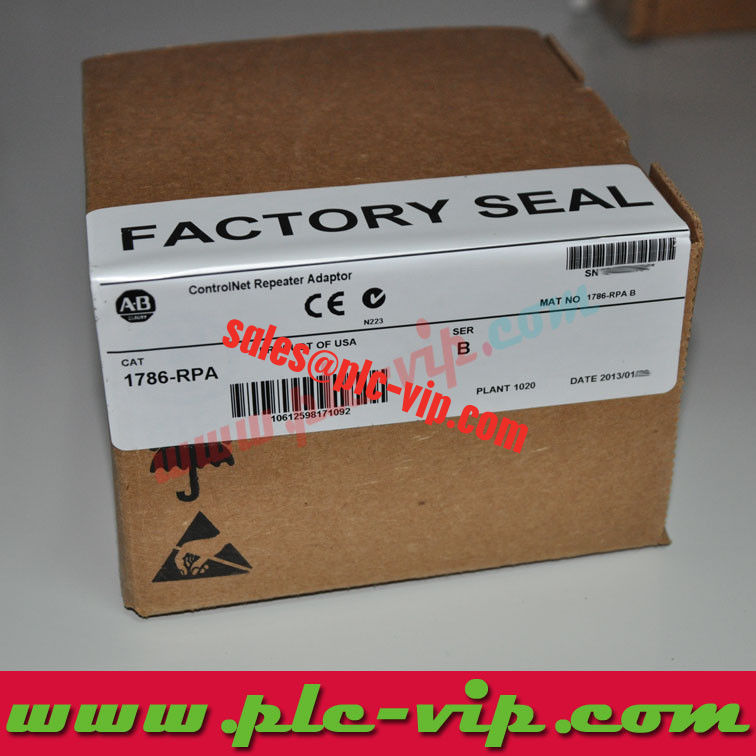













1788-EN2FFR EtherNet/IP to FOUNDATION Fieldbus linking device
1788-EN2FFR is the EtherNet/IP version of the 1788 fieldbus gateway: one H1 segment with 16 devices on the process side and a dual-port EtherNet/IP switch on the control side, which is what allows a device-level ring to be built through the gateway.

Specifications as printed
The rows come from 1788-TD001, the quick start 1788-QS006 and the shared user manual 1788-UM057.
| Power requirements | Input 24 to 32 V dc at 0.75 A, Class 2 or SELV, on a 2-way Phoenix connector |
| Fieldbus side | One FOUNDATION Fieldbus H1 segment, 16 field devices maximum |
| H1 ports | The segment is split across two hardware ports, each able to supply 500 mA |
| Power conditioning | Built in, so no external power conditioner is required |
| Fieldbus power | 0.5 A at 24 V dc on a single trunk, 0.4 A at 24 V dc on a dual trunk |
| Host capability | Full FOUNDATION Fieldbus host function including link active scheduler (LAS) |
| Process variables | 8 input PV, 8 output PV and 8 PV for device-to-device communication per field device |
| Termination | Line termination is built into the device |
| Power consumption | 260 mA at 24 V with no field devices attached |
| Power dissipation | 12.24 W at 24 V dc |
| Isolation | 30 V continuous basic insulation, network channels to power and channel to channel; no isolation between redundant network channels; type tested at 500 V dc for 60 s |
| Terminal torque | 0.22 to 0.25 N m (2 to 2.2 lb in) on dc power, 0.5 to 0.6 N m (4.4 to 5.3 lb in) on the fieldbus terminals |
| Wire size | 0.205 to 0.823 mm2 (24 to 18 AWG) solid or stranded copper rated 82 °C or greater, 1.2 mm insulation maximum |
| Enclosure | None, open style; temperature code T4 |
| Temperature | 0 to 60 °C operating and surrounding air maximum, 5 to 95 percent relative humidity non-condensing |
| Shock | 15 g operating, 30 g non-operating |
| EtherNet/IP port | RJ45 connector, dual-port switch supporting multiple topologies including device level ring (DLR) |
| Addressing | BOOTP enabled at shipment; address set by BOOTP server or by the hardware switches under the front cover |
Where it fits
A dual-port switch on the gateway is the detail that changes the network drawing. Instead of a single home run to the panel switch, the gateway can sit in a ring, so a cut cable on one side leaves the segment reachable from the other. That is a real availability gain in a process unit where the fieldbus cabinet is at the end of a long tray run.
Addressing is deliberately manual by default. The unit ships with BOOTP enabled and the switches at 888, and the switches set the last three octets of a 192.168.1.xxx address. Switch changes are read at power-up only, so an address that refuses to change is almost always a gateway that was not power-cycled, not a failed switch block. The field side is identical to the ControlNet version: 16 devices, two ports at 500 mA each, built-in conditioning and termination, LAS capability, and 8 input plus 8 output process variables per device. What differs is only the upper network and the diagnostics that come with it, including a web interface for the gateway itself.
Engineering notes
The gateway has to be added to the Logix project with the add-on profile before any field device can be configured, and the DTM is what gives asset management access to the instruments. Power is 24 to 32 V dc at 0.75 A; the 12.24 W dissipation and the 60 °C surrounding-air limit are the two numbers that decide cabinet layout.
Lifecycle
1788-TD001 lists only 1788-CN2DN and 1788-EN2DNR as active in the 1788 family, so this EtherNet/IP fieldbus gateway is delisted. No discontinuation date is printed.
Checks before the number is ordered
- Confirm the network topology, because a DLR ring through the gateway needs both ports wired and the ring supervisor configured.
- Set the IP address by switch or BOOTP and power-cycle before expecting the change to take effect.
- Check the H1 segment current against 500 mA per port, with the instruments split between the two ports where possible.
Questions engineers ask
What is 1788-EN2FFR?
An EtherNet/IP to FOUNDATION Fieldbus H1 linking device supporting 16 field devices on one segment, with a dual-port EtherNet/IP switch.
Does it support HSE?
No. The quick start states that the High-Speed Ethernet layer is not supported; the gateway bridges EtherNet/IP to H1.
How is the IP address set?
The unit ships BOOTP enabled with switches at 888; the address comes from a BOOTP server or from the switches, which set the last three octets and are read at power-up.
Is an external power conditioner required?
No. Conditioning and termination are built in and each H1 port supplies 500 mA.
Is 1788-EN2FFR still available?
No. It is delisted; 1788-TD001 identifies only 1788-CN2DN and 1788-EN2DNR as active.
Documentation
- 1788-QS006,
- EtherNet/IP and ControlNet to FOUNDATION Fieldbus Linking Devices User Manual, publication 1788-UM057
Related numbers
Data quoted from publications for this catalog number. Availability and price are quoted per order.