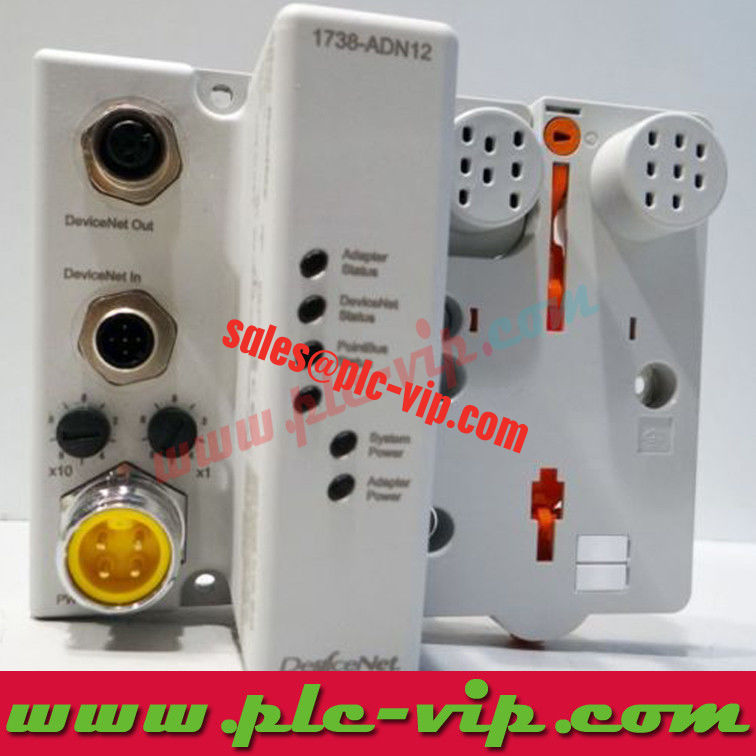
1738-IB8M8
This page documents catalog number 1738-IB8M8, a 8-channel sinking dc input, M8 connectors in the ArmorPoint I/O family. It is a sealed IP67 module that mounts on a base bridging two positions and needs no enclosure, and the figures below are taken from the module installation instructions rather than from a nameplate.
What the module is and where it sits
| Field | Value |
| Catalog number | 1738-IB8M8 |
| Family | 1738 ArmorPoint I/O, 24 V dc digital input |
| Channels | 8 (1 group of 8), non-isolated, sinking |
| Connectors | M8 (pico), 8 single-pin connectors |
| Connector pinout | Pin 1 24 V dc, pin 3 common, pins 4 inputs 0-7 on M8-A through M8-H |
| Keyswitch position | 1 |
| PointBus current | 75 mA at 5 V dc |
| Power dissipation | 1.6 W at 28.8 V dc (5.5 BTU/hr) |
| Isolation | 50 V rms continuous withstand, tested at 1,250 V ac rms for 60 s |
Input thresholds an engineer checks first
On-state 10-28.8 V dc, nominal 24 V dc; off-state input 5 V dc maximum; on-state current 2 mA nominal, 4 mA at 24 V dc minimum, 5 mA maximum; off-state leakage 1.5 mA maximum; impedance 3.6 kohm nominal, 4.7 kohm maximum. The two numbers that decide whether a field device works are the on-state minimum of 10 V dc and the off-state maximum of 5 V dc: a sensor that leaks enough to hold the input above 5 V when it is off is a sensor that reads on permanently, and 1.5 mA of off-state leakage is the published ceiling.
Input delay is %s. A hardware delay of 0.5 ms is the floor and the filter adds up to 63 ms, which is the difference between counting a fast pulse and rejecting contact bounce on a mechanical switch.
The module produces one byte of input data and consumes none: one bit per channel, 0 for off and 1 for on. That is the whole interface a controller sees, whatever the terminal arrangement on the connector is.
Sinking and sourcing is the decision that is made once per machine and then copied: a sinking input takes the field device to common and is the choice for PNP sensors that switch the supply, while the sourcing variant takes the device to the supply and suits NPN sensors. Mixing the two on one machine is not a fault, but it is a second spare part, and the catalog number is where that second part becomes visible.
Environment and installation facts that repeat across the family
| Parameter | Value |
| Dimensions with base | 120 H x 72 W x 42 D mm (4.72 x 2.83 x 1.65 in.) for I/O modules; 112 H x 72 W x 65 D mm (4.41 x 2.83 x 2.56 in.) for the DeviceNet adapters |
| Enclosure rating | Meets IP65/66/67 when marked; the sealed housing needs no cabinet, though a plant with washdown or corrosive atmosphere can still require one |
| Operating temperature | -20 to 60 degrees C (-4 to 140 degrees F), IEC 60068-2-1 cold, 60068-2-2 dry heat and 60068-2-14 thermal shock |
| Storage temperature | -40 to 85 degrees C (-40 to 185 degrees F) |
| Relative humidity | 5 to 95 percent non-condensing, IEC 60068-2-30 damp heat |
| Shock and vibration | Operating 30 g, non-operating 50 g; 5 g at 10-500 Hz operating |
| Isolation | 50 V rms continuous withstand, tested at 1,250 V ac rms for 60 s |
| ESD and RF immunity | 6 kV contact and 8 kV air discharge, 10 V/m radiated RF from 30 MHz to 2,000 MHz, 10 Vrms conducted RF from 150 kHz to 80 MHz |
| Transient immunity | Plus or minus 3 kV at 5 kHz EFT on signal ports, plus or minus 1 kV line-to-line and plus or minus 2 kV line-to-earth surge |
| Emissions | CISPR 11 Group 1 Class A |
| Mounting | Mounted on a grounded metal plate with #8 (M4) screws; base torque 7.5 in-lb in aluminium and 16 in-lb in steel; the ground lug is also a mounting hole |
| Weight | 0.29 kg (0.64 lb) with base |
| Field power bus | 24 V dc nominal, 10 to 28.8 V dc range |
| PointBus current | 75 mA at 5 V dc for digital and analog modules, 110 mA for 1738-SSIM23 |
The environmental claims in this family are stated per module and per connector: IP65/66/67 applies when the connector caps are tightened, and the installation instructions repeat the attention note that all connectors and caps have to be securely tightened to keep the seal. That single step is where most field failures on sealed I/O originate, and it is a mechanical check rather than a network check.
Field power and PointBus power are two separate budgets. The bus current listed for each module is drawn at 5 V dc from the adapter, and the field power at 10 to 28.8 V dc is what the sensors and the loads take; a segment planned on one of them and commissioned on the other trips on the one that was not counted.
What this page does not claim matters as much as what it does. It does not state a module count, a cable length, a cycle time or a network baud rate for this catalog number, because those are properties of the segment and the adapter rather than of the module, and a figure of that kind copied into a page becomes a specification nobody can trace back to a publication. Where the source publications do fix a value - the channel count, the connector shell, the current limit, the isolation rating, the temperature window, the data size - it is on this page with the publication named.
No lifecycle statement and no price is implied. The electrical, environmental and data-map figures are quoted from the ArmorPoint installation instructions and the DeviceNet adapter user manual; a figure not printed here is one the source publication does not state for this catalog number.