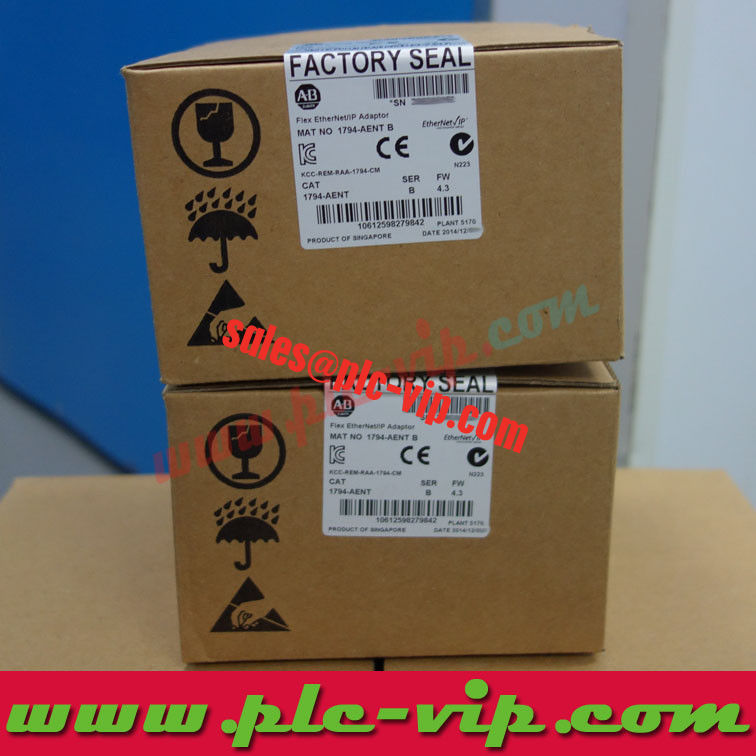
FLEX I/O 1794-AENTR / 1794AENTR Dual-Port EtherNet/IP Adapter
Category:
PLCs, Power Supplies & I/Os
Manufacturer:
Rockwell
Group:
PLC I/O
The 1794-AENTR adds a second RJ45 port to the FLEX I/O EtherNet/IP adapter, so the island can sit on a redundant media ring instead of a single star link.
Both ports are Category 5 RJ45 on the underside of the module, and the redundancy is in the network design — the adapter presents one node to the controller either way.
| 1794-AENT |
EtherNet/IP adapter, single RJ45, 8 modules |
IN STOCK |
| 1794-AENTR |
dual-port EtherNet/IP adapter, redundancy capable |
IN STOCK |
| 1794-AENTRXT |
dual-port EtherNet/IP adapter, extended temperature |
IN STOCK |
| 1794-ACN15 |
ControlNet adapter, 5 Mbps, 8 modules |
IN STOCK |
| 1794-ACN15K |
ControlNet adapter, 5 Mbps, conformal coated |
IN STOCK |
| 1794-ACNR |
ControlNet adapter with redundant media |
IN STOCK |
| 1794-ACNR15XT |
ControlNet adapter, redundant media, extended temperature |
IN STOCK |
| 1794-ACN |
ControlNet adapter module, 8 modules |
IN STOCK |
| 1794-ADN |
DeviceNet adapter, 8 modules |
IN STOCK |
| 1794-ADNK |
DeviceNet adapter, conformal coated |
IN STOCK |
| 1794-APB |
Profibus DP adapter, 8 modules |
IN STOCK |
| 1794-APBDPV1 |
Profibus DP-V1 adapter, 8 modules |
IN STOCK |
| 1794-ASB |
Remote I/O adapter, 8 modules |
IN STOCK |
| 1794-ASB2 |
Remote I/O adapter, extended functionality |
IN STOCK |
| 1794-ASBLT |
Remote I/O adapter with built-in termination |
IN STOCK |
Product Specifications 1794-AENTR (PDF)
Application |
FLEX I/O dual-port EtherNet/IP adapter |
Cat Num |
1794-AENTR |
Brand Name |
Rockwell |
I/O module capacity |
8 modules |
Ethernet connectors |
2 x RJ45 Category 5 |
Communication rate |
10/100 Mbps |
Input voltage |
24V DC nom, 19.2...31.2V DC range |
Inrush current |
18 A for 2 ms |
Flexbus output |
640 mA at 5V DC |
Power consumption, max |
500 mA at 24V DC |
Operating temperature |
0...55 deg C |
Attribute values above are reproduced from the manufacturer's product data. For the authoritative technical record see Rockwell publications 1794-DU001 (module specifications) and 1794-SG002 (installation instructions). Certification details, with certificate and file numbers, are listed in the FAQ below.
Two ports, one node
2 Ethernet RJ45 Category 5 connectors, labelled link 1 and link 2 with yellow/green indicators.
The second cable is described as the redundant Ethernet network cable, connecting to the second RJ45.
One adapter, one IP address, with 8 modules of I/O behind it.
Media redundancy is a network-level property, not a second controller connection.
Power
18 A inrush for 2 ms, which is why the 24V supply has to tolerate a capacitive load.
500 mA at 24V DC maximum consumption, against 440 mA on the single-port adapter.
<640 mA of 5V Flexbus output for the modules behind it.
19.2...31.2V DC input range including 5 percent ripple.
Isolation and thermal
50V continuous isolation, tested at 1000V AC for 60 s between power, Flexbus and EtherNet/IP.
7.1 W dissipation at 19.2V DC and 24.2 BTU/hr, the figures for enclosure sizing.
T5 temperature code for 1794-AENTR, with Ex ec IIC T5 Gc protection in Zone 2.
87 x 94 x 92 mm, 227 g, larger than the single-port part because of the second connector.
Application
Redundant media rings where a single cable failure must not drop the island.
<<Process areas with critical I/O and a documented network redundancy requirement.
Not the extended range; the 1794-AENTRXT runs -25...70 deg C.
Not a controller platform; the adapter is an I/O node only.
Where it fits
Dual-port islands on EtherNet/IP with device-level ring topologies.
Panels standardised on the FLEX I/O adapter family.
Not for 16 modules; the capacity is 8 per adapter.
Not for ControlNet media.
FAQ — 1794-AENTR
How many ports has the 1794-AENTR?
Two RJ45 Category 5 Ethernet ports.
What is the inrush current?
18 A for 2 ms.
How many modules can it carry?
8 FLEX I/O modules.
What is the power consumption?
500 mA at 24V DC maximum.
What is the isolation rating?
50V continuous, tested at 1000V AC for 60 s.
What is the operating temperature?
0...55 deg C, T5 temperature code.
Data sources. Technical values on this page come from Rockwell publication 1794-IN131 (FLEX I/O Dual Port EtherNet/IP Adapter Modules). Any attribute the publication does not print is marked Not published rather than taken from a distributor page. Catalog number, packaging and stock status are the stock record of this listing.