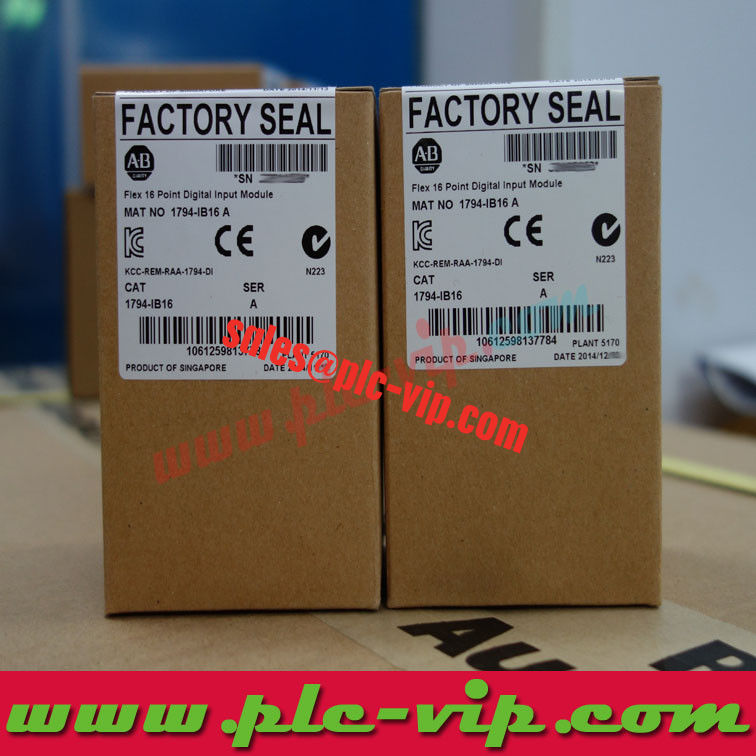
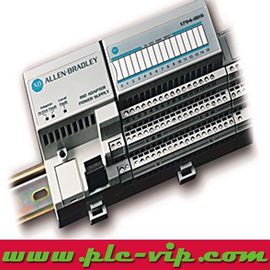
FLEX I/O 1794-IB8 / 1794IB8 8-Point 24V DC Sinking Input Module
Category:
PLCs, Power Supplies & I/Os
Manufacturer:
Rockwell
Group:
PLC I/O
The 1794-IB8 is the eight-point 24V DC sinking input module of the FLEX I/O family: eight inputs in one group, no channel-to-channel isolation, designed for two-wire and three-wire DC sensors wired through a 1794-TB3 series terminal base.
It is the module a panel designer reaches for when a remote FLEX I/O island needs a small block of limit switches, prox sensors or pushbuttons, and when the point count does not justify a 16-point card.
Product Specifications 1794-IB8 (PDF)
Application |
FLEX I/O digital input, 1794 terminal base |
Cat Num |
1794-IB8 |
Brand Name |
Rockwell |
Inputs |
8, current, sinking |
On-state voltage |
10V DC min, 24V DC nom, 31.2V DC max |
On-state current |
2.0 mA min, 8.0 mA nom, 12.0 mA max |
Off-state voltage |
5.0V DC max |
Input impedance |
4.6 kΩ nominal |
Isolation |
50V continuous basic; type tested 850V DC for 60 s |
Flexbus current |
20 mA at 5V DC |
Power dissipation |
3.5 W max at 31.2V DC (11.9 BTU/hr) |
Terminal base |
1794-TB3, -TB3S, -TB3K, -TB3SK, -TBKD, -TB37DS |
Dimensions |
94 x 94 x 69 mm with terminal base |
Weight |
71 g (2.50 oz) |
Attribute values above are reproduced from the manufacturer's product data. For the authoritative technical record see Rockwell publications 1794-DU001 (module specifications) and 1794-SG002 (installation instructions). Certification details, with certificate and file numbers, are listed in the FAQ below.
Input characteristics
8 sinking inputs, one common group. The module sinks current from the field device, so the sensor supply is brought to the +V terminals of row C and the return to row B of the terminal base.
Thresholds that suit 24V DC sensors. On-state from 10V DC, nominal 24V DC, maximum 31.2V DC; on-state current 2.0 mA minimum, 8.0 mA nominal, 12.0 mA maximum; off-state voltage 5V DC maximum and off-state current 1.5 mA maximum.
4.6 kΩ nominal input impedance, which sets the load the sensor sees and therefore the leakage current that will still read as an off state.
Every input is wired through the terminal base, so a module change never disturbs field wiring: the card is swapped on the base once the island is de-energised.
Because the commons are internally connected, one return terminal serves all eight sensors — convenient, and the usual source of a ground loop on a long cable run.
The 850V DC figure is a type test on the module, not a routine dielectric test on the panel; an installer's insulation test should not be applied across the field terminals.
An open-style enclosure rating means the island has to sit inside a panel; the module itself carries no standalone IP rating.
A 5% AC ripple allowance is printed with the 10...31.2V DC supply range, which matters when the 24V rail is a transformer and bridge rather than a switch-mode supply.
Wiring on the terminal base
Three rows carry the field wiring. Inputs land on row A (terminals 0...7 for this module), the +V sensor supply on row C (34...51, internally connected), and the sensor commons on row B (16...33, internally connected).
Daisy-chaining is built in. Jumper C-51 to C-34 and B-33 to B-16 on the next base to carry supply and common along the island without a separate terminal strip.
Two-wire and three-wire devices share the same rows. A two-wire sensor uses signal and supply; a three-wire sensor adds the common, which is why row B exists at all.
Isolation and system boundaries
50V continuous basic insulation, type tested at 850V DC for 60 s between the field side and the system side, and no isolation between individual channels.
This is a logic-level module, not a barrier. It does not isolate field circuits from each other, so a shared common across sensors is a design decision, not an accident of wiring.
Flexbus current of 20 mA at 5V DC is the module's draw from the adapter's backplane budget and belongs in the island power sum.
Thermal and mechanical fit
3.5 W maximum dissipation at 31.2V DC (11.9 BTU/hr) is what the enclosure has to remove; at 24V DC the figure is lower but the maximum is the number to design with.
94 x 94 x 69 mm with the terminal base, 71 g. The module sits on the DIN rail through the base, and grounding is through the rail, so the rail has to be zinc-plated chromate-passivated steel.
Keyswitch position 2 on the terminal base is the setting for this module type; a base left at another position will not accept the module.
When the eight-point module is the right choice
Mixed islands. A small block of DC inputs beside a larger analog group is cheaper and clearer on a drawing than a 16-point card half used.
Spare strategy. One spare 1794-IB8 covers several small islands, which is easier to justify than a spare 32-point module.
Upgrade path. The same terminal base family carries the 16-point and 32-point modules, so the wiring practice does not change when the point count grows.
FAQ — 1794-IB8
How many inputs does the 1794-IB8 have?
Eight, in one group, current sinking, with no isolation between channels.
What sensor voltage does it accept?
On-state from 10V DC, nominal 24V DC, maximum 31.2V DC; the external supply range is 10...31.2V DC including 5% AC ripple.
Which terminal base does it need?
1794-TB3, 1794-TB3S, 1794-TB3K, 1794-TB3SK, 1794-TBKD or 1794-TB37DS, keyswitch in position 2.
How is the module isolated?
50V continuous basic insulation, type tested at 850V DC for 60 s between field side and system; no channel-to-channel isolation.
What does it dissipate?
3.5 W maximum at 31.2V DC, equivalent to 11.9 BTU/hr.
Can two-wire and three-wire sensors be mixed?
Yes. Two-wire devices use the signal and supply terminals, three-wire devices also use the common terminals on row B.
Data sources. Technical values on this page come from Rockwell publication 1794-IN093 (FLEX I/O Digital Input Modules, 1794-IB8, -IB16, -IB32), 1794-IN083 (1794-IB10XOB6 and 1794-IB16XOB16P) and 1794-DU001 (protection method and electrical ratings). Any attribute the publication does not print is marked Not published rather than taken from a distributor page. Catalog number, packaging and stock status are the stock record of this listing.