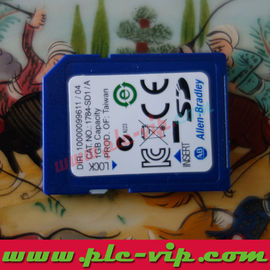
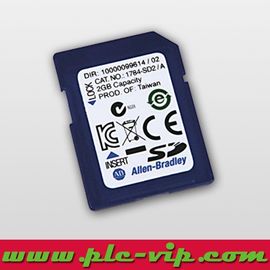
1784-SD2
This page documents catalog number 1784-SD2, the two gigabyte Secure Digital card ordered separately for additional nonvolatile memory. The capacity, shipment state and power behaviour below are published facts about the card; the contents of any particular card are not a specification, and are not asserted here.
Published data
| Specification | Value |
|---|
| Catalog number | 1784-SD2 |
| Product type | Secure Digital (SD) card for nonvolatile memory |
| Capacity | 2 GB of available memory |
| Shipment | Available for separate ordering; in ControlLogix and GuardLogix controllers the 2 GB card ships pre-installed |
| Use | Nonvolatile storage of the controller project, loaded and saved through the programming software |
| Power behaviour | System energy maintains controller power long enough to store the program to internal nonvolatile memory, but not enough to write the external SD card |
What the published data settles
This catalog number is the larger of the two cards in the family, published as 2 GB of available memory and available for separate ordering rather than shipped as standard with the 5370 controllers. The capacity difference is the reason the part exists, and the ordering difference is the reason a spares list has to name it.
In the ControlLogix and GuardLogix controllers the published shipment state is the reverse: the 2 GB card ships pre-installed. That asymmetry across families is a small fact with a large effect on a spares audit, because the same catalog number is standard equipment on one platform and an option on another.
The function is published as nonvolatile storage written and read through the programming software, with the option to configure a powerup load from the card. Doubling the capacity therefore does not change how the card is used; it changes how much history a plant can keep on it and how many programs fit in one store.
The published power behaviour applies to both capacities: the system store keeps the program in internal nonvolatile memory across a power loss, and does not extend to a write of the external card. A 2 GB card is not a bigger version of that guarantee, it is the same guarantee with more room.
The practical reason to order the larger card is not program size. A published capacity of 2 GB against a program measured in megabytes leaves most of the card unused, so the real reason is either a plant standard that specifies one card type across a platform or a use of the free space as a portable archive of several machine programs.
A portable archive is a published capability of the hardware and an unpublished risk of the process. A card that carries six programs is a card that can be inserted into the wrong controller, and the load-from-card option means that insertion has consequences at the next power cycle.
The card ships pre-installed in ControlLogix controllers, which means the published state of a new controller includes a card with no project on it. A commissioning procedure that assumes otherwise is a procedure that produces an empty controller on first power up, and the fix is documentation rather than hardware.
The 1768 and 5370 controllers are published as not requiring a battery, and the retention they do have is the internal store rather than the card. A plant that treats the card as its retention is a plant that has misunderstood two published sentences, one about power behaviour and one about cards.
A 2 GB card in a plant with 1 GB standard is an inconsistency, and inconsistency is the enemy of a spares audit. The published capacity of each catalog number is the fact that lets an audit turn a drawer of cards into two named line items with quantities.
The part is published as available for separate ordering, which describes a supply route rather than a lifecycle statement. Cards of this kind remain orderable long after the controllers that use them change series, and that durability is why the card is a better spare than the controller.
Cards are consumable in a way that controllers are not: they are removed, handled, inserted and occasionally lost. A published capacity figure does not describe wear, but the handling does, and a spare card in stores is the difference between a ten minute replacement and a purchase order.
The most useful thing this page can say is that the two cards are the same product in two sizes. A buyer who understands the published shipment states and the power behaviour does not need a datasheet for either, and a buyer who does not will order the wrong one for a platform they have not identified.
A card's contents are the only thing that makes it valuable, and the contents are not a published specification. That is the gap between a catalog number and a backup, and it is closed by a procedure that names the card, the controller and the date on which the card was written.
The other 1784 interface cards, memory cards and legacy interface products in this range are collected in the 1784 interface cards and memory products category. This card can be checked against the shop listing at 1784-SD2, and the other capacity is listed at 1784-SD1.
The eight 1784 records by host interface and network
The table puts the eight 1784 records on this site side by side on the three fields that make them comparable - what the page calls the part, how it attaches to the host, and which network it reaches - together with the lifecycle sentence each record prints. Half of these parts are cables or memory and print no network interface at all.
| Catalog number | What the page calls it | Host interface as printed | Network as printed | Lifecycle as printed |
| 1784-PCC1 | PCMCIA cable to ControlNet | PCMCIA Type II | ControlNet | Active Mature |
| 1784-PCD1 | PCMCIA cable to DeviceNet | PCMCIA Type II | DeviceNet | Active |
| 1784-PKTCS | PCI scanner card | PCI | ControlNet | Discontinued May 8, 2019 |
| 1784-PKTXD | PCI dual-channel card | PCI | DH+ / remote I/O / DH-485 | Discontinued March 31, 2022 |
| 1784-SD1 | SD memory card, 1 GB | not applicable | not applicable | not printed |
| 1784-SD2 | SD memory card, 2 GB | not applicable | not applicable | not printed |
| 1784-U2CN | USB interface to ControlNet | USB | ControlNet | Discontinued April 01, 2024 |
| 1784-U2DN | USB interface to DeviceNet | USB | DeviceNet | Active |
Where this record sits: the page prints it as "Secure Digital (SD) card for nonvolatile memory". In the eight-record group the host side is not applicable and the network side is not applicable, and the lifecycle row reads "not printed on this record". Across the group 3 records stand at Active or Active Mature, 3 print a discontinuation, and the two SD cards print no lifecycle row at all - so the family is a set of accessories of very different age rather than a single product line.
The lifecycle column is the one an engineer should read first here, because these eight records are not interchangeable parts of one system: they are the four ways a PC has been connected to a Rockwell network over three generations - PCMCIA, PCI, USB, and nothing at all for the SD cards. Which generation is still buyable decides what the retrofit looks like.
What these eight records do not carry: no current draw on any interface, no operating system or driver requirement, no cable pinout beyond a verbal description of each end, no software version and no supported-host list. The lifecycle and network rows are therefore the only planning data on the pages, and a compatibility check has to be done against the installation instruction each record cites.
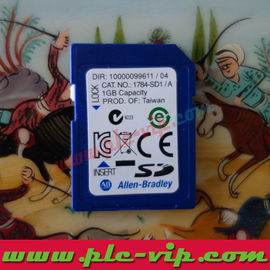
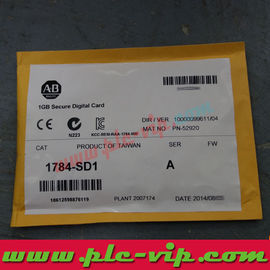
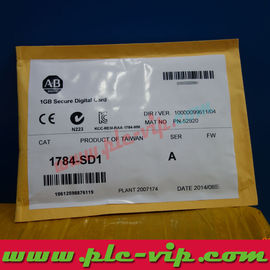
The two SD records differ only in capacity, 1 GB against 2 GB, and in shipment: the 1 GB card is printed as shipped installed in CompactLogix 5370 controllers, while this 2 GB card is printed as pre-installed in ControlLogix and GuardLogix controllers and also available for separate ordering.
Source: the field tables printed on the eight 1784 records on this site - catalog number, product type, host interface, network, lifecycle, replacement, country of origin and the installation instruction each cites - with the control-network figures (99 nodes, 500 m, IP20) quoted from the record that prints them. Nothing in this table is inferred from a catalog number.