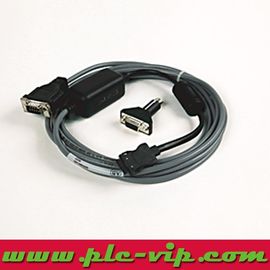
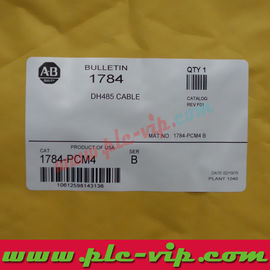
Allen Bradley PLC 1784-PCM2 / 1784PCM2
-
-
Large Image :
Allen Bradley PLC 1784-PCM2 / 1784PCM2
|
Product Details:
| Place of Origin: |
Made in USA |
| Brand Name: |
PLC Module |
| Certification: |
All goods we supply are 100% original factory sealed with 1 year warranty! |
| Model Number: |
Allen Bradley PLC 1784-PCM2 / 1784PCM2 |
Payment & Shipping Terms:
| Minimum Order Quantity: |
1 /PCS |
| Price: |
$279.00 (USD/PCS) |
| Packaging Details: |
100% original new |
| Delivery Time: |
IN STOCK; 4-6 weeks for ordering |
| Payment Terms: |
Paypal, T/T and Western Union. |
| Supply Ability: |
10 PCS |
|
Detailed Product Description
 1784-PCM2 Rockwell PLC-2 PCMCIA Communication Cable
Category:
PLCs, Power Supplies & I/Os
Manufacturer:
Rockwell
Group:
Bulletin 1784 · PC interface cards and cables
1784-PCM2 is the narrowest cable in the family: it connects a PCMK card to a PLC-2 processor and nothing else.
The cable ships with a loopback connector, which is used for the diagnostic test described in 1784-IN022: cable plus loopback proves the card and the lead before a processor is involved.
Product Specifications 1784-PCM2 (PDF)
Catalog number |
1784-PCM2 |
Product type |
PLC-2 communication cable for the PCMK card |
Connects to |
PLC-2 processor |
Cable total length |
3.16 m (10.4 ft) |
Loopback connector |
Supplied with the cable |
Country of origin |
United States of America |
Warranty |
1 year |
Publication |
1784-IN022 |
Attribute values above are reproduced from the manufacturer's product data. For the authoritative technical record see Rockwell publications 1784-IN022 (module specifications) and 1784-IN022 (installation instructions). Certification details, with certificate and file numbers, are listed in the FAQ below.
What it connects
1784-PCM2 is the narrowest cable in the family: it connects a PCMK card to a PLC-2 processor and nothing else.
Because the PLC-2 port is unlike the DH+ ports on later processors, this lead cannot stand in for a PCM4 or a PCM5; the catalog number has to match the processor family.
Interface and cabling
Total length is about 3.16 m, with the usual pod in the middle and the wedges that carry its weight.
Lifecycle and replacement
No current Rockwell product page is published for this catalog number; the cable exists in the documentation as 1784-PCM2/B in 1784-IN022.
Treated as discontinued with the rest of the PCM family. The PLC-2 itself is long out of production.
Where these are still in use
Programming and diagnostics of a PLC-2 from a laptop with the PCMK card — a rare but still encountered requirement in plants that never replaced the controller.
The loopback test is the other real use: proving a PCMK card and cable are good before blaming a processor.
Buying a used unit
Ask whether the loopback connector is included; without it the cable's own diagnostic is unavailable and a buyer loses the only test that isolates the card from the lead.
Check the processor-end connector shell and the pod, as with every cable in this family.
FAQ — 1784-PCM2
What does 1784-PCM2 connect?
1784-PCM2 is the narrowest cable in the family: it connects a PCMK card to a PLC-2 processor and nothing else.
Is 1784-PCM2 still available from Rockwell?
No current Rockwell listing; treated as discontinued.
What replaces 1784-PCM2?
No successor is named; the PLC-2 itself is out of production.
Where does 1784-PCM2 sit in the system?
What should I check before buying 1784-PCM2?
The loopback connector, the processor-end shell and the pod.
Data sources. Compatible processor, loopback connector, package contents and cable length come from installation instruction 1784-IN022; no product page is currently published for this catalog number. Any attribute a publication does not print is marked Not published rather than taken from a distributor page. Catalog number, packaging and stock status are the stock record of this listing.
1784-PCM2
This page documents catalog number 1784-PCM2, a communication cable assembly for the 1784-PCMK PCMCIA card, as published by Rockwell Automation in the PCMK Communication Card User Manual, 1784-UM519. Every value below comes from that manual; nothing is inferred.
Published facts for this catalog number
| Specification | Value |
|---|
| Assembly | PCM2/B communication cable assembly for the 1784-PCMK card |
| Devices served | PLC-2 family processors, connected through the program panel interface |
| Published limitation | PLC-2 support is not available through CardBus sockets |
| Diagnostic loopback | Loopback connector supplied with the assembly |
| Card the assembly serves | 1784-PCMK, PCMCIA Type II network adapter, PC Card standard February 1995, socket services version 2.1 |
| Total cable length | 3.16 m (10.4 ft) |
| Card connector to pod | 17.8 cm (7 in) |
| Pod to processor | 2.8 m (9.2 ft) |
| Communication cable limit | Less than 10 m (32.81 ft) |
How the assembly is used
The card is a PCMCIA Type II adapter that occupies one slot in a host computer; the assembly is what turns that slot into a physical connection to a controller. The published procedure inserts the card, installs the driver, then connects the cable to the processor port named in the device list. Nothing in that chain can be substituted without changing the outcome, which is why the device list and the connector type are printed here rather than summarised as a protocol.
Consequences on site
The device list is the whole specification of this assembly. It names the controllers and the one interface module the cable reaches, and it does not generalise to the rest of the family: the SLC controllers on this cable are the 5/01 to 5/03 generation, and a 5/04 needs the other DH+ assembly. Matching the cable to the controller model, not to the network name, is what prevents a returned order.
The loopback provision is published per assembly rather than per card, and it is uneven across the family. One assembly ships with a connector, two support a test without the connector, and the DH-485 assembly has neither. When a link will not come up, that difference decides whether the first test is a loopback or a substitution with a known good cable.
Scope of the published data
Only values that appear in 1784-UM519 are printed here. The device list is quoted as published, including the specific controller series it names, because the manual distinguishes between generations that share a network name. Pin-level wiring, the driver version history and the operating system support matrix are not reproduced on this page: they belong to the manual and to the software release notes, and a supplier page is not the place to reconstruct them. Where the manual is silent, the row is silent.
Compatibility in this family is expressed as a list of devices rather than as a protocol name, and the list is precise: SLC 5/01 through 5/03 on one cable, SLC 5/04 and enhanced PLC-5 on another, PLC-2 on a third. Reading that list is faster than reasoning about protocols, because the same physical port on two adjacent controller models can belong to different generations of the same network.
These cable assemblies are the second half of a PCMCIA interface, and they exist because one card has to reach several networks through different connectors. The card side is a single PCMCIA slot; the processor side changes with the protocol, so the catalog number of the cable is what actually decides whether the laptop can talk to the device in front of it. A card without the right cable is a card that does not connect to anything.
A card that is inserted into a PCMCIA slot depends on the host for power, timing and driver support, and the published card standard for this family is the 1995 PC Card standard with socket services version 2.1. That is the reason these interfaces work in a particular generation of laptops and not in later ones, and it is also the reason a working laptop is often kept in a plant long after its operating system has been retired everywhere else.
A PLC-3 connection through the DH+ cable is made through a specific interface module rather than directly into the processor, and the manual names that module. That detail is what turns a cable into a working link: the cable reaches the interface, the interface reaches the processor, and a site that has lost the interface has lost the connection regardless of how many cables are in the drawer.
Cables, cards and adapters for the same 1784 range are listed in the 1784 DH-485 category. This item itself can be checked against the shop listing at 1784-PCM2.