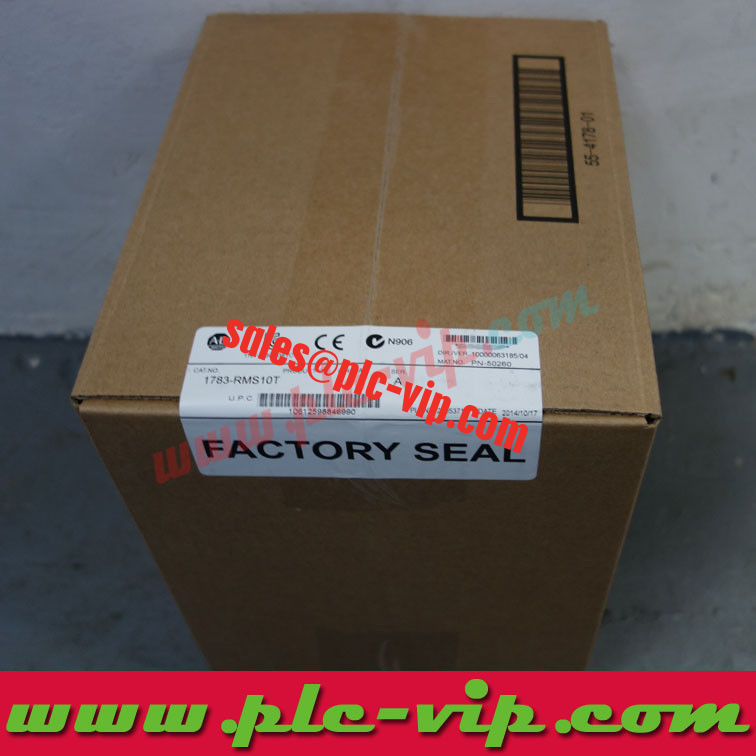
Detailed Product Description
 1783-SFP1GLX Rockwell Stratix 1000LX SFP Transceiver
Category:
PLCs, Power Supplies & I/Os
Manufacturer:
Rockwell
Group:
Stratix 5700 / 8000 / 8300 / 2000 · 1783
1783-SFP1GLX is a Stratix fibre SFP transceiver: 1000BASE-LX/LH singlemode fibre at 1310 nm.
It is the part that turns an empty SFP cage on a Stratix switch into a working fibre link — and the part most often replaced after a lightning season.
| 1783-BMS20CL |
Stratix 5700, 20 ports, 16 copper + 2 combo + 2 SFP |
IN STOCK |
| 1783-BMS20CGP |
Stratix 5700, 20 ports, gigabit combo |
IN STOCK |
| 1783-BMS20CGL |
Stratix 5700, 20 ports, gigabit combo, Lite firmware |
IN STOCK |
| 1783-BMS20CGPK |
Stratix 5700, 20 ports, gigabit combo, kit |
IN STOCK |
| 1783-BMS06TA |
Stratix 5700, 6 copper ports |
IN STOCK |
| 1783-BMS06TL |
Stratix 5700, 6 copper ports, Lite firmware |
IN STOCK |
| 1783-BMS06TGA |
Stratix 5700, 4 copper + 2 gigabit copper |
IN STOCK |
| 1783-BMS06SA |
Stratix 5700, 4 copper + 2 SFP |
IN STOCK |
| 1783-BMS06SL |
Stratix 5700, 4 copper + 2 SFP, Lite firmware |
IN STOCK |
| 1783-BMS06SGA |
Stratix 5700, 4 copper + 2 gigabit SFP |
IN STOCK |
| 1783-BMS06SGL |
Stratix 5700, 4 copper + 2 gigabit SFP, Lite firmware |
IN STOCK |
| 1783-MS06T |
Stratix 8000, 6 port chassis |
IN STOCK |
| 1783-MS10T |
Stratix 8000, 10 port chassis |
IN STOCK |
| 1783-RMS06T |
Stratix 8300, 6 port layer 3 |
IN STOCK |
| 1783-RMS10T |
Stratix 8300, 10 port layer 3 |
IN STOCK |
| 1783-EMS04T |
Stratix 6000, 4 port managed |
IN STOCK |
| 1783-MX08T |
Stratix 8000 copper 8 port expansion |
IN STOCK |
| 1783-MX08F |
Stratix 8000 fibre 8 port expansion |
IN STOCK |
| 1783-MCF |
Stratix 8000 CompactFlash spare card |
IN STOCK |
| 1783-RMCF |
Stratix 8300 CompactFlash spare card |
IN STOCK |
| 1783-ETAP |
EtherNet/IP tap, 3 copper ports |
IN STOCK |
| 1783-ETAP2F |
EtherNet/IP tap, 1 copper + 2 fibre |
IN STOCK |
| 1783-SFP100FX |
100FX multimode SFP, 2 km |
IN STOCK |
| 1783-SFP100LX |
100LX singlemode SFP, 10 km |
IN STOCK |
| 1783-SFP1GSX |
1000SX multimode SFP, 550 m |
IN STOCK |
| 1783-SFP1GLX |
1000LX singlemode SFP, 10 km |
IN STOCK |
| 1783-US8T |
Stratix 2000, 8 copper ports, unmanaged |
IN STOCK |
| 1783-US03T01F |
Stratix 2000, 3 copper + 1 fibre, unmanaged |
IN STOCK |
Product Specifications 1783-SFP1GLX (PDF)
Catalog number |
1783-SFP1GLX |
Description |
Stratix fibre SFP transceiver |
Optical type |
1000BASE-LX/LH singlemode fibre |
Wavelength |
1310 nm |
Connector |
Dual LC |
Reach |
10 km |
Fibre |
G.652 singlemode |
Digital optical monitoring |
Supported |
Estimated lead time |
45 days |
Lifecycle status |
Active |
Warranty |
1 year standard |
Publication |
1783-UM011 |
Attribute values above are reproduced from the manufacturer's product data. For the authoritative technical record see Rockwell publications 1783-UM011 (module specifications) and Rockwell literature library (installation instructions). Certification details, with certificate and file numbers, are listed in the FAQ below.
Optics
1000BASE-LX/LH singlemode fibre, 1310 nm, Dual LC connector, rated reach 10 km over G.652 singlemode.
The reach figure assumes the specified fibre. A link that works at 300 m on multimode will not work at 2 km because the switch negotiated something — the optic sets the distance, not the port.
Matching the far end
Both ends have to be the same optical type. A 100BASE-FX multimode SFP will not link to a 100BASE-LX singlemode port, whatever the connector looks like.
Keep a record of which cage holds which optic. Two identical switches with mixed SFPs is the most common cause of a link nobody can explain.
Digital optical monitoring
DOM exposes transmit power, receive power and temperature to the switch diagnostics, which turns a marginal link into a measured problem.
Use it before swapping hardware: a receive level 6 dB down on one port is usually the patch lead, not the transceiver.
Availability
Lifecycle status Active with a published estimated lead time of 45 days. These are orderable new, unlike the switches they plug into.
Because the transceiver outlives the chassis, buying new SFPs for a discontinued Stratix 5700 is normal practice — the switch is the scarce part.
Related parts
Stratix 5700 (1783-BMS…) and Stratix 8000/8300 chassis carry the cages; 1783-MX08F is the fibre expansion module for the 8000.
1783-SFP100FX and 1783-SFP100LX are the 100 Mbit pair; 1783-SFP1GSX and 1783-SFP1GLX the gigabit pair.
FAQ — 1783-SFP1GLX
What fibre does 1783-SFP1GLX need?
1000BASE-LX/LH singlemode fibre over G.652 singlemode.
What reach does 1783-SFP1GLX support?
10 km
What connector does 1783-SFP1GLX use?
Dual LC
Is 1783-SFP1GLX still orderable?
Yes. Lifecycle status Active, estimated lead time 45 days.
Can 1783-SFP1GLX be mixed with another SFP type?
No. Both ends of the link must be the same optical type.
Data sources. Optical type, wavelength, connector, fibre core and reach come from the Rockwell product page of this catalog number. Any attribute a publication does not print is marked Not published rather than taken from a distributor page. Catalog number, packaging and stock status are the stock record of this listing.
1783-SFP1GLX: 1000BASE-LX singlemode SFP
1783-SFP1GLX is part of the Stratix industrial Ethernet range from Allen-Bradley, and this page carries the figures from the Rockwell technical data so that a cabinet can be sized and a spare ordered without going back to a distributor datasheet.
| Specification | Value |
|---|
| Standard | 1000BASE-LX/LH, singlemode fiber |
| Connector | Dual LC |
| Wavelength | 1310 nm |
| Fiber and length | G.652 singlemode, up to 10 km (32,808 ft) |
| Transmit power | -3 dBm maximum to -9.5 dBm minimum |
| Receive power | -3 dBm maximum to -20 dBm minimum |
| Diagnostics | Digital optical monitoring supported |
| Port rule | Gigabit SFP modules work only in Gigabit SFP slots or combo ports |
| Source | 1783-TD002D-EN-P, May 2023 |
An SFP is a link budget in a plug, and the two columns that decide whether a link works are the transmit window and the receive window, not the headline distance. The published ranges here are the ones to subtract connector, splice and aging margin from, and a link that only works at the maximum published distance is a link that will drop out in summer.
The port rule catches more orders than any other detail in this range: a Gigabit SFP works only in a Gigabit slot or a combo port, and a Fast Ethernet SFP will not train in a Gigabit slot. Matching the optic to the switch suffix before the purchase order is cheaper than matching it afterwards.
Where the Rockwell table prints a maximum rather than a typical value, this page keeps the maximum, because a power budget built on typical numbers fails on the coldest morning of the year rather than on the day it was designed.
On 1783-SFP1GLX the 24V DC input is Class 2 or SELV, which is what allows a cabinet to feed them from the same distribution as the PLC without a separate transformer. Where a site still runs 24V AC, that option exists on the unmanaged range and disappears on the managed ones, and the difference is worth checking before a retrofit order is placed.
Precision time is a separate question from data. IEEE 1588 CIP Sync is what lets a controller timestamp an input at the switch edge rather than at the scanner, and only the Full firmware variants carry it. If an application needs coordinated motion or sequence of events, the Lite part on the shelf will not do the job.
Temperature is quoted at the surrounding air rather than at the board, and the 60 degrees C ceiling on the managed units is lower than the 70 degrees C that the FLEX Ex and most I/O families allow. A cabinet that was designed around an I/O module rating will need a thermal review before a switch is added at the top of the rail.
A switch that has been in a cabinet for eight years, 1783-SFP1GLX among them, is usually still electrically sound and functionally obsolete. The practical question at replacement time is whether the firmware can still be managed by the current tool, and a unit that cannot be reached by the engineering software is a unit that will be replaced on failure rather than on schedule.
A managed switch adds the diagnostics that make a network debuggable: port level counters, spanning tree, and in the Stratix range a Device Level Ring that survives a single cable break. The catalog suffix tells you whether that firmware is present, and a Lite unit is not upgradeable into a Full one by flashing it. For 1783-SFP1GLX the suffix is the only reliable statement of which firmware set ships.
Every one of these units, 1783-SFP1GLX included, is open style, which means it belongs in an enclosure with a pollution degree 2 environment. The IP30 rating protects against fingers and tools, not against water, and a switch mounted on an open panel in a wet area is a warranty claim waiting to happen.
Cybersecurity hardening starts at the switch, not at the firewall. Disabling unused ports, changing the default credentials, and keeping the management interface off the plant backbone are the three steps that close most findings in an industrial network assessment, and none of them require a licence.
Ethernet ports are rated for Category 5e cable at minimum, and the connector is the IEC 60603-7 RJ45 that every industrial patch cord already uses. Where a cabinet is wired with older Category 5 cable, the link will usually train at 100 Mbps but the error counters will climb, which is why the cable class is printed next to the port table.
For 1783-SFP1GLX the NAT variants exist for the machine builder who must hand over a cell with a fixed internal address scheme. A configurable NAT router lets the same internal IP plan be reused on every machine while the plant side sees a different address, which removes an entire class of commissioning arguments.
Spare parts strategy on a switch is driven by firmware, not by hardware. A Lite spare cannot replace a Full unit in a ring that depends on CIP Sync, so the stocking list should carry the suffix rather than the base number, and the label on the failed unit is the authority.
In a plant network the switch, 1783-SFP1GLX included, is usually the part that gets blamed last and fails first, because it sits between a drive that trips and a controller that logs nothing. Keeping the port count, the supply range and the temperature rating on the page means a maintenance engineer can replace a unit without opening a drawing set.
Device Level Ring is the reason many of these switches exist in a machine line. A ring built from two ports per device survives one open cable without dropping the cell, and the recovery time is a property of the ring rather than of any single switch, so a mixed vendor ring has to be checked as a whole.
The emission class is CISPR 11 Class A, which is an industrial environment statement. Mounting one of these in a light industrial or residential panel can require additional filtering, and that is a compliance question rather than a performance one, so it belongs in the quotation stage.
The distance an SFP reaches is a property of the optic and the fiber, not of the switch. Multimode runs to a few hundred meters, singlemode runs to kilometers, and the budget has to cover connectors and splices, so the link loss calculation belongs in the same document as the port list.
Match the optic to the switch port type, subtract connector and splice loss from the published budget before quoting a distance, and specify the industrial temperature marked part for any cabinet that runs outside a comfortable range.