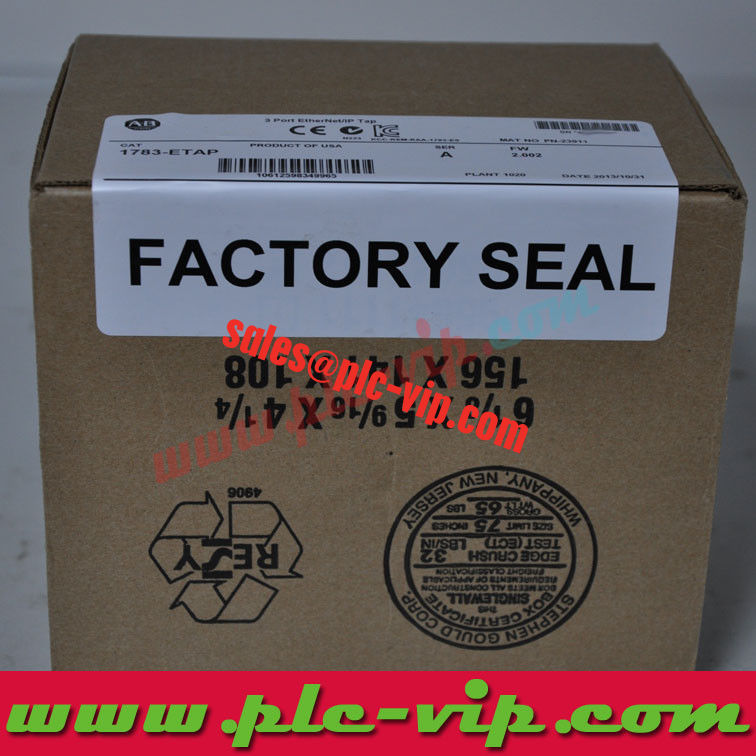
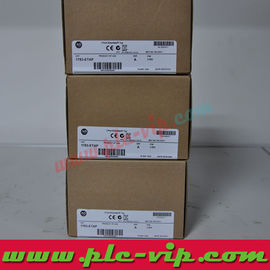
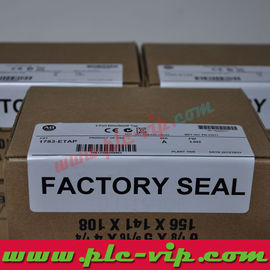
Allen Bradley PLC 1783-MX08T / 1783MX08T
-
-
Large Image :
Allen Bradley PLC 1783-MX08T / 1783MX08T
|
Product Details:
| Place of Origin: |
Made in USA |
| Brand Name: |
PLC Module |
| Certification: |
All goods we supply are 100% original factory sealed with 1 year warranty! |
| Model Number: |
Allen Bradley PLC 1783-MX08T / 1783MX08T |
Payment & Shipping Terms:
| Minimum Order Quantity: |
1 /PCS |
| Price: |
$1135.00 (USD/PCS) |
| Packaging Details: |
100% original new |
| Delivery Time: |
IN STOCK; 4-6 weeks for ordering |
| Payment Terms: |
Paypal, T/T and Western Union. |
| Supply Ability: |
2 PCS |
|
Detailed Product Description
 1783-MX08T Rockwell Stratix 8000 8 Port Copper Expansion Module
Category:
PLCs, Power Supplies & I/Os
Manufacturer:
Rockwell
Group:
Stratix 5700 / 8000 / 8300 / 2000 · 1783
1783-MX08T is the copper expansion module for the Stratix 8000 chassis: eight copper ports added to a switch that is already installed.
Expansion is the point of the 8000 design, and it is why these modules are still bought years after the chassis was commissioned.
| 1783-BMS20CL |
Stratix 5700, 20 ports, 16 copper + 2 combo + 2 SFP |
IN STOCK |
| 1783-BMS20CGP |
Stratix 5700, 20 ports, gigabit combo |
IN STOCK |
| 1783-BMS20CGL |
Stratix 5700, 20 ports, gigabit combo, Lite firmware |
IN STOCK |
| 1783-BMS20CGPK |
Stratix 5700, 20 ports, gigabit combo, kit |
IN STOCK |
| 1783-BMS06TA |
Stratix 5700, 6 copper ports |
IN STOCK |
| 1783-BMS06TL |
Stratix 5700, 6 copper ports, Lite firmware |
IN STOCK |
| 1783-BMS06TGA |
Stratix 5700, 4 copper + 2 gigabit copper |
IN STOCK |
| 1783-BMS06SA |
Stratix 5700, 4 copper + 2 SFP |
IN STOCK |
| 1783-BMS06SL |
Stratix 5700, 4 copper + 2 SFP, Lite firmware |
IN STOCK |
| 1783-BMS06SGA |
Stratix 5700, 4 copper + 2 gigabit SFP |
IN STOCK |
| 1783-BMS06SGL |
Stratix 5700, 4 copper + 2 gigabit SFP, Lite firmware |
IN STOCK |
| 1783-MS06T |
Stratix 8000, 6 port chassis |
IN STOCK |
| 1783-MS10T |
Stratix 8000, 10 port chassis |
IN STOCK |
| 1783-RMS06T |
Stratix 8300, 6 port layer 3 |
IN STOCK |
| 1783-RMS10T |
Stratix 8300, 10 port layer 3 |
IN STOCK |
| 1783-EMS04T |
Stratix 6000, 4 port managed |
IN STOCK |
| 1783-MX08T |
Stratix 8000 copper 8 port expansion |
IN STOCK |
| 1783-MX08F |
Stratix 8000 fibre 8 port expansion |
IN STOCK |
| 1783-MCF |
Stratix 8000 CompactFlash spare card |
IN STOCK |
| 1783-RMCF |
Stratix 8300 CompactFlash spare card |
IN STOCK |
| 1783-ETAP |
EtherNet/IP tap, 3 copper ports |
IN STOCK |
| 1783-ETAP2F |
EtherNet/IP tap, 1 copper + 2 fibre |
IN STOCK |
| 1783-SFP100FX |
100FX multimode SFP, 2 km |
IN STOCK |
| 1783-SFP100LX |
100LX singlemode SFP, 10 km |
IN STOCK |
| 1783-SFP1GSX |
1000SX multimode SFP, 550 m |
IN STOCK |
| 1783-SFP1GLX |
1000LX singlemode SFP, 10 km |
IN STOCK |
| 1783-US8T |
Stratix 2000, 8 copper ports, unmanaged |
IN STOCK |
| 1783-US03T01F |
Stratix 2000, 3 copper + 1 fibre, unmanaged |
IN STOCK |
Product Specifications 1783-MX08T (PDF)
Catalog number |
1783-MX08T |
Description |
Stratix 8000 copper 8 port expansion module |
Ports |
8 * 10/100 RJ45 |
Fits |
Stratix 8000 managed switch chassis |
Depth |
117.5 mm |
Optical reach |
|
Lifecycle status |
Discontinued November 30, 2020 |
Replacement category |
Functional Replacement |
UPC |
612598347742 |
Publication |
1783-UM011 |
Attribute values above are reproduced from the manufacturer's product data. For the authoritative technical record see Rockwell publications 1783-UM011 (module specifications) and Rockwell literature library (installation instructions). Certification details, with certificate and file numbers, are listed in the FAQ below.
What it adds
8 * 10/100 RJ45, mounted in the Stratix 8000 chassis.
The module extends the same managed switch, so VLANs, ring membership and diagnostics apply across old and new ports without a second device to own.
Fibre variant
Copper variant: eight RJ45 ports, no optical reach figure applies.
Mixing a copper and a fibre module in one chassis is the normal build — copper for devices in the cabinet, fibre for the run to the next one.
Fit and power
The module draws from the chassis supply; fitting one does not require a second power feed. Depth is 117.5 mm, matching the chassis footprint.
Power the chassis down before fitting. These are not field hot-swap parts, whatever a bench test allowed.
Lifecycle
Discontinued November 30, 2020 with the Stratix 8000 line, replacement category Functional Replacement.
A used module is a reasonable buy for a known-good chassis; it is not a reasonable buy as the only spare for three of them.
Related parts
Chassis: 1783-MS06T, 1783-MS10T. SFPs for the front cages: 1783-SFP100FX, 1783-SFP100LX, 1783-SFP1GSX, 1783-SFP1GLX.
Configuration media for the chassis: 1783-MCF CompactFlash spare card.
On a used module, read the port label on the front rather than a photograph: the copper and fibre versions share one housing and one connector layout, and only the marking tells them apart.
FAQ — 1783-MX08T
What does 1783-MX08T add?
8 * 10/100 RJ45
Which chassis does 1783-MX08T fit?
The Stratix 8000 managed switch chassis.
Is 1783-MX08T still available from Rockwell?
No. Discontinued November 30, 2020; Functional Replacement.
What optical reach does 1783-MX08T support?
Not applicable — copper module.
Can 1783-MX08T be fitted with the chassis powered?
No. Power the chassis down first.
Data sources. Module role, port count and optical reach come from the Rockwell product page of this catalog number. Any attribute a publication does not print is marked Not published rather than taken from a distributor page. Catalog number, packaging and stock status are the stock record of this listing.
1783-MX08T: 8 port copper expansion module
1783-MX08T is part of the Stratix industrial Ethernet range from Allen-Bradley, and this page carries the figures from the Rockwell technical data so that a cabinet can be sized and a spare ordered without going back to a distributor datasheet.
| Specification | Value |
|---|
| Ports | 8 ports, 10/100 Base-T copper Ethernet, RJ45 to IEC 60603-7 |
| Backplane power | 3.3V DC, 1.7 A maximum |
| Power consumption | 2.8 W maximum, dissipation 2.8 W |
| Isolation | 75V continuous basic insulation, expansion backplane to network channels; no isolation between ports; tested 1000V AC 60 s |
| Cabling | Category 5e minimum to TIA 568-B.1 or Category 5 to ISO/IEC 24702, 2 or 4 pair |
| Enclosure | None, open style, T4 temperature code |
| Certification | UL E65584 and E194810, Class I Division 2 and Zone 2, Ex nA IIC T4 Gc X |
| Compatibility | Any Stratix 8000 or 8300 base switch |
| Source | 1783-TD002D-EN-P, May 2023 |
The fiber version is the one that usually decides a layout, because 2000 m over graded index multimode covers a plant building without a media converter, and the link budget of 8 dB on 62.5/125 micron fiber is the number to compare against the connector and splice losses on the run. On 50/125 micron fiber the same module is specified at 4 dB, which is a shorter reach in practice.
Both modules take their power from the switch backplane, so there is no separate supply terminal to wire and no separate ground reference to establish in the cabinet. The cost appears in the switch budget instead: 2.8 W for the copper module and 10.1 W for the fiber module, and that is the figure the enclosure thermal calculation needs.
Where the Rockwell table prints a maximum rather than a typical value, this page keeps the maximum, because a power budget built on typical numbers fails on the coldest morning of the year rather than on the day it was designed.
An unmanaged switch has no address and no configuration, so it either forwards frames or it does not. That is a feature in a machine cell where nobody wants a config file to restore after a controller swap, and it is a liability in a line where someone needs to know which port dropped a packet.
On 1783-MX08T conformal coating is a suffix rather than a separate product, and it matters in washdown or sulfur bearing atmospheres. Where a cabinet sits in a food plant or near a rubber process, the coated variant is the one to quote, because condensation on an uncoated board is a failure that shows up months later.
Commissioning a switch takes an afternoon the first time and twenty minutes afterwards: address it, set the ring or the redundant path, confirm the port counters stay clean under load, and record the firmware revision on the as-built drawing. The failures that survive to production are almost always a duplicate address or a loop nobody documented.
On 1783-MX08T the 24V DC input is Class 2 or SELV, which is what allows a cabinet to feed them from the same distribution as the PLC without a separate transformer. Where a site still runs 24V AC, that option exists on the unmanaged range and disappears on the managed ones, and the difference is worth checking before a retrofit order is placed.
Precision time is a separate question from data. IEEE 1588 CIP Sync is what lets a controller timestamp an input at the switch edge rather than at the scanner, and only the Full firmware variants carry it. If an application needs coordinated motion or sequence of events, the Lite part on the shelf will not do the job.
Temperature is quoted at the surrounding air rather than at the board, and the 60 degrees C ceiling on the managed units is lower than the 70 degrees C that the FLEX Ex and most I/O families allow. A cabinet that was designed around an I/O module rating will need a thermal review before a switch is added at the top of the rail.
A switch that has been in a cabinet for eight years is usually still electrically sound and functionally obsolete. The practical question at replacement time is whether the firmware can still be managed by the current tool, and a unit that cannot be reached by the engineering software is a unit that will be replaced on failure rather than on schedule.
A managed switch adds the diagnostics that make a network debuggable: port level counters, spanning tree, and in the Stratix range a Device Level Ring that survives a single cable break. The catalog suffix tells you whether that firmware is present, and a Lite unit is not upgradeable into a Full one by flashing it. For 1783-MX08T the suffix is the only reliable statement of which firmware set ships.
Every one of these units, 1783-MX08T included, is open style, which means it belongs in an enclosure with a pollution degree 2 environment. The IP30 rating protects against fingers and tools, not against water, and a switch mounted on an open panel in a wet area is a warranty claim waiting to happen.
Cybersecurity hardening starts at the switch, not at the firewall. Disabling unused ports, changing the default credentials, and keeping the management interface off the plant backbone are the three steps that close most findings in an industrial network assessment, and none of them require a licence.
Ethernet ports are rated for Category 5e cable at minimum, and the connector is the IEC 60603-7 RJ45 that every industrial patch cord already uses. Where a cabinet is wired with older Category 5 cable, the link will usually train at 100 Mbps but the error counters will climb, which is why the cable class is printed next to the port table.
For 1783-MX08T the NAT variants exist for the machine builder who must hand over a cell with a fixed internal address scheme. A configurable NAT router lets the same internal IP plan be reused on every machine while the plant side sees a different address, which removes an entire class of commissioning arguments.
Spare parts strategy on a switch is driven by firmware, not by hardware. A Lite spare cannot replace a Full unit in a ring that depends on CIP Sync, so the stocking list should carry the suffix rather than the base number, and the label on the failed unit is the authority.
In a plant network the switch, 1783-MX08T included, is usually the part that gets blamed last and fails first, because it sits between a drive that trips and a controller that logs nothing. Keeping the port count, the supply range and the temperature rating on the page means a maintenance engineer can replace a unit without opening a drawing set.
Size the fiber run against the published link budget rather than against the headline distance, add the module consumption to the switch budget, and keep the 105 mm airflow clearance above and below the assembled stack.