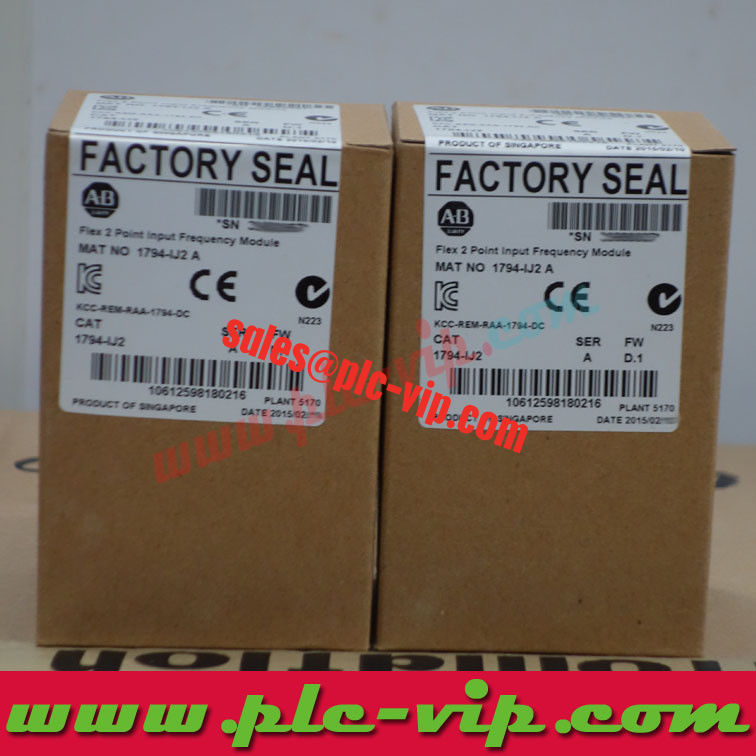
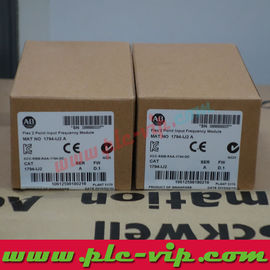
Allen Bradley PLC 1794-IJ2XT / 1794IJ2XT
-
-
Large Image :
Allen Bradley PLC 1794-IJ2XT / 1794IJ2XT
|
Product Details:
| Place of Origin: |
Made in SINGAPORE |
| Brand Name: |
PLC Module |
| Certification: |
All goods we supply are 100% original factory sealed with 1 year warranty! |
| Model Number: |
Allen Bradley PLC 1794-IJ2XT / 1794IJ2XT |
Payment & Shipping Terms:
| Minimum Order Quantity: |
1 /PCS |
| Price: |
$507.00 (USD/PCS) |
| Packaging Details: |
100% original new |
| Delivery Time: |
IN STOCK; 4-6 weeks for ordering |
| Payment Terms: |
Paypal, T/T and Western Union. |
| Supply Ability: |
10 PCS |
|
Detailed Product Description
 FLEX I/O 1794-IJ2XT / 1794IJ2XT Frequency Input, Extended Temp
Category:
PLCs, Power Supplies & I/Os
Manufacturer:
Rockwell
Group:
PLC I/O
The 1794-IJ2XT is the extended-temperature frequency input: two channels from 1 to 32 kHz, 4 ms processing, and the same two isolated 24V outputs, rated to 70 deg C.
The measurement circuit is identical to the standard card. The coating and the operating window are the reason to specify it, and that matters on a meter run in an unheated enclosure.
Product Specifications 1794-IJ2XT (PDF)
Application |
FLEX I/O frequency input, 1794 terminal base |
Cat Num |
1794-IJ2XT |
Brand Name |
Rockwell |
Inputs |
2 frequency inputs with gate and counter |
Frequency range |
1...32 kHz, sine wave or square wave |
Processing time |
4 ms or less |
Minimum pulse width |
20 us |
On-state |
10, 24 or 31.2V at 2.0, 9.0 and 10.0 mA |
Wire-off detection |
0.4 mA through a 50 kOhm shunt |
Outputs |
2 isolated 24V DC outputs, 1.0 A per channel |
External supply current |
220 mA at 19.2V, 180 mA at 24V, 140 mA at 31.2V |
Power dissipation |
4.5 W at 31.2V DC (15.3 BTU/hr) |
Operating temperature |
-20...70 deg C |
Attribute values above are reproduced from the manufacturer's product data. For the authoritative technical record see Rockwell publications 1794-DU001 (module specifications) and 1794-SG002 (installation instructions). Certification details, with certificate and file numbers, are listed in the FAQ below.
Extended temperature
-20...70 deg C operating range against -20...55 deg C on the standard 1794-IJ2.
Two frequency inputs, 1...32 kHz, with a 20 us minimum pulse width unchanged.
4 ms or less processing and two isolated 24V outputs at 1.0 A per channel carry over.
Conformal coating is what makes the wider window usable where condensation forms on a cold start.
Input thresholds
On-state 10, 24 or 31.2V at 2.0, 9.0 and 10.0 mA; off-state 5V at 1.5 mA, the same published levels.
A 50 kOhm shunt with 0.4 mA wire-off current reports a broken pickup instead of reading zero speed.
Input impedance above 5 kOhm for a 50 or 500 mV magnetic pickup and above 10 kOhm for a 3V or 6V vortex sensor.
The slowest tooth rate still has to exceed the 10V on-state — the check is done at minimum speed, not at nameplate speed.
Supply and heat
220 mA at 19.2V, 180 mA at 24V, 140 mA at 31.2V is the current, unchanged from the standard card.
4.5 W at 31.2V DC (15.3 BTU/hr) has to be shed by an enclosure that may have no fan.
Storage -40...85 deg C and 5...95% RH non-condensing complete the environmental statement.
The two 24V outputs are isolated in two groups of 30 mA, so the wider temperature range does not change the field wiring.
Each group draws its current from the external 24V supply, so 30 mA per group is a budget line in the panel load calculation rather than a free output.
Wiring practice
Shielded twisted pair from the pickup with the shield at the panel only.
A dry contact is limited by the 20 us minimum pulse width: a bouncing relay produces counts that look like flow.
Verify each channel at low temperature before the first production run, because the coating and the wider window are exactly what a cold commissioning exposes.
Field power removed before insertion, following the FlexBus steps in the publication.
Where it fits
Outdoor meter runs and unheated flow skids down to -20 deg C.
Rate and batch control that needs the two local outputs, not just a count into the PLC.
Not for encoder position; the 1794-VHSC is the two-axis quadrature module.
Not for sensorless speed below 1 kHz; use a digital input with a timer.
FAQ — 1794-IJ2XT
How does the 1794-IJ2XT differ from the 1794-IJ2?
It is rated -20...70 deg C and conformally coated; the frequency and output specifications are the same.
What frequency range does it accept?
1...32 kHz with a 20 us minimum pulse width.
How many outputs has it?
Two isolated 24V DC outputs rated 1.0 A per channel.
What current does the module draw?
220 mA at 19.2V, 180 mA at 24V, 140 mA at 31.2V.
Does it detect an open pickup?
Yes, by 0.4 mA through a 50 kOhm shunt.
What is the processing time?
4 ms or less.
Data sources. Technical values on this page come from Rockwell publication 1794-SG002 (FLEX I/O Selection Guide, Table 37) and 1794-IN093. Any attribute the publication does not print is marked Not published rather than taken from a distributor page. Catalog number, packaging and stock status are the stock record of this listing.
1794-IJ2XT: frequency input module, extreme temperature variant
1794-IJ2XT is a FLEX I/O specialty module for the 1794 system, documented here from the Rockwell specialty module technical data so that the input thresholds, the counting limits, the output ratings and the terminal base requirement are stated for this catalog number.
| Specification | Value |
|---|
| Catalog number | 1794-IJ2XT, extreme temperature variant of the 1794-IJ2 frequency input family |
| Inputs | 2 frequency inputs, each with a frequency channel and a gate channel used to establish direction |
| Processing time | 4 ms or less |
| Input frequency, maximum | 1 to 32 kHz with sine wave input, 1 to 32 kHz with square wave input |
| Frequency value, maximum | 32,767 or 3,276.7 depending on the frequency range bit |
| Input pulse width, minimum | 20 microseconds |
| Resolution and accuracy | Resolution 0.01 percent minimum, accuracy 0.425 percent |
| On-state input voltage | 10V DC minimum on the 24V DC IEC plus one proximity, encoder or contact switch input |
| Input sensing modes | Selected by terminal base connections: 50 mV extended magnetic pickup, 500 mV magnetic pickup, vortex flowmeter low range up to 3V, vortex high range from 6V, 24V DC IEC proximity or encoder, 24V DC contact switch |
| On-state input current | 2.0 mA minimum, 9.0 mA nominal, 10.0 mA maximum |
| Off-state limits | 5.0V DC maximum at the 24V DC IEC plus one terminal, 1.5 mA maximum |
| Wire-off detection | 0.4 mA minimum, about 50 kOhm shunt resistance at 24V DC |
| Input impedance | Over 5 kOhm for 50 and 500 mV magnetic pickup, over 10 kOhm for 3V and 6V vortex, over 2.5 kOhm for 24V DC IEC plus one and contact switch inputs |
| Outputs | 2 outputs in two isolated groups of one, customer supplied through the 1794-TB3G or 1794-TB3GS base, 10 to 31.2V DC |
| Terminal base | 1794-TB3G or 1794-TB3GS, keyswitch position 1 |
| Source | 1794-TD017-EN-E FLEX I/O specialty modules, and 1794-IN049 installation instructions |
The input table is a list of sensors rather than a list of voltages. Fifty millivolt extended magnetic pickup, five hundred millivolt pickup, vortex flowmeters in a low and a high range, 24 volt proximity and encoder signals and dry contacts are all selectable by the way the terminal base is wired, which is why the base part number is part of the specification.
Twenty microseconds of minimum pulse width and four milliseconds of processing time define the fastest event this module will report. A meter that produces a narrower pulse, or a flow application that needs a faster response than the processing time, is a different module.
These modules are judged on four figures: the maximum rate or count, the minimum pulse width or processing time, the input threshold with its sensing current, and the output rating with its protection behaviour. The table carries all four, and the notes explain where each of them limits the machine rather than the module.
Short circuit protection that latches off until power is cycled is a behaviour a maintenance team has to know. It protects the module, and it also means a field short stops the output until someone opens the panel, which is a commissioning note rather than a datasheet footnote.
A counter module counts edges, so mechanical contact bounce becomes counts. Debounce is either a filter setting or a hardware answer, and a panel that uses a dry contact on a fast counter without either will report counts that do not exist.
Filter selections are the answer to electrical noise, and they cost resolution. Off, ten microseconds, a hundred microseconds, a millisecond and ten milliseconds per channel group is a menu, and choosing a heavy filter to clean up a noisy encoder also caps the maximum frequency the channel can count.
Compare windows turn a counter into a cam controller. Eight windows tied to two physical outputs is a small motion controller built from a counter module, and the resolution of the windows is the resolution of the machine, not the resolution of the counter.
These modules draw only a few milliamps from the flexbus, and their field supplies are separate. A rail budget that charges them like discrete outputs will over provision the adapter, while a rail that forgets the field supply will find the module dead but the indicators healthy.
The maximum count value is a range statement, not a memory statement. A twenty four bit counter wraps at over sixteen million counts, and a machine that counts a fast pulse train for a week has to know exactly when that wrap happens and how the program handles it.
A frequency input module with gate channels measures direction as well as rate. The gate input establishes direction while the frequency input provides the pulse train, and that pairing is what allows a flow meter or an encoder to report signed rate rather than speed alone.
A specialty module in a FLEX rail exists because the adapter cannot time an event. A scan based discrete module takes a snapshot, and a counter or frequency module does its own arithmetic between scans, which is why these parts carry processing time and pulse width limits instead of turn on delays.
Pulse width is the real bandwidth limit. A minimum pulse of a few microseconds defines how fast an input can toggle regardless of the nominal frequency, and an encoder with a fine line count at high speed will violate that before it violates the frequency rating.
Accuracy and resolution are quoted separately for a reason. A resolution of a hundredth of a percent with an accuracy of a few tenths of a percent means the display can show digits that the measurement does not justify, and a control loop tuned to those digits will chase noise.
The terminal base is part of the specification on these modules. The counter and frequency parts are documented on the TB3G family with the keyswitch at position one, and a base that lacks the sensing terminations will not provide the low level inputs the module is specified against.
Isolated output groups are a safety and noise measure rather than an electrical feature. Two isolated groups of one or two outputs allow separate field supplies and separate returns, which is what a counter module needs when it drives a valve on one circuit and a lamp on another.
Wire off detection is the diagnostic that saves a commissioning day. A small detect current through a shunt resistor proves the field circuit is closed before the machine runs, and losing that function by wiring without the shunt is a silent trade.
Choose the terminal base that matches the sensor type, set the filter and the range bit for the expected frequency, and wire the shunt resistor if wire off detection is expected to work.