Category:
PLCs, Power Supplies & I/Os
Manufacturer:
Rockwell
Group:
PLC Automation
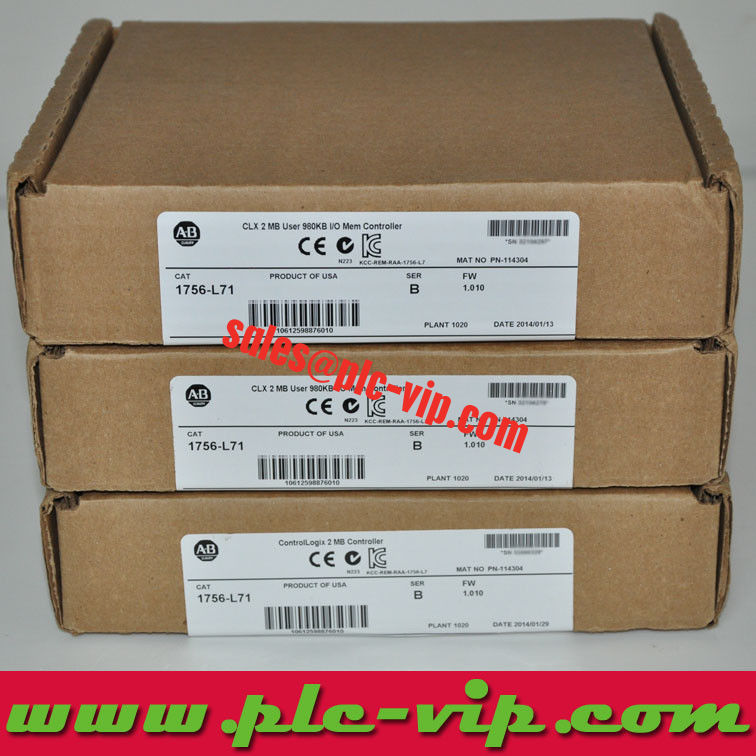
The 1756-L61 (also written 1756L61) is the 2 MB controller of the ControlLogix 5560 range: one chassis slot, one RS-232 serial port, and the backplane through which it reaches every communication and I/O module in the rack. Rockwell lists it as discontinued since 1 June 2017, replacement category functional replacement — the installed base, not the catalogue, is where these controllers still run.
The published figures are 2 MB of user memory against 478 KB of I/O memory, a ceiling of 128,000 digital and 4,000 analogue I/O points, 32 tasks with 100 programs per task, and 250 controller connections (1756-TD003-equivalent Table in 1756-TD001S). Current draw is 1200 mA at 5.1 V DC plus 14 mA at 24 V DC, dissipating 3.5 W and 11.9 BTU/hr; isolation is 30 V continuous basic insulation from the RS-232 port to the system, compliant and tested to IEC/UL 61010-1.
Application |
Programmable Logic Controller |
Brand Name |
Rockwell (Rockwell) |
Cat Num |
1756-L61 |
Communication |
Backplane (EtherNet/IP, ControlNet, DeviceNet, DH+, Remote I/O, SERCOS) |
Display |
Indicators (OK, RUN, I/O, FORCE, BATTERY, RS-232) |
Enclosure |
None (open-style) |
Interface |
1 RS-232 serial port |
Mounting |
Chassis |
Number Of Channels |
1 |
Standard |
CCC,CE,CSA,C-TICK,CUL,GOST,KC,MARINE,NRTL,RCM,UL
Vendor attribute list — the current Rockwell certification record, with certificate and file numbers, is in the FAQ. |
Sub Brand |
ControlLogix |
Type |
Controller |
UNSPSC |
32151705 |
Attribute values above are reproduced from the manufacturer's product data. For the authoritative technical record see Rockwell publications 1756-TD003 (module specifications) and 1756-UM001 (ControlLogix controller user manual). Certification details, with certificate and file numbers, are listed in the FAQ below.
Where the module sits in a typical system
The 2 MB ceiling is what defines this controller: a machine with a modest I/O count, a few hundred ladder rungs and no coordinated motion. Where a line needs SERCOS or EtherNet/IP motion, the same chassis uses a larger 5560 controller or moves to the 5570 family — the memory, not the instruction set, is the limit here.
Its 250 connections are shared across everything the chassis talks to: each produced or consumed tag, each I/O module connection and each HMI session draws from that budget. On a line with several panels and two HMIs, that number is reached before the memory is.
Commissioning in five steps
- Confirm the controller and chassis are on a supply that covers 1200 mA at 5.1 V DC plus 14 mA at 24 V DC, and that the battery is the one the series needs — 1756-BA1, BA1M or BATA for Series A, 1756-BA2 for Series B.
- Set the serial port before the first download: DF1 full duplex at the project's own settings is the default path for a programming terminal, and the port is RS-232 through a 1756-CP3 or 1747-CP3 cable.
- Load firmware that the project was written for, then download. A 5560 controller at an older revision rejects a project built at a newer one, so the revision is checked first.
- Insert the controller in any chassis slot — it is not restricted to slot 0 — and start the chassis before the I/O modules are expected online.
- Read the indicators after the first power-up: OK, RUN, I/O, FORCE, BATTERY and RS-232. A red I/O indicator with a running program is a module that did not come online, not a controller fault.
Diagnostics: status indicators
Three bi-colour indicators plus the alphanumeric display cover almost every commissioning fault, so most problems are resolved at the panel without a laptop.
| Indicator |
State |
Meaning and first action |
| OK |
Flashing green |
Power-up self-test in progress; wait for solid. |
| OK |
Red |
Major fault or self-test failure. Read the fault in the project before any restart. |
| RUN |
Green solid |
Program running. |
| RUN |
Red |
Major fault latched; the program is stopped. |
| I/O |
Green solid |
All configured I/O modules are communicating. |
| I/O |
Flashing green |
One or more configured modules are not responding. |
| I/O |
Red |
Faulted I/O connection; the program may still be running. |
| FORCE |
Amber |
Forces are enabled in the project — a live wiring check is not valid while this is lit. |
| BATTERY |
Red |
Battery low or missing; the project in RAM is not protected across a power cycle. |
| RS-232 |
Green flashing |
Serial activity on the programming port. |
Indicator behaviour per Rockwell publication 1756-UM001 (ControlLogix 5570 and 5560 Controllers User Manual) and 1756-IN050.
Replacing a 1756-ENBT
Rockwell discontinued the 1756-L61 on 1 June 2017 with the replacement category listed as functional replacement. The functional successor is not another 5560 controller but a 5570 or 5580 part: 1756-L71E/L72E/L73E for a like-for-like rack, or the 5580 L8xE where the chassis is being rebuilt around EtherNet/IP and CIP Security.
The migration is a project change, not a swap. Program memory is re-sized, the serial port gives way to USB plus an embedded Ethernet port, and the CIP packet rate rises — all of which means the program is re-verified on the bench before the panel goes back into the line.
Which ControlLogix 5560 controller to specify
- 1756-L61 — 2 MB user memory. Smallest 5560 controller; enough for a line with a few I/O modules and no motion.
- 1756-L62 — 4 MB. One step up; the usual choice where a 2 MB program left no room for edits.
- 1756-L63 — 8 MB. The workhorse of the 5560 range, and the one most installed bases are built around.
- 1756-L65 — 32 MB. Largest 5560 memory; scan time for a project in this controller can be slower than the same project in the smaller 5560 models.
- 1756-L63XT — the 5560 controller in the XT range, for -25…+70 °C panels.
- 1756-L71 / L72 / L73 (5570) — the current family, 1 MB to 32 MB with USB and higher packet rates. The functional replacement path from the 5560 controllers.
FAQ — ControlLogix 1756-L61 / 1756L61 2 MB Controller
How much memory does the 1756-L61 have?
2 MB of user memory and 478 KB of I/O memory, with a maximum of 128,000 digital and 4,000 analogue I/O points (1756-TD001S, ControlLogix 5560 Controllers). Non-volatile storage is the 1784-CF128 CompactFlash card at 128 MB.
Is the 1756-L61 still available from Rockwell?
No. Rockwell lists it as discontinued as of 1 June 2017, replacement category functional replacement. Units in the field are supported as spares; new builds use the 5570 or 5580 families.
What does it draw from the backplane?
1200 mA at 5.1 V DC and 14 mA at 24 V DC, dissipating 3.5 W and 11.9 BTU/hr, one slot wide (1756-TD001S). That 1200 mA is the figure to add to the module budget before the chassis supply is chosen.
Which communication options does it support?
EtherNet/IP, ControlNet, DeviceNet, Data Highway Plus, Remote I/O, SERCOS and third-party process and device networks — all through modules in the same chassis. The controller itself has one RS-232 port carrying ASCII, DF1 full and half duplex, DF1 radio modem, DH-485 and Modbus via logic.
How many connections can it hold?
250 controller connections (1756-TD001S). Produced and consumed tags, I/O module connections and HMI sessions all count against that same 250, so a large tag set and several panels exhaust it before memory does.
Which chassis and power supplies are approved?
1756-A4, A7, A10, A13 or A17, any slot, one slot wide. Standard supplies 1756-PA50, PA72, PA75, PB50, PB72, PB75; redundant 1756-PA75R, PB75R or PSCA2. Wire category 2 applies on the RS-232 port.
What are its environmental limits?
Operating 0…60 °C with 60 °C maximum surrounding air, storage -40…85 °C, 5…95% RH non-condensing, 2 g vibration at 10…500 Hz, 30 g operating and 50 g non-operating shock, CISPR 11 Class A, ESD 6 kV contact and 8 kV air, radiated RF immunity 10 V/m from 80…2000 MHz and 3 V/m from 2000…2700 MHz, EFT ±4 kV at 5 kHz and surge ±2 kV line-earth on the RS-232 port, conducted RF 10 V rms from 150 kHz…80 MHz (1756-TD001S).
Which certifications does the controller carry?
c-UL-us UL E65584 and Class I Division 2 UL E194810, CSA LR54689C and LR69960C, CE to 2004/108/EC, RCM, ATEX 94/9/EC II 3 G Ex nA IIC T4 X under LCIE01ATEX6020X, KC and FM Class I Division 2 (1756-TD001S). The ATEX entry is withheld for the 1756-L64 and L65; the L61 carries it.
What is the difference between this and the 1756-L62?
Memory only: 2 MB against 4 MB. Both are 5560 controllers with the same RS-232 port, 250 connections, 128,000 digital I/O ceiling, 1200 mA draw and 3.5 W dissipation, and both were discontinued on 1 June 2017.
Data sources. Technical values on this page come from Rockwell publications 1756-TD001 (ControlLogix and GuardLogix Controller Specifications) and 1756-UM001 (ControlLogix 5570 and 5560 Controllers User Manual) and the manufacturer's product page for 1756-L61. Values re-checked 15 November 2026.