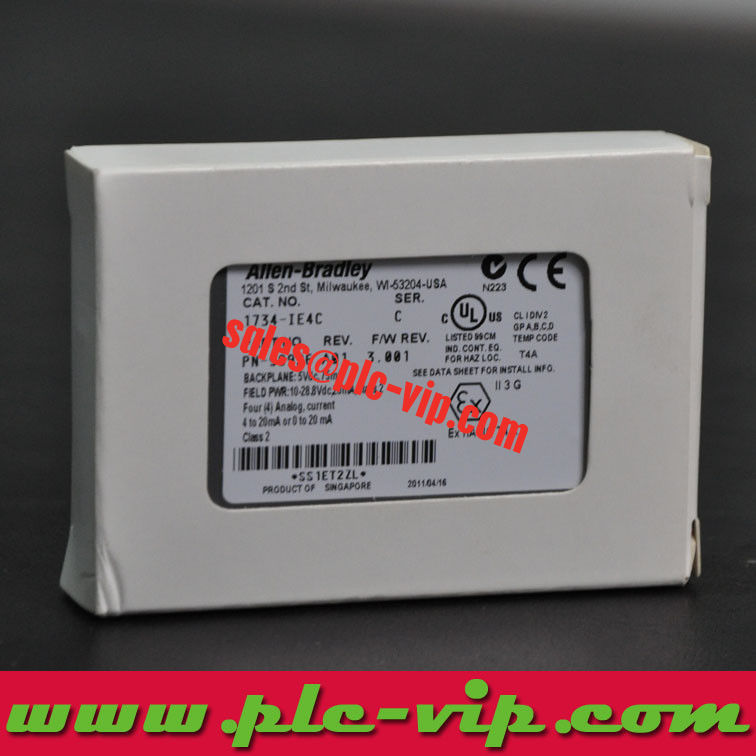
POINT I/O 1734-IM2 / 1734IM2 2-Channel AC Input Module
Category:
PLCs, Power Supplies & I/Os
Manufacturer:
Rockwell
Group:
POINT I/O AC Input Module
The 1734-IM2 takes 2 nonisolated sinking AC inputs on one slice, 8.5 mA at 220V AC. No external relay or interface card is needed between a 120V or 220V field contact and the POINTBus.
Because the input is sinking and nonisolated, all points share one common and the field supply must come from a source that matches the module voltage class exactly: 159V AC...264V AC.
Product Specifications 1734-IM2 (PDF)
Number of inputs |
2 (1 group of 2), nonisolated, sinking |
Voltage, on-state, nom |
220V AC |
Voltage, on-state range |
159V AC...264V AC |
Voltage, off-state, max |
43V AC |
Current, on-state, nom |
8.5 mA @ 220V AC, 60 Hz |
Current, on-state range |
6.2 mA @ 159V AC...10.2 mA @ 264V AC, 60 Hz |
Impedance, input, nom |
22.3 kOhm |
Input filter time |
20 ms hardware filter plus 1...65 ms digital filter, programmable in 1 ms steps |
POINTBus current, max |
75 mA @ 5V DC |
Power dissipation, max |
0.48 W @ 264V AC |
Thermal dissipation, max |
1.63 BTU/hr @ 264V AC |
Isolation voltage |
240V (continuous), type tested at 3250V DC for 60 s, field side to system |
External AC power supply |
220V AC @ 60 Hz, 159...264V AC, 47...63 Hz |
Terminal base |
1734-TB, 1734-TBS, 1734-TOP or 1734-TOPS |
Wiring category |
1 - on signal ports |
Keyswitch position |
8 |
Dimensions, HxWxD |
56.0 x 12.0 x 75.5 mm |
Weight, approx |
30.9 g |
Temperature, operating |
-20...55 deg C (-4...131 deg F), T4A |
Attribute values above are reproduced from the manufacturer's product data. For the authoritative technical record see Rockwell publications 1734-SG001E-EN-P (module specifications) and 1734-UM001 (installation instructions). Certification details, with certificate and file numbers, are listed in the FAQ below.
Voltage window and off-state guard
On-state range 159V AC...264V AC, off-state guaranteed below 43V AC. That gap is what keeps a 120V circuit from reading a stray 40V induced level as a valid ON, and it is the reason this module tolerates long field wiring runs next to contactor coils.
Input current sets the load on the field device
Nominal 8.5 mA @ 220V AC, 60 Hz, with a working range of 6.2 mA @ 159V AC...10.2 mA @ 264V AC, 60 Hz. A dry contact or a small pilot relay has to carry that current reliably at the low end of the range; a sealed reed rated for switching only 1 mA may not wet properly, so check the device's minimum load before dropping a 2-point slice into a panel full of low-current sensors.
Filter: 20 ms hardware plus a digital window
Every Series C AC input slice carries a 20 ms hardware filter, then a digital filter from 1 to 65 ms set in 1 ms steps. Twenty milliseconds is already longer than a half cycle at 60 Hz, so the hardware stage alone rejects most contact bounce; the digital stage is for a noisy bus, not for speed. Do not expect this slice to catch a 10 ms pulse.
Supply, isolation and base
External supply 220V AC @ 60 Hz, 159...264V AC, 47...63 Hz. Isolation is 240V continuous, type tested at 3250V DC for 60 s from field side to system - the highest test level in the POINT I/O digital family, which is what a 220V circuit demands. The slice fits a TB, TBS, TOP or TOPS base at keyswitch position 8 and dissipates 0.48 W @ 264V AC.
Cost per point versus a DC slice
A 2-point AC slice removes four or eight interposing relays, their DIN rail, and the wiring between relay coil and input. On a panel that switches 120V pushbuttons and level switches directly, the saving is real; on a panel already built around 24V DC, stay with a DC slice and keep one voltage class in the cabinet. The four AC input slices share one 30.9 g moulding and one keyswitch position, so keeping a single spare on the shelf covers 2 and 4 point duties in either voltage class.
FAQ — 1734-IM2
What is the difference between 1734-IM2 and 1734-IA2?
Voltage class only: IM2 is 220V AC nominal from 159V AC to 264V AC, IA2 is 120V AC nominal from 65V AC to 132V AC. Both are two-point nonisolated sinking slices with a 20 ms hardware filter.
Can 1734-IM2 be used on a 120V circuit?
No. 159V AC is the lowest on-state voltage; a 120V signal never guarantees an ON state.
What current does each point draw at 220V?
8.5 mA nominal, 6.2 mA at 159V AC and 10.2 mA at 264V AC.
What isolation does it provide?
240V continuous, type tested at 3250V DC for 60 s, field side to system; the two points are not isolated from each other.
Which base does it need?
1734-TB, 1734-TBS, 1734-TOP or 1734-TOPS at keyswitch position 8, with a 220V AC external supply.
Data sources. Technical values on this page come from Rockwell publication 1734-SG001E-EN-P (POINT I/O Modules Selection Guide) and 1734-UM001. Any attribute the publication does not print is marked Not published rather than taken from a distributor page. Catalog number, packaging and stock status are the stock record of this listing.