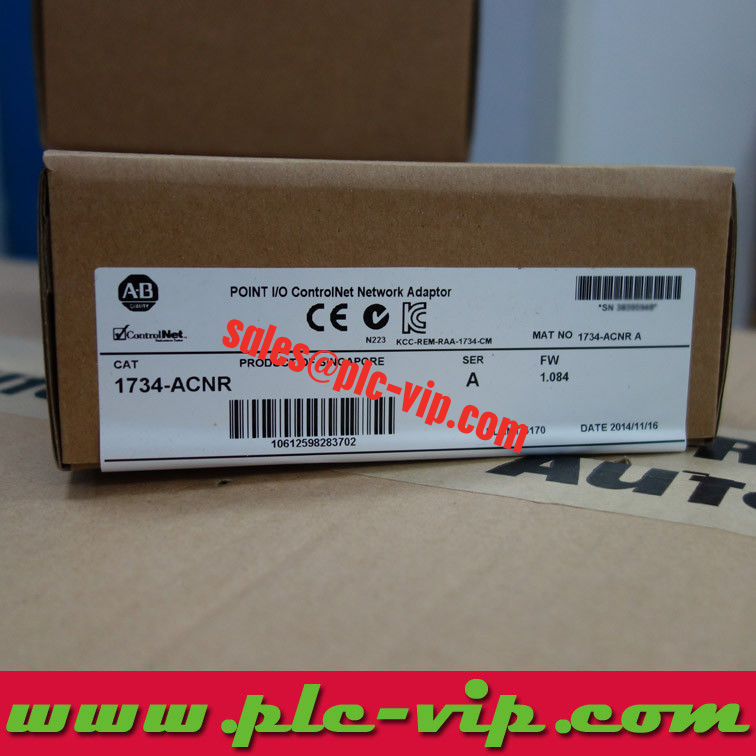
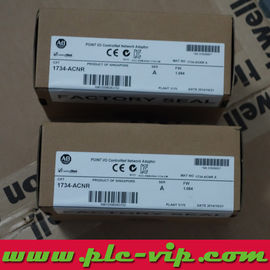
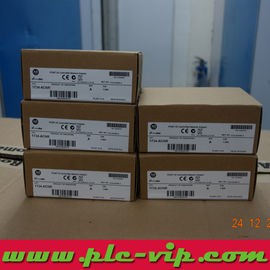
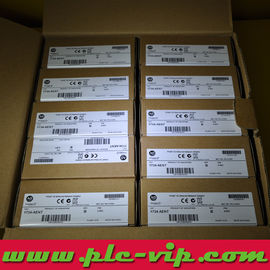
POINT I/O 1734-ACNR / 1734ACNR ControlNet Redundant Adapter
Category:
PLCs, Power Supplies & I/Os
Manufacturer:
Rockwell
Group:
POINT I/O Communication Adapter
The 1734-ACNR is the ControlNet head of a POINT I/O assembly with two coaxial channels, A and B, so the adapter keeps talking to the controller when one trunk cable or one tap fails.
It carries 17 modules on its internal 1 A POINTBus supply, addresses 248 output bytes, and consumes 10.2 W at 28.8V DC - which is more than the EtherNet/IP equivalent, because the ControlNet physical layer is built into the adapter.
Product Specifications 1734-ACNR (PDF)
Network |
ControlNet, redundant media, coaxial channel A and channel B |
Node address |
2-position thumbwheel, 01...99 |
Expansion I/O capacity |
Up to 17 modules at 75 mA each (1.275 A), further modules need an expansion power supply |
POINTBus output current, max |
1 A @ 5V DC (4.75...5.25V DC) |
Input voltage rating, nom |
24V DC, range 10...28.8V DC |
Field side power requirement, max |
425 mA @ 24V DC (+20% = 28.8V DC) |
Field power bus supply current, max |
10 A |
Inrush current |
6 A for 10 ms |
Output byte capacity |
248 bytes |
Isolation voltage |
50V continuous, Basic insulation, type tested 750V AC for 60 s |
Power consumption |
10.2 W @ 28.8V DC |
Processor compatibility |
1747, 1756, 1761, 1762, 1764, 1789, 1794 |
Temperature code |
T4A (North American) |
Operating temperature |
-20...55 °C |
Dimensions, HxWxD |
76.2 x 54.9 x 133.4 mm |
Weight, approx |
255 g |
Attribute values above are reproduced from the manufacturer's product data. For the authoritative technical record see Rockwell publications 1734-IN582 (module specifications) and 1734-UM008 (installation instructions). Certification details, with certificate and file numbers, are listed in the FAQ below.
What media redundancy actually protects
Two coax channels are not two networks: both carry the same ControlNet traffic and the receiver picks the healthy channel. A cut trunk, a failed tap or a loose BNC on one segment therefore costs a re-tune, not a shutdown. What it does not protect is the adapter itself, the POINTBus, or the modules - those remain single points of failure and must be covered by spare parts rather than by the redundant cabling.
17 modules, and why the arithmetic matters
The published expansion table works through 17 modules at 75 mA, which is 1.275 A. The adapter's POINTBus output is rated 1 A at 5V DC, so a stack of analog or relay modules reaches the ceiling well before 17 slots. Design to the 1.0 A rating and insert a 1734-EP24DC where the budget runs out, rather than trusting the module count.
Node address 01...99
A 2-position thumbwheel selects 01 to 99 - the deepest node range of any POINT I/O adapter, which is what a large ControlNet segment needs. The address is read at power-up, so changing it means a power cycle; the adapter is then scheduled by the ControlNet scanner like any other node.
Isolation is 750V AC, not 2550V DC
50V continuous, Basic insulation, type tested at 750V AC for 60 s between communication, user power and chassis. That is a logic-level barrier for a coax network - it is not a substitute for separating the assembly's 24V field wiring from mains circuits elsewhere in the panel.
Series C modules only
Rockwell states that only Series C POINT I/O modules work with the 1734-ACNR; Series A and B modules do not. A like-for-like replacement of an older ControlNet adapter therefore becomes a module audit as well, and the spare-parts list has to be checked before the swap, not after.
Where the 10.2 W goes
At 28.8V DC the adapter consumes 10.2 W and passes up to 10 A of field power to the modules, with 425 mA taken for itself. In a 76.2 x 54.9 x 133.4 mm housing weighing 255 g, the heat is concentrated at one end of the stack, so vertical clearance above the assembly and the enclosure's internal circulation decide whether the 55 deg C ambient limit is actually held.
FAQ — 1734-ACNR
What does redundant media mean on 1734-ACNR?
The adapter has two coaxial ControlNet channels, A and B, carrying the same traffic so a failed cable or tap on one segment does not stop communication. The adapter, POINTBus and modules are still single points of failure.
How many modules can 1734-ACNR support?
Up to 17 modules at 75 mA each, but the POINTBus output is 1 A at 5V DC. Add the current of every module and use 1734-EP24DC expansion supplies beyond that.
What node addresses are available?
01 to 99, set with the 2-position thumbwheel, and read at power-up.
What isolation voltage does the adapter have?
50V continuous, Basic insulation, type tested at 750V AC for 60 s - a logic-level barrier, not a mains barrier.
Does 1734-ACNR work with Series A or B modules?
No. Only Series C POINT I/O modules are supported by the 1734-ACNR.
Data sources. Technical values on this page come from Rockwell publication 1734-IN582 (POINT I/O ControlNet Adapter 1734-ACNR, 1734-ACRNK) and 1734-UM008 (POINT I/O ControlNet Adapter 1734-ACNR User Manual). Any attribute the publication does not print is marked Not published rather than taken from a distributor page. Catalog number, packaging and stock status are the stock record of this listing.