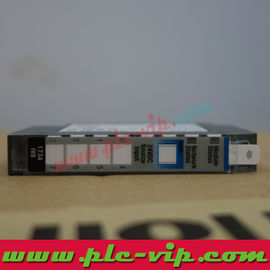
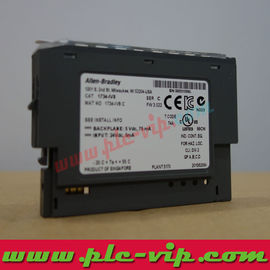
POINT I/O 1734-IV8 / 1734IV8 8-Channel 24V DC Sourcing Input Module
Category:
PLCs, Power Supplies & I/Os
Manufacturer:
Rockwell
Group:
POINT I/O DC Input Module
The 1734-IV8 is the sourcing counterpart of the 1734-IB series: instead of sinking current from a powered sensor, it feeds the input circuit from field power and expects the sensor to pull that point low. 8 points on one slice, 24V DC nominal.
That direction matters at commissioning. A sourcing input is wired to a sinking sensor or a dry contact to common, and reversing the two is the single most common cause of a slice that reads all eight points ON.
Product Specifications 1734-IV8 (PDF)
Number of inputs |
8 (1 group of 8), sourcing |
Voltage, on-state, nom |
24V DC |
Voltage, on-state range |
11...28.8V DC |
Voltage, off-state range |
-3...+5V DC |
Current, on-state range |
2...15 mA |
Current, off-state, max |
1.5 mA |
Input filter time |
0.5 ms hardware plus 0...65 ms selectable |
POINTBus current, max |
75 mA @ 5V DC |
Power dissipation, max |
1.2 W @ 28.8V DC |
Thermal dissipation, max |
4.1 BTU/hr @ 28.8V DC |
Isolation voltage |
50V (continuous), reinforced insulation, type tested at 2500V DC for 60 s, field side to system |
External DC power supply |
None required - the module sources its inputs from field power |
Terminal base |
1734-TB or 1734-TBS |
Keyswitch position |
1 |
Dimensions, HxWxD |
56 x 12 x 75.5 mm |
Weight, approx |
32.32 g |
Temperature, operating |
-20...55 deg C (-4...131 deg F), T4A |
Same-family catalog numbers: 1734-IV4. Each of those catalogue numbers has its own stock page on this store; this page covers what differs in the 1734 family.
Attribute values above are reproduced from the manufacturer's product data. For the authoritative technical record see Rockwell publications 1734-SG001E-EN-P (module specifications) and 1734-UM001 (installation instructions). Certification details, with certificate and file numbers, are listed in the FAQ below.
Sourcing is not a preference, it is a wiring direction
With a sourcing input the module supplies the wetting current and the field device sinks it. A PNP sensor drops straight in; an NPN sensor will not, and neither will a sinking-output photoeye. Decide the sensor family before ordering the slice, because the two directions are not field-convertible.
11V to 28.8V is the usable window
On-state starts at 11V DC, off-state is guaranteed between -3V and +5V DC. The upper bound is 28.8V, so a nominal 24V supply with normal tolerance is inside the window and a 30V rail is not. Reverse polarity on the field supply is handled by the module, but a sustained 30V still sits above the rating.
2 to 15 mA per point
On-state current range 2...15 mA, off-state leakage up to 1.5 mA. The 2 mA floor is what wets a dry contact; a sensor that only sources 500 uA may never cross it, which reads as a stuck-off point. Leakage above 1.5 mA from a failed sensor or a long shielded run reads as a stuck-on point.
Filter and heat
0.5 ms hardware filter plus a 0...65 ms selectable digital window. The hardware stage is short enough for a counter-style signal at low speed; the digital stage is the debounce for mechanical contacts. Dissipation is 1.2 W @ 28.8V DC per slice at 28.8V DC - 4.1 BTU/hr @ 28.8V DC BTU/hr - and the slice draws 75 mA from the 5V POINTBus.
Where a sourcing slice earns its place
Panels that already run PNP sensors, or that feed inputs from a common positive rail, save the interposing relays and the extra terminal blocks when they use 1734-IV8 instead of a sinking slice. The isolation is 50V reinforced, type tested at 2500V DC for 60 s, the same envelope as the IB family, so replacing an IB slice with an IV slice does not change the panel's segregation plan.
FAQ — 1734-IV8
How many sourcing inputs does 1734-IV8 have?
Eight, in one group of eight, 24V DC nominal with an on-state range of 11...28.8V DC.
What is the power dissipation?
1.2 W at 28.8V DC, 4.1 BTU/hr - the highest of the DC input slices because eight points share one moulding.
Can a 30V supply be used?
No. 28.8V DC is the maximum on-state voltage; a sustained 30V rail is outside the rating.
Which terminal bases are listed?
1734-TB or 1734-TBS at keyswitch position 1. The one-piece TOP/TOPS bases are not listed for the IV family.
What happens if an NPN sensor is wired to it?
The point never sources current into a sinking sensor, so it reads OFF regardless of the sensor state - swap to a sinking slice instead.
Data sources. Technical values on this page come from Rockwell publication 1734-SG001E-EN-P (POINT I/O Modules Selection Guide) and 1734-UM001. Any attribute the publication does not print is marked Not published rather than taken from a distributor page. Catalog number, packaging and stock status are the stock record of this listing.