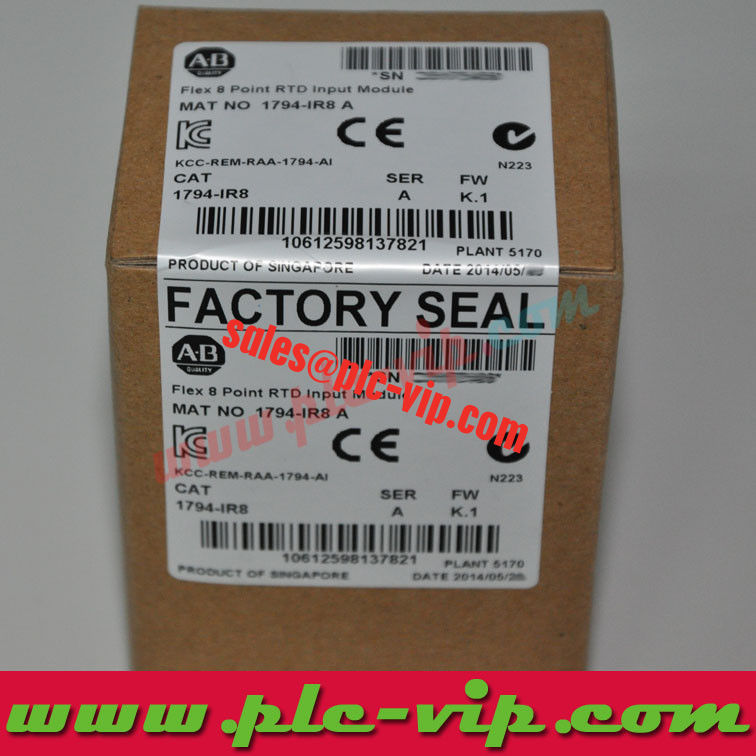
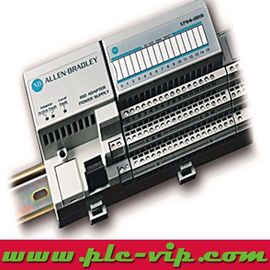
FLEX I/O 1794-IR8 / 1794IR8 8-Channel RTD Input Module
Category:
PLCs, Power Supplies & I/Os
Manufacturer:
Rockwell
Group:
PLC I/O
The 1794-IR8 measures eight resistance temperature detectors: 16-bit resolution across a 435 Ohm span, 718.39 uA excitation, and a per-channel throughput programmable from 28 to 325 ms.
It is the RTD card for slow but accurate temperature work — bearing temperatures, tank and pipe sensors, and any Pt100 or Ni120 installation where a 0.05% reading matters more than a fast update.
Product Specifications 1794-IR8 (PDF)
Application |
FLEX I/O RTD input, 1794 terminal base |
Cat Num |
1794-IR8 |
Brand Name |
Rockwell |
Channels |
8, 2-wire and 3-wire RTD |
Input range |
1...433 Ohm |
Resolution |
16 bits across 435 Ohm |
Throughput |
Programmable 28...325 ms per channel |
Excitation current |
718.39 uA |
Accuracy |
0.05% of full scale normal mode, 0.01% enhanced mode |
Common mode rejection |
-120 dB at 60 Hz, -100 dB at 50 Hz |
Overvoltage |
35V DC, 25V AC continuous; 250V peak transient |
External supply current |
140 mA at 24V DC |
Power dissipation |
3 W at 31.2V DC (10.2 BTU/hr) |
Operating temperature |
-20...55 deg C |
Attribute values above are reproduced from the manufacturer's product data. For the authoritative technical record see Rockwell publications 1794-DU001 (module specifications) and 1794-SG002 (installation instructions). Certification details, with certificate and file numbers, are listed in the FAQ below.
Resistance measurement
1...433 Ohm input span, 16 bits resolution across 435 Ohm, which is the whole Pt100 range from -200 to +870 deg C in one span.
718.39 uA excitation current keeps self-heating in the element low, which is the reason for a low excitation rather than a convenient 1 mA.
Two-wire and three-wire RTDs are both accepted; three-wire cancels the lead resistance that a two-wire connection adds to the reading.
Sensor support includes Pt100 and Pt200 at 0.00385 and 0.003916, Pt500, Ni100, Ni120, Ni200, Ni500 and Cu10,each with its own published temperature range.
Open RTD detection reads upscale,so a broken element produces an out-of-range value rather than a plausible low temperature.
Throughput and accuracy
28...325 ms per channel programmable is 2.6 s for eight channels at the slow end and 224 ms at the fast end.
0.05% of full scale normal mode without calibration, and 0.01% typical in enhanced mode, which is the accuracy that justifies an RTD over a thermocouple.
Common mode rejection of -120 dB at 60 Hz and -100 dB at 50 Hz is what makes a grounded, slow temperature loop readable in a drive cabinet.
Normal mode rejection of 60 dB at 60 Hz with the A/D filter at 15 Hz is the published figure for line-frequency hum.
Gain drift of 20 ppm/deg C in normal mode and 10 ppm/deg C in enhanced mode is the term that dominates an accuracy budget over a wide cabinet temperature.
Electrical protection and supply
35V DC or 25V AC continuous and 250V peak transient overvoltage capability covers a miswired 24V supply or a surge on a long sensor cable.
140 mA at 24V DC from the external supply and 3 W dissipation (10.2 BTU/hr) are the two figures for the panel heat budget.
Channel bandwidth of DC to 2.62 Hz is deliberate: the card is not intended to see a step, only a temperature.
The derating curve publishes the safe operating area for user-applied 24V supply voltages against ambient temperature, with the 24V line flat to 40 deg C.
Common mode voltage is 0V between channels, with a common return — an RTD is not an isolated input on this card.
Wiring practice
Three-wire RTDs land the two element leads and the return, so the lead resistance appears in both directions and cancels in the measurement.
Keep the RTD cable away from switching conductors; the excitation is microamps and the signal is correspondingly small.
Shielded cable with the shield at the module is normal practice; the card's RFI immunity is specified as under 1% error at 10 V/m from 27 to 1000 MHz.
One channel per sensor, no sharing:the excitation current is per channel and a shared element would corrupt both readings.
Open-circuit detection is available at the system throughput rate,so a broken lead is reported on the next scan rather than never.
Where it fits
Pt100 process temperatures where an accuracy of 0.05% of full scale is the requirement.
Slow, stable loops — the 2.62 Hz bandwidth is not a limitation for a tank or a bearing.
Not for fast temperature such as a thermocouple on a fast cycle; the 1794-IRT8 publishes 8–10 ms throughput.
Not for thermocouples.The IR8 has no cold junction compensation; a thermocouple needs the 1794-IRT8 or 1794-IT8.
FAQ — 1794-IR8
How many RTDs can the 1794-IR8 read?
Eight, using 2-wire or 3-wire RTD connections.
What is the resolution?
16 bits across a 435 Ohm span, with a 1...433 Ohm input range.
How accurate is it?
0.05% of full scale in normal mode and 0.01% typical in enhanced mode, without calibration.
How fast does it update?
Programmable from 28 to 325 ms per channel, 2.6 s for eight channels at the slow setting.
What excitation current does it supply?
718.39 uA per channel.
Does it support thermocouples?
No. Cold junction compensation is in the 1794-IRT8 and 1794-IT8, not in the IR8.
Data sources. Technical values on this page come from Rockwell publication 1794-SG002 (FLEX I/O Selection Guide, Table 19 and Table 26) and 1794-IN093. Any attribute the publication does not print is marked Not published rather than taken from a distributor page. Catalog number, packaging and stock status are the stock record of this listing.