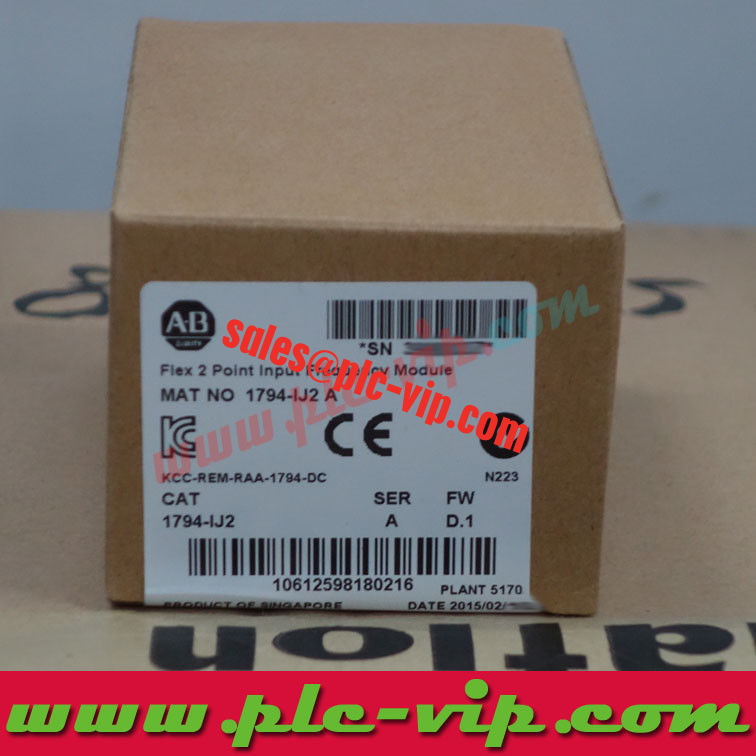
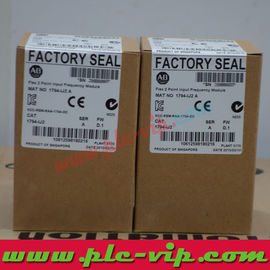
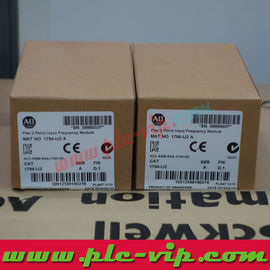
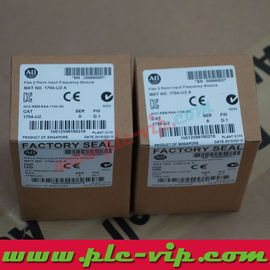
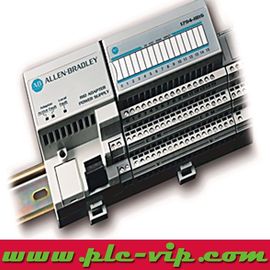
FLEX I/O 1794-IJ2 / 1794IJ2 Frequency Input Module
Category:
PLCs, Power Supplies & I/Os
Manufacturer:
Rockwell
Group:
PLC I/O
The 1794-IJ2 reads two frequency inputs from 1 to 32 kHz, converts them into rate or totaliser values in 4 ms, and drives two isolated 24V outputs from the same module.
Flow meters, turbine pickups, encoder pulse trains and proximity switches that switch faster than a digital input can count all land on this card, and the two outputs let it act as a stand-alone batch or rate alarm unit.
Product Specifications 1794-IJ2 (PDF)
Application |
FLEX I/O frequency input, 1794 terminal base |
Cat Num |
1794-IJ2 |
Brand Name |
Rockwell |
Inputs |
2 frequency inputs, A and B, gate and counter |
Frequency range |
1...32 kHz, sine wave or square wave |
Processing time |
4 ms or less |
Minimum pulse width |
20 us |
On-state |
10, 24 or 31.2V at 2.0, 9.0 and 10.0 mA |
Off-state |
5V at 1.5 mA |
Wire-off detection |
0.4 mA through a 50 kOhm shunt |
Outputs |
2 isolated 24V DC outputs, 1.0 A per channel |
Isolation |
2 groups, 30 mA isolated 24V supply |
External supply current |
220 mA at 19.2V, 180 mA at 24V, 140 mA at 31.2V |
Power dissipation |
4.5 W at 31.2V DC (15.3 BTU/hr) |
Operating temperature |
-20...55 deg C |
Attribute values above are reproduced from the manufacturer's product data. For the authoritative technical record see Rockwell publications 1794-DU001 (module specifications) and 1794-SG002 (installation instructions). Certification details, with certificate and file numbers, are listed in the FAQ below.
Frequency input
Two channels, 1...32 kHz, accepting sine wave from a magnetic pickup or square wave from a solid-state sensor.
A minimum pulse width of 20 us is the limit that rules out a slow mechanical contact; a bouncing relay will not produce a clean count.
Processing time of 4 ms or less is the module's own update, separate from the adapter's scan.
The on-state thresholds are 10, 24 and 31.2V at 2.0, 9.0 and 10.0 mA, and the off-state is 5V at 1.5 mA, which defines the sensor drive requirement.
Input impedance is above 5 kOhm for a 50 or 500 mV magnetic pickup, above 10 kOhm for a 3V or 6V vortex sensor, and above 2.5 kOhm for a 24V IEC type 1+ input or a dry contact.
Wire-off and outputs
Wire-off detection uses 0.4 mA through a 50 kOhm shunt, which is how an open pickup coil is reported instead of being read as zero speed.
Two outputs rated 1.0 A per channel, 2 A for 50 ms every 2 s, with a 0.9V drop at 1 A.
Turn-on is under 0.5 ms and turn-off under 1 ms, so the output can follow a rate threshold rather than only a slow alarm.
Two groups of 30 mA isolated 24V supply let the outputs drive two separate field circuits.
Supply and environment
220 mA at 19.2V, 180 mA at 24V and 140 mA at 31.2V — the current falls as the supply rises, which is the module's own regulator behaviour.
4.5 W at 31.2V DC (15.3 BTU/hr) is the heat to add to the enclosure.
-20...55 deg C on the standard version; the 1794-IJ2XT publishes -20...70 deg C.
1...32 kHz is a published window, not a suggestion: below 1 kHz the resolution of the rate calculation degrades and a digital input with a timer is the better instrument.
Wiring practice
Mag pickup inputs want shielded twisted pair, with the shield at the panel; the 50 kOhm shunt path is sensitive to induced noise at low signal levels.
Check the sensor's output at minimum speed, because the 10V on-state at 2.0 mA has to be met at the slowest tooth rate, not at the rated speed.
The two outputs are isolated from the inputs, so a field-side relay or solenoid can sit at a different reference from the pickup.
Grounding the pickup shield at one end only avoids a circulating current through the sensor body.
Where it fits
Flow totalisation and rate alarms with two channels and two outputs in one slot.
Turbine and positive-displacement meter pickups from 1 kHz upward.
Not for quadrature encoder position — the 1794-VHSC decodes A, B and Z with x1, x2 and x4 multiplication.
Not for slow contact counting; a digital input module with a timer instruction is cheaper and adequate.
FAQ — 1794-IJ2
What frequency range does the 1794-IJ2 accept?
1...32 kHz, sine wave or square wave, with a minimum pulse width of 20 us.
How many channels has it?
Two frequency inputs plus two isolated 24V DC outputs.
How fast does it process?
4 ms or less, independent of the adapter scan.
What sensor thresholds apply?
On-state 10, 24 or 31.2V at 2.0, 9.0 and 10.0 mA; off-state 5V at 1.5 mA.
Does it detect an open sensor?
Yes, by 0.4 mA through a 50 kOhm shunt on the input.
What current does the module draw?
220 mA at 19.2V, 180 mA at 24V or 140 mA at 31.2V.
Data sources. Technical values on this page come from Rockwell publication 1794-SG002 (FLEX I/O Selection Guide, Table 37) and 1794-IN093. Any attribute the publication does not print is marked Not published rather than taken from a distributor page. Catalog number, packaging and stock status are the stock record of this listing.
Which counter module fits the pulse train
Five FLEX I/O modules read pulses, and they are not interchangeable: the choice is decided by whether the signal needs quadrature decoding, by the fastest edge the process produces, and by whether the card has to act on its own without the adapter scan.
| Catalog number | Channels | Frequency | Min pulse width | Outputs | Operating temperature |
|---|
| 1794-IJ2 | 2 frequency inputs, A and B, gate and counter | 1...32 kHz, sine wave or square wave | 20 us | 2 isolated 24V DC outputs, 1.0 A per channel | -20...55 deg C |
| 1794-IJ2XT | 2 frequency inputs with gate and counter | 1...32 kHz, sine wave or square wave | 20 us | 2 isolated 24V DC outputs, 1.0 A per channel | -20...70 deg C |
| 1794-VHSC | 2 groups, A/A, B/B and Z/Z inputs | 1 MHz at x1, 500 kHz at x2, 250 kHz at x4 | Not published | 5...7V or 10...31V, 0.5 or 1.0 A per output | 0...55 deg C |
| 1794-ID2 | 2 counter channels | 100 kHz | 2 ms | Not published | 0...55 deg C |
| 1794-IP4 | 4 counter channels | 100 kHz | Not published | Not published | 0...55 deg C |
The 1794-IJ2 and 1794-IJ2XT sit on the frequency side: sine wave from a magnetic pickup or square wave from a solid-state sensor, 1...32 kHz, with a 50 kOhm shunt that reports an open coil instead of reading zero speed, and two isolated 24V outputs that let the card trip a diverter without involving the PLC.
The 1794-VHSC is the position card. Two axes of A, B and Z reach 1 MHz at x1, and the multiplication used costs bandwidth — 500 kHz at x2 and 250 kHz at x4 — while eight compare windows fire the outputs with a 25 us turn-on, which is what a registration correction needs.
The 1794-ID2 and 1794-IP4 are totalisers. The ID2 carries A, B, Z and a hardware gate on two channels and allows 304.8 m of Belden 8761, so a remote meter run is practical; the IP4 puts four channels at 100 kHz in one slot with 6V on-state and 3V off-state thresholds, which suits four shafts or four meters but not quadrature position.
What none of the five publishes is a count register width or a firmware revision: those sit in the module instruction sheet, and the selection guide stops at the electrical window. A substitution between them should be checked against the adapter block-transfer limits as well, because the IJ2, VHSC and ID2 exchange more data per channel than a plain digital card.