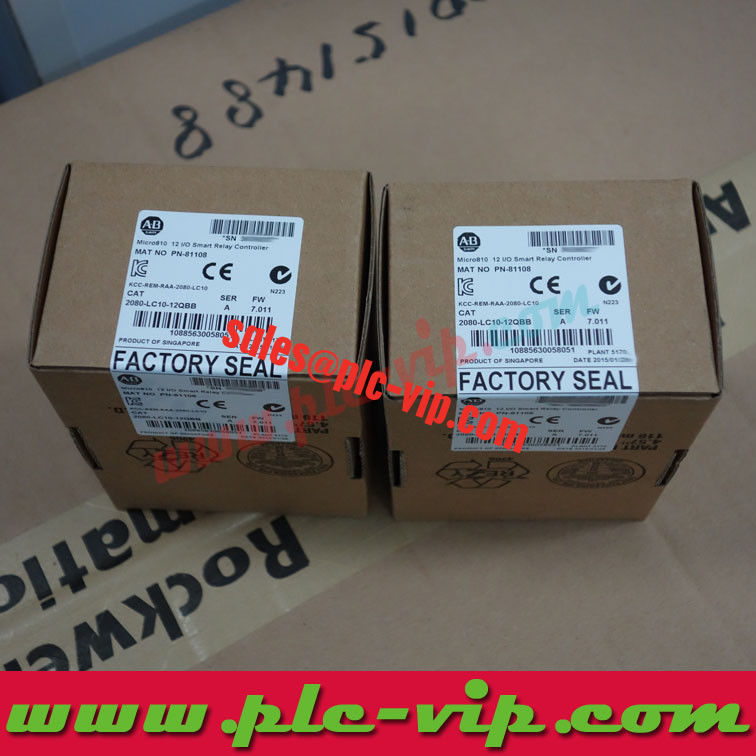
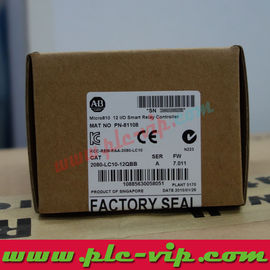
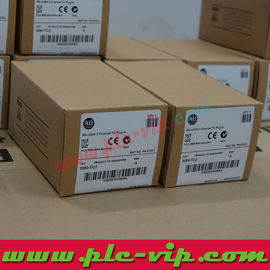
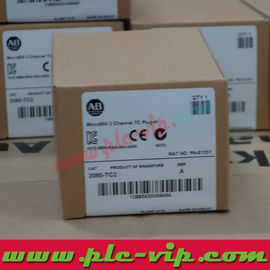
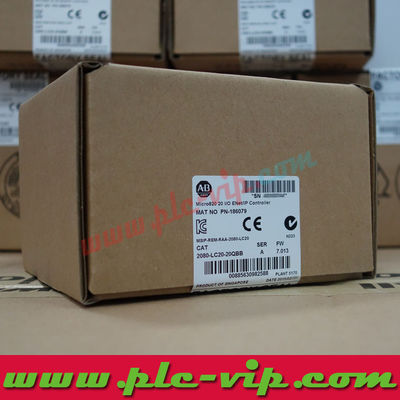
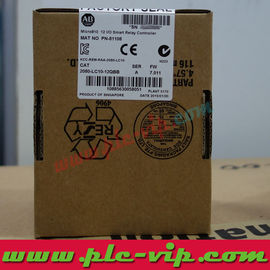
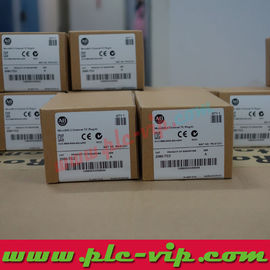
2080-LC30-24QVB: Micro830 24 point controller, 14 inputs and 10 sinking 24V DC outputs
The catalog number 2080-LC30-24QVB identifies a Micro830 24 point controller with 14 inputs and 10 sinking 24V DC outputs. The point counts, the output type, the pulse train output support and the high speed counter count below are the published values for this catalog number, and the suffix convention is spelled out because it carries all four.
| Specification | Value |
|---|
| Catalog number | 2080-LC30-24QVB, Micro830 24 point controller |
| Inputs | 14 inputs, 24V DC or AC |
| Outputs | 10 sinking 24V DC outputs |
| PTO axes | 2 axes |
| High speed counters | 4 counters, one main plus one sub per pair |
| High speed counter rate | 100 kHz on models with counter support; the AC input models have no counter path |
| Main counter inputs | Four dedicated inputs per main counter |
| Sub counter inputs | Two dedicated inputs per sub counter |
| Suffix convention | A is AC input, Q is DC input, W is relay output, V is sinking output, B is sourcing output |
| Source | 2080-UM002 Micro830, Micro850 and Micro870 user manual, Table 1 and the high speed counter table |
Two PTO axes and four counters on a twenty four point frame is the smallest two axis configuration. Sinking outputs mean the field devices are wired to the positive supply, which is the European panel convention.
Point counts, output type, PTO support and HSC support are published per catalog number. Where a column is empty in the source table it is reported here as not published for this model rather than as zero, because the two are not the same statement.
The output rating per point is a switching capability and the rating per common is a thermal limit. Ten outputs each rated at two amps cannot all be energised at once on one common, and the datasheet separates those two rows for that reason.
The AC input models have no high speed counter support at all. A 110V AC input passes through an optocoupler with a filter that is slow by design, and a frame built around AC inputs cannot be retrofitted with a counter by changing a setting.
A forty eight point frame with twenty eight inputs and twenty outputs is a machine controller rather than a cell controller, and the six counters on that frame are the reason it exists. Twenty eight inputs is enough for a full safety-guarded station with sensors on every nest.
Relay outputs and transistor outputs are not interchangeable at the panel level. A relay switches either AC or DC and it can carry an inductive load with a snubber, while a transistor output switches one polarity only and needs a freewheeling diode on every coil. The same point count with a different suffix is a different wiring drawing.
The ten point frame is the smallest that still has a plug-in slot, and it is the frame that gets chosen when a panel has already been built around a fixed I/O count. Adding one analog channel later costs a slot rather than a new controller.
Expansion on Micro830 is limited and the limit is published as a module count rather than a point count. A frame that is chosen with the expansion limit already used up cannot grow, and that is a decision made at the quotation stage.
Each main high speed counter has four dedicated inputs and each sub counter has two. That is why a twenty four point frame can run two independent main counters and still have inputs left for the rest of the machine, and why a forty eight point frame is the natural choice for a three axis application.
Twenty four point frames split fourteen inputs and ten outputs, which leaves enough inputs for sensors and enough outputs for a valve bank without an expansion module. The expansion modules are what the frame is chosen to avoid, not to add.
The point count and the output type are the two numbers that decide a Micro830 model, and the suffix after the dash is what carries them. A W is a relay output, a V is a 24V DC sinking output, a B is a 24V DC sourcing output, and the leading A is an AC input. Reading the catalog number is faster than reading the data sheet once the convention is known.
Pulse train output support is a separate column from the counter support and the two are not the same resource. A model with three PTO axes and six counters is a motion frame, and a model with no PTO is a logic frame, even when the point count is identical.
The source or sink decision on the output side is a decision about the field wiring convention, not about the controller. A sourcing output delivers twenty four volts and a sinking output pulls to common, and mixing the two on one machine means two wiring drawings and two spare part numbers.
High speed counter support tracks the frame size rather than the option letter. Ten and sixteen point frames carry two counters, twenty four point carries four, forty eight point carries six, and each of those is one main counter plus one sub counter per pair.
A sixteen point frame with ten inputs and six relay outputs is the classic small machine shape, and the same frame with ten inputs and six sinking outputs is the same shape for a machine that already distributes twenty four volts to every field device.
The smallest two axis frame, for a panel wired to positive.
>
 2080-LC30-24QVB Rockwell Micro830 24 Point Controller, DC Sink Outputs
Category:
PLCs, Power Supplies & I/Os
Manufacturer:
Rockwell
Group:
Micro800 2080 plug-in modules
The 2080-LC30-24QVB has ten 24 V DC sink outputs and two PTO channels on the 24-point chassis.
It is the Micro830 for a machine with two small axes and a purely DC output list.
| 2080-LC10-12AWA |
Micro810, 8 AC in / 4 relay out |
IN STOCK |
| 2080-LC10-12QWB |
Micro810, 8 DC/AC in / 4 relay out |
IN STOCK |
| 2080-LC10-12QBB |
Micro810, 8 DC/AC in / 4 DC source out |
IN STOCK |
| 2080-LC10-12DWD |
Micro810, 8 12V DC in / 4 relay out |
IN STOCK |
| 2080-LC20-20AWB |
Micro820, 12 AC in / 8 relay out |
IN STOCK |
| 2080-LC20-20QWB |
Micro820, 12 DC in / 8 relay out |
IN STOCK |
| 2080-LC20-20QBB |
Micro820, 12 DC in / 8 DC source out |
IN STOCK |
| 2080-LC20-20AWBR |
Micro820 with removable terminal blocks |
IN STOCK |
| 2080-LC20-20QWBR |
Micro820 with removable terminal blocks |
IN STOCK |
| 2080-LC20-20QBBR |
Micro820 with removable terminal blocks |
IN STOCK |
| 2080-LC30-10QWB |
Micro830, 6 DC/AC in / 4 relay out |
IN STOCK |
| 2080-LC30-10QVB |
Micro830, 6 DC/AC in / 4 DC sink out |
IN STOCK |
| 2080-LC30-16AWB |
Micro830, 10 AC in / 6 relay out |
IN STOCK |
| 2080-LC30-16QWB |
Micro830, 10 DC/AC in / 6 relay out |
IN STOCK |
| 2080-LC30-16QVB |
Micro830, 10 DC/AC in / 6 DC sink out |
IN STOCK |
| 2080-LC30-24QWB |
Micro830, 14 DC/AC in / 10 relay out |
IN STOCK |
| 2080-LC30-24QVB |
Micro830, 14 DC/AC in / 10 DC sink out |
IN STOCK |
| 2080-LC30-24QBB |
Micro830, 14 DC/AC in / 10 DC source out |
IN STOCK |
| 2080-LC30-48AWB |
Micro830, 28 AC in / 20 relay out |
IN STOCK |
| 2080-LC30-48QWB |
Micro830, 28 DC/AC in / 20 relay out |
IN STOCK |
| 2080-LC30-48QVB |
Micro830, 28 DC/AC in / 20 DC sink out |
IN STOCK |
| 2080-LC50-24AWB |
Micro850, 14 AC in / 10 relay out |
IN STOCK |
| 2080-LC50-24QVB |
Micro850, 14 DC/AC in / 10 DC sink out |
IN STOCK |
| 2080-LC50-24QBB |
Micro850, 14 DC/AC in / 10 DC source out |
IN STOCK |
| 2080-LC50-48AWB |
Micro850, 28 AC in / 20 relay out |
IN STOCK |
| 2080-LC50-48QWB |
Micro850, 28 DC/AC in / 20 relay out |
IN STOCK |
| 2080-LC50-48QVB |
Micro850, 28 DC/AC in / 20 DC sink out |
IN STOCK |
| 2080-LC50-48QBB |
Micro850, 28 DC/AC in / 20 DC source out |
IN STOCK |
Product Specifications 2080-LC30-24QVB (PDF)
Catalog number |
2080-LC30-24QVB |
Family |
Micro830 brick controller |
I/O points |
24 (14 inputs, 10 sink outputs) |
Inputs |
14 inputs, 24 V DC or 24 V AC |
Outputs |
10 outputs, 24 V DC sink |
Supply |
24 V DC Class 2 through the optional power supply slot |
Communication |
USB 2.0 Type B programming port and RS-232/RS-485 non-isolated combo serial port |
Plug-in modules |
3 plug-in slots |
Dimensions, H x W x D |
90 x 150 x 80 mm |
Shipping weight |
See 2080-UM002 table |
Temperature rating |
-20 to 65 C (-4 to 149 F) |
Power consumption, max |
8 W |
Lifecycle |
Listed in the current Micro830 catalog table of 2080-UM002 |
Attribute values above are reproduced from the manufacturer's product data. For the authoritative technical record see Rockwell publications 2080-UM002 (module specifications) and 2080-UM002 (installation instructions). Certification details, with certificate and file numbers, are listed in the FAQ below.
What this controller covers
The 2080-LC30-24QVB has ten 24 V DC sink outputs and two PTO channels on the 24-point chassis.
It is the Micro830 for a machine with two small axes and a purely DC output list.
Four high-speed counters are available on this size.
Inputs, outputs and field wiring
Sink outputs handle solenoids and drive enable inputs; two PTO channels drive pulse-type drives.
Inputs are 24 V DC or 24 V AC.
No relay contacts are fitted, so AC loads need an external interface.
Communication, plug-ins and programming
Communication and capacity. USB 2.0 Type B programming port and RS-232/RS-485 non-isolated combo serial port
3 plug-in slots plug-in modules can be fitted, each drawing about 1.44 W of the controller's internal budget.
Connected Components Workbench is the programming environment for the whole family, so a project built for one Micro800 controller converts to another with the I/O reassigned.
Dimensions, ratings and lifecycle
Mounting is DIN rail or panel, 90 x 150 x 80 mm, shipping See 2080-UM002 table.
Rated ambient -20 to 65 C (-4 to 149 F), maximum consumption 8 W.
Lifecycle. Listed in the current Micro830 catalog table of 2080-UM002
Buying a used Micro800 controller
Three plug-in slots, 8 W base consumption, 90 x 150 x 80 mm.
2080-UM002 Table 1 lists 14 inputs, 10 sink outputs, 2 PTO and 4 HSC for this catalog.
Rockwell's Micro830 catalog table still lists this catalog number.
FAQ — 2080-LC30-24QVB
How many I/O points does 2080-LC30-24QVB have?
Micro830 brick controller: 24 (14 inputs, 10 sink outputs).
What is the input type on 2080-LC30-24QVB?
14 inputs, 24 V DC or 24 V AC.
What does 2080-LC30-24QVB use for communication?
USB 2.0 Type B programming port and RS-232/RS-485 non-isolated combo serial port.
What are the dimensions of 2080-LC30-24QVB?
90 x 150 x 80 mm, See 2080-UM002 table.
What is the lifecycle status of 2080-LC30-24QVB?
Listed in the current Micro830 catalog table of 2080-UM002.
Data sources. Controller I/O counts, supply ranges, dimensions and weights come from the Micro800 technical data 2080-TD001 and the controller manual 2080-UM002. Application text is written from those tables; nothing here is estimated. Any attribute a publication does not print is marked Not published rather than taken from a distributor page. Catalog number, packaging and stock status are the stock record of this listing.