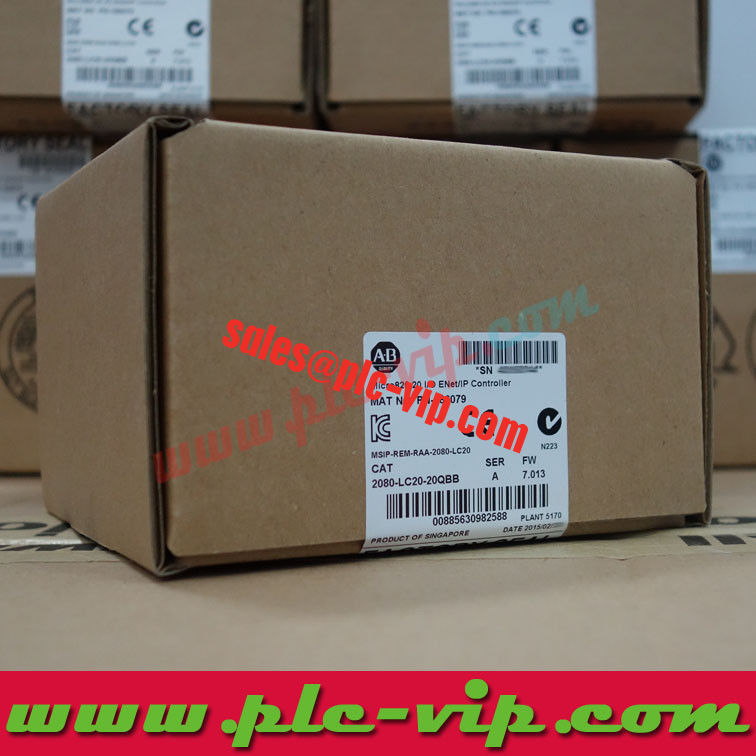
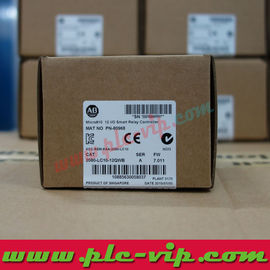
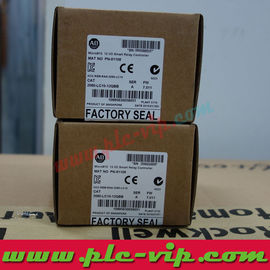
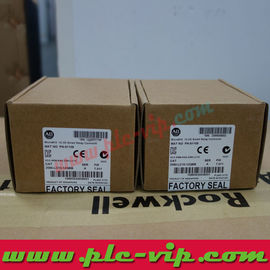
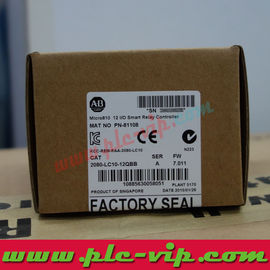
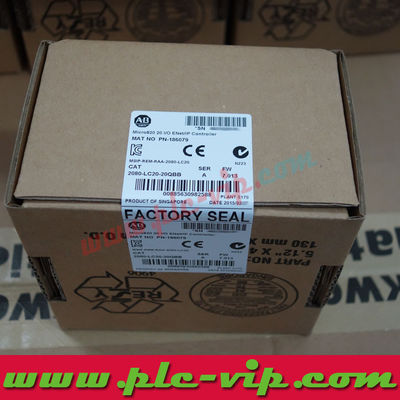
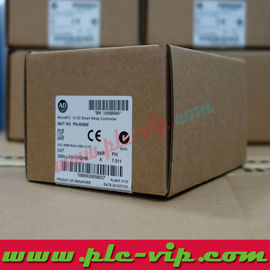
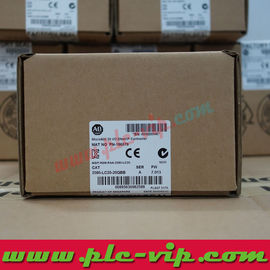
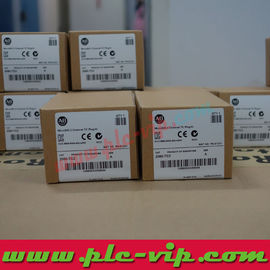
2080-LC20-20QWBR
This page documents catalog number 2080-LC20-20QWBR, a Micro820 controller with 20 I/O points. Every value below is taken from the Micro800 technical data general specifications for the Micro820 controllers; figures that are not published for this catalog number are not stated.
Published specification
| Specification | Value |
|---|
| Catalog number | 2080-LC20-20QWBR |
| Controller | Micro820, 20 I/O (12 inputs, 8 outputs) |
| Input circuit type | 24V DC sink/source, standard |
| Output circuit type | 24V DC source, standard and high-speed |
| Power input | 24V DC, supply range 20.4...26.4V DC, Class 2 |
| Power consumption, maximum | 5.62 W without plug-in modules; 8.5 W with plug-in modules |
| Power dissipation, maximum | 6 W |
| Output rating | 24V DC, 1 A per point at 30 °C surrounding air; 24V DC, 0.3 A per point at 65 °C surrounding air |
| Input rating | 24V DC, 8.8 mA |
| Isolation | 250V continuous, reinforced, output to aux and network, inputs to outputs; 50V continuous, reinforced, input to aux and network |
| Dimensions | 90 x 104 x 75 mm (3.54 x 4.09 x 2.95 in.) |
| Shipping weight | Approximately 0.38 kg (0.83 lb) |
| Wire size | Solid 0.14...2.5 mm2 (26...14 AWG); stranded 0.14...1.5 mm2 (26...16 AWG); 90 °C insulation, 7 mm strip length |
| Terminal torque | 0.5...0.6 N·m (4.4...5.3 lb·in) with a 0.6 x 3.5 mm screwdriver |
| Enclosure and temperature code | Open style; North American temperature code T4 |
What the published ratings decide
This catalog number is a Micro820 controller with twenty I/O points, twelve of them inputs and eight outputs, and the published general specifications table groups it with the non-R form of the same rating. The suffix does not appear as a separate specification column, so the ratings on this page are the ratings of the group, which is what a buyer needs when the two forms are treated as one line item.
Both the inputs and the outputs are 24V DC, which makes this a controller for a DC panel rather than a mixed one: no 120V AC input group, no relay output stage. The published input circuit type is sink/source, so the field devices can be wired either way, and the output circuit type is source, which fixes how the loads are connected.
The supply range is published as 20.4 to 26.4V DC, Class 2, and it is worth comparing with the 24V nominal figure that appears on every drawing. A supply that holds 24V under load is inside the window; a supply that sags to 19V during a contactor drop is outside it, and the published range is narrow enough that the sag matters.
Power consumption is published as 5.62 W without plug-in modules and 8.5 W with them, with a maximum dissipation of 6 W. Those two numbers are the panel's heat input, and the difference between them is the reason a controller chosen early in a project can be a controller that runs hotter than the enclosure calculation assumed.
Output current is published with a temperature condition attached: 1 A per point at 30 °C surrounding air, and 0.3 A per point at 65 °C. That is a factor of more than three across the range, and it is the single most consequential line in the table for anyone driving a solenoid or a small contactor from this controller.
Isolation is published in two tiers. Outputs are rated 250V continuous reinforced to aux and network, and inputs to outputs; inputs are rated 50V continuous reinforced to aux and network. The lower input figure is the one that decides whether a field device on a different reference can be connected without an external relay.
The physical data is published as 90 by 104 by 75 mm and about 0.38 kg, open style, with a North American temperature code of T4. Open style means the enclosure is the panel, and the temperature code is a statement about the controller's own surface temperature in a classified location rather than about the panel's ambient.
Wiring is published as solid 0.14 to 2.5 mm2 or stranded 0.14 to 1.5 mm2 at 90 °C insulation, with a 7 mm strip length and a terminal torque of 0.5 to 0.6 N·m using a 0.6 by 3.5 mm screwdriver. The 90 °C insulation requirement is the one that quietly disqualifies leftover cable, and the 7 mm strip length is what makes a ferrule fit properly.
Twenty points on a controller this size is a small machine controller, and the published split of twelve inputs and eight outputs is the shape of a machine rather than the shape of a process. Twelve inputs covers a set of sensors, a couple of guards and a start-stop station; eight outputs covers a set of valves or contactors and one or two indicators.
The published power figures and the derating curve together define the panel, not the controller. A cabinet with this controller, a plug-in module, a power supply and a drive is a cabinet whose internal temperature is the sum of published dissipations, and the output derating is what translates that temperature into a usable current.
Panel, wiring and replacement notes
1 A at 30 °C against 0.3 A at 65 °C is a published derating, not a tolerance. A panel that runs at 55 °C and drives eight outputs at 0.9 A each is a panel operating outside the table, and the failure it produces is a thermal shutdown that looks like a program fault.
5.62 W without plug-in modules is a small heat load, and 8.5 W with them is a third more. Multiply that by the number of controllers in a cabinet and the difference becomes the reason an enclosure fan was or was not needed, which is why the with-modules figure belongs in the panel calculation from the start.
A supply window of 20.4 to 26.4V DC is published as the operating range, and Class 2 is published alongside it. The narrow window is the practical constraint: a 24V supply set at 24.0V with a 10 percent sag reaches 21.6V and stays inside, while the same sag on a supply set at 23V leaves the window.
Isolation of 50V continuous on the input side is the number to check before connecting a device that references a different earth. A sensor on the machine frame and a controller on the panel earth are usually within that; a device on a separate supply with its own reference is usually not, and an interposing relay is the published workaround rather than a modification.
The 90 °C insulation requirement is published with the wire range, and it is the item most often missed because the copper gauge matches. A 26 AWG wire with 60 °C insulation meets the gauge and fails the temperature, and the difference shows up years later as an intermittent terminal rather than as an installation error.
Open style with a T4 temperature code describes a controller that expects an enclosure and a classified location assessment. T4 is a surface temperature class rather than an ambient rating, and a panel builder who reads it as an ambient limit is reading the wrong row of the table.
Twenty I/O points and a 90 by 104 mm footprint is a controller that fits a machine-mounted box rather than a central cabinet. That is the segment this catalog number serves, and the published dimensions are what make a distributed architecture possible without a second enclosure.
Twelve inputs and eight outputs leaves a specific ratio: one and a half inputs per output. A machine with eight valves and sixteen sensors does not fit, and the published point count is the first check rather than the last, because the ratio is where small machine designs usually break.
The terminal torque of 0.5 to 0.6 N·m with a named screwdriver size is published for a reason: a removable terminal block that is over-tightened cracks, and one that is under-tightened reads as a field device fault. The published tool specification is the part of the instruction that turns a torque figure into practice.
A controller with DC outputs rated at 1 A can drive a small contactor coil directly, and that saves a relay per output. The saving is real and so is the consequence: the coil's suppression then matters to the controller's output stage, and the published output type does not include a suppression device.
Micro820 plug-in support is published for the family, and the power figures show the cost of using it. Adding a communication module adds roughly three watts of dissipation, which in a sealed box is the difference between a controller running at its published limit and one running past it.
The published data for this catalog number is a table of limits rather than a description of capability, and the limits are what a machine builder's panel calculation consumes. A page that described the controller's usefulness without those numbers would be a brochure rather than documentation.
A 24V DC controller at this size is replaced in the field rather than repaired, and the published attributes that make a replacement fit are the point count, the input and output circuit types, the supply range and the footprint. Those four are the checklist, and all four are in the table above.
A 20 point controller with DC inputs and DC source outputs is the modern default for a small machine, and the published ratings describe a device that assumes a 24V DC panel. Plants that still run 120V AC pushbuttons are plants where this catalog number is the wrong shape, and the family's other variants exist for them.
The sink/source input description means the common can be either polarity, which is a wiring convenience and a documentation hazard. A panel where some inputs are wired sink and others source is a panel whose drawings have to say so on every page, and the published flexibility does not remove that obligation.
DC source outputs are published for both standard and high-speed use, which means the same terminal is used for a fast pulse and for a steady load. A high-speed output driving a load with a long cable is a load whose rise time is set by the cable rather than by the controller, and the published output type does not change that.
The other Micro800 controllers, expansion modules and accessories in this range are collected in the AB Micro & Nano Systems category. This controller can be checked against the shop listing at 2080-LC20-20QWBR.
Data sources: the I/O count, supply and communication rows quoted on this page for 2080-LC20-20QWBR follow 2080-UM004 (Micro800 programmable controllers user manual); nothing here is inferred from the catalog string.