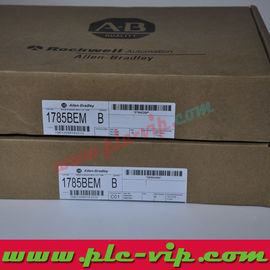
Detailed Product Description
 1785-ENET Rockwell PLC-5 Ethernet Interface Module
Category:
PLCs, Power Supplies & I/Os
Manufacturer:
Rockwell
Group:
Bulletin 1785 · PLC-5 controllers, memory and accessories
1785-ENET adds an Ethernet interface to a PLC-5 system from a 1771 chassis slot, which is how a non-Ethernet processor such as a /40B or /60B reached an Ethernet network.
The module occupies one slot in a 1771 chassis and is configured as part of the processor's I/O image, which means rack and group assignment has to be planned, not guessed.
| 1785-ACC5LA |
PLC-5 accessory kit |
IN STOCK |
| 1785-ACC5LB |
PLC-5 accessory kit |
IN STOCK |
| 1785-CHBM |
ControlNet backup cartridge |
IN STOCK |
| 1785-ENET |
PLC-5 Ethernet interface module |
IN STOCK |
| 1785-L26B |
PLC-5/26 protected processor, 16 K words |
IN STOCK |
| 1785-L40C15 |
PLC-5 ControlNet 1.5 processor, 48 K words |
IN STOCK |
| 1785-L40C |
PLC-5 ControlNet 1.25 processor, 48 K words |
IN STOCK |
| 1785-L46C15 |
PLC-5/46C ControlNet 1.5 protected processor |
IN STOCK |
| 1785-L40E |
PLC-5/40E Ethernet processor, 48 K words |
IN STOCK |
| 1785-L60B |
PLC-5/60 processor, 64 K words |
IN STOCK |
| 1785-L60L |
PLC-5/60L processor with extended local I/O |
IN STOCK |
| 1785-L80C |
PLC-5 ControlNet 1.25 processor, 100 K words |
IN STOCK |
| 1785-L80B |
PLC-5/80 processor, 100 K words |
IN STOCK |
| 1785-L80C15 |
PLC-5 ControlNet 1.5 processor, 100 K words |
IN STOCK |
| 1785-L80E |
PLC-5/80E Ethernet processor, 100 K words |
IN STOCK |
| 1785-L86B |
PLC-5/86 protected processor, 100 K words |
IN STOCK |
| 1785-M100 |
100 K word memory module |
IN STOCK |
| 1785-ME16 |
16 K word EEPROM memory cartridge |
IN STOCK |
| 1785-ME32 |
32 K word EEPROM memory cartridge |
IN STOCK |
| 1785-ME64 |
64 K word EEPROM memory cartridge |
IN STOCK |
| 1785-RC |
Relay cartridge, edit and force monitoring |
IN STOCK |
Product Specifications 1785-ENET (PDF)
Catalog number |
1785-ENET |
Product type |
PLC-5 Ethernet interface module |
Mounting |
1771 I/O chassis slot |
Lifecycle status |
Discontinued |
Discontinued date |
18 May 2017 |
Replacement category |
Engineering Replacement |
UPC |
612598169207 |
Country of origin |
United States of America |
Attribute values above are reproduced from the manufacturer's product data. For the authoritative technical record see Rockwell publications 1785-UM041 (module specifications) and Rockwell literature library (installation instructions). Certification details, with certificate and file numbers, are listed in the FAQ below.
ControlNet or DH+ channels and memory
1785-ENET adds an Ethernet interface to a PLC-5 system from a 1771 chassis slot, which is how a non-Ethernet processor such as a /40B or /60B reached an Ethernet network.
It is a separate module rather than a processor port, so the processor keeps its DH+/RIO channels while the module handles the Ethernet side.
Installing it in a PLC-5 chassis
The module occupies one slot in a 1771 chassis and is configured as part of the processor's I/O image, which means rack and group assignment has to be planned, not guessed.
Network addressing and messaging are set up in the programming software; the module itself has no front-panel address selector to rely on.
Lifecycle and replacement
Rockwell lists 1785-ENET as Discontinued as of 18 May 2017, replacement category Engineering Replacement.
Modern Ethernet access to a PLC-5 is normally achieved during a Logix migration rather than by adding this module.
Where these are still in use
The module is still bought where a PLC-5 must be connected to a plant network for data collection, and where the processor itself has no Ethernet port.
It is also the practical route for a historian or SCADA link on a line that will not be re-engineered this year.
Buying a used unit
Check the module's revision and confirm the chassis slot it came from, since the I/O image assignment may be documented in the original drawings only.
Ask whether the module was working when removed from the panel, and test it in a bench chassis before fitting it to a live rack.
FAQ — 1785-ENET
What does 1785-ENET do?
It gives a PLC-5 system an Ethernet interface from a 1771 chassis slot.
Which processors need it?
Those without an embedded Ethernet port, such as the /40B and /60B classes.
When was it discontinued?
18 May 2017.
Does it replace the processor's DH+ channels?
No, it adds Ethernet alongside them.
What should I check before buying?
Revision, slot history and that it is tested before going into a live rack.
Data sources. Memory, I/O and channel figures come from the PLC-5 system specification table in 1785-UM012; lifecycle dates and UPC codes come from the Rockwell product page for the catalog number. Anything neither source prints is marked Not published. Any attribute a publication does not print is marked Not published rather than taken from a distributor page. Catalog number, packaging and stock status are the stock record of this listing.
1785-ENET: PLC-5 Ethernet sidecar interface module
1785-ENET is the PLC-5 Ethernet sidecar interface module in the PLC-5 support and interface group. Memory cards back up the program, the relay cartridge provides a hardwired contact, and the sidecar puts a DH+ controller onto Ethernet.
| Attribute | Value |
| Catalog number | 1785-ENET |
| Product type | PLC-5 Ethernet sidecar interface module |
| Family | PLC-5, bulletin 1785 |
| Function | Sidecar Ethernet interface for a PLC-5 controller, giving channel 2 Ethernet |
| Network | 10 Mbps baseband Ethernet, 802.3 media: 10Base5, 10Base2, 10Base-T, fiber, broadband |
| Port | 15-pin AUI connector, connected through a transceiver or Medium Access Unit |
| Transceivers | 1785-TR10BT twisted pair, 1785-TR10BF optical, 1785-TR10B2 thin wire, 1785-TR10B5 thick wire |
| Cables | 5810-TC02/A 2.0 m and 5810-TC15/A 15.0 m transceiver cables; kit versions 5810-TAS/A, TAM/A, TBS/A, TBM/A |
| Series | Series B or later required for multihop messaging |
| Multihop | Controller must be series E revision D or later, sidecar series B or later |
| Fault codes | 93 sidecar module illegal maximum pool size, 96 sidecar module not physically connected |
| Indicators | STAT red for critical hardware fault; Ethernet LED green when channel 2 sees an active network |
| Source | 1785-UM012D-EN-P, Enhanced and Ethernet PLC-5 controllers |
The sidecar is how a DH+ PLC-5 gets onto Ethernet without being replaced, and the two fault codes in the manual are the ones a commissioning engineer will meet: 93 means the module pool size is illegal, 96 means the module is not physically connected to the controller. Both point at the sidecar rather than at the network, which is worth knowing before the cable is swapped.
Three facts from 1785-UM012D set the boundary for this part: the card slot reports its contents in S:68, the loading rules are set by user memory and I/O racks rather than by the card alone, and ControlNet and non ControlNet cards never cross.
The published controller limits that decide whether this part is the right one are 8,192 words on the PLC-5/11, 16,384 on the PLC-5/20, 32,768 on the PLC-5/30, 65,536 on the PLC-5/40 and 102,400 on the PLC-5/80, with a rack ceiling of 4, 4, 8, 16 and 24 respectively.
The controller reports what is in the slot through S:68. Code 0 means no card, 1 is 1785-ME16, 2 is 1785-ME32, 3 is 1785-ME64, 4 is the 100 K card, 5 is 1785-CHBM and 6 is 1785-RC. Codes 7 to 15 are reserved, so an unexpected value is a fault indication rather than an unknown card.
Multihop messaging is the feature that lets a PLC-5 reach a ControlLogix processor through a 1756-ENET module and out through a 1756-DHRIO. It requires a series E revision D controller or later and a series B or later sidecar, plus RSLogix 5 release 3.2 or later, and the routing table in the DHRIO is configured from the Gateway software.
The restore path has one behaviour worth writing into the maintenance procedure. If the controller memory is bad, restoring from the card also sets the controller date and time to the date and time that were saved with the card. If the controller memory is still valid, the current date and time are kept. A historian that timestamps events will show the difference.
The battery behind all of this is the 1770-XYC, which contains 0.65 grams of lithium. On the PLC-5/11, PLC-5/20 and PLC-5/20E the published life is 256 days at 60 degrees C with the power off 100 percent of the time and 1.4 years at 50 percent, or 2 years and 4 years at 25 degrees C. The larger processors are shorter: 84 and 150 days at 60 degrees C, 1 year and 1.2 years at 25 degrees C.
Ethernet on this generation is 10 Mbps and the physical layer is whatever 802.3 media the site already has: thick wire 10Base5, thin wire 10Base2, twisted pair 10Base-T, fiber or broadband. The controller port is a 15-pin AUI connector, so the media choice is made by the transceiver rather than by the controller.
The programming port on these controllers is channel 0, a 25-pin D-shell serial port that supports RS-232C and RS-423 and is RS-422A compatible. Its pin assignment is printed on the side label of the controller, and the RS-422A use assumes no termination resistors with the distance and rate reduced to RS-423 limits.
ControlNet is a hard boundary. A card burned on a ControlNet PLC-5 cannot be loaded to a non ControlNet controller, and a card burned on a non ControlNet controller cannot be loaded to a ControlNet PLC-5. The two families look identical at the card slot, so this rule is the one that ruins a weekend if it is missed.
Two fault codes cover the card itself. Code 82 means an illegal cartridge type for the selected operation and also appears when the controller has no memory module at all, and code 85 means the memory module is bad. A successful upload sets S:1/10, which is the bit to check after a save rather than the programmer screen.
A DH+ channel and a remote I/O channel are the same physical port on these controllers, and the three pin ports are configured for remote I/O scanner, remote I/O adapter or DH+ communication. Changing that configuration after commissioning changes the addresses of everything downstream, so the mode belongs in the as built drawing.
Compatibility is defined twice, once by user memory and once by I/O memory. The card will load if the target controller has at least the user memory that was in use when the card was burned, and if its I/O memory is at least that of the controller the card came from. The rack counts are 4 for PLC-5/11 and PLC-5/20, 8 for PLC-5/30, 16 for PLC-5/40 and 24 for PLC-5/60 and PLC-5/80.
After the battery indicator first lights, the remaining life is measured in days rather than months: 11.5 days at 60 degrees C and 47 days at 25 degrees C on the small processors, 5 days and 30 days on the PLC-5/30 and above. A maintenance schedule built on months will therefore miss the window on a large controller.
The transceiver catalogue is small and specific: 1785-TR10BT for twisted pair, 1785-TR10BF for optical, 1785-TR10B2 for thin wire and 1785-TR10B5 for thick wire, with the 5810 series thin and thick wire parts as the older equivalents. Transceiver cables come in 2.0 m and 15.0 m lengths, and the kits pair a transceiver with one of those cables.
An EEPROM card is a program backup device, not extra working memory. The program is saved to the card from the programming software while the controller runs, and the card is then loaded back into controller memory after a battery failure or a memory fault. Nothing executes from the card, so the controller user memory still decides what program size is possible.
Firmware is the second boundary. A card saved on a series D revision B controller cannot be loaded to a controller with earlier firmware, and the same applies to cards saved on series E revision A and series E revision B. Older cards move forward freely, newer cards do not move back.
The memory module goes into the slot marked on the controller, and the module is keyed so that it seats in one orientation only. On a live panel the card is fitted with the chassis powered down, because the controller reads the card type at power up and a hot insertion leaves the status word reporting the previous device.
Before ordering any memory or interface part for a PLC-5, confirm the processor catalog number, the series and firmware revision, and check the label on the card itself against the catalog number on the drawing before the part is fitted.