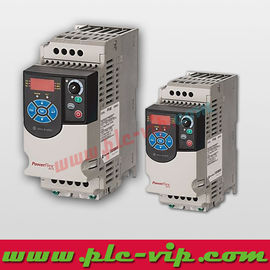
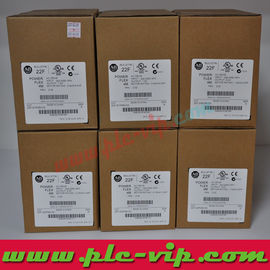
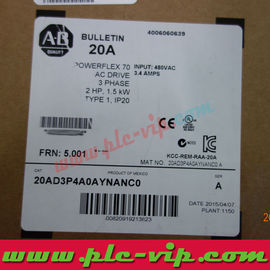
20BE2P7A0AYNAND0
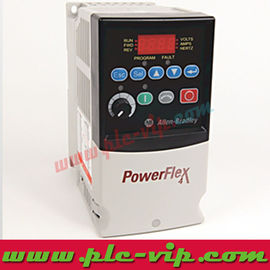
This page documents catalog number 20BE2P7A0AYNAND0, a PowerFlex 700 drive in the 600 V AC class at 2.7 A. The decode and the ratings below are taken from the drive family's published catalog number explanation and line reactor tables; the trailing option blocks are not interpreted here.
Decode and published ratings
| Specification | Value |
|---|
| Catalog number | 20BE2P7A0AYNAND0 |
| Family (first three characters) | 20B - PowerFlex 700 |
| Voltage class (fourth character) | E - 600 V AC, three-phase |
| Rating code (fifth to seventh) | 2P7 - 2.7 A |
| Heavy-duty rating as published | 1 Hp |
| Normal-duty rating as published | 2 Hp |
| Input line reactor, heavy duty | 1321-3R2-B |
| Output line reactor, heavy duty | 1321-3RA2-B |
| Input line reactor, normal duty | 1321-3R4-D |
| Output line reactor, normal duty | 1321-3RA4-D |
| Full power range, 600 V class frames 0-4 | 575...660 V |
| Operating range, 600 V class frames 0-4 | 432...660 V |
| Nominal motor voltage | 575 V |
| Low voltage directive note | 600 V class below 77 A (frames 0-4) declared to meet the Low Voltage Directive; EMC compliance determined by the user |
What the number decides and what it leaves open
A 2.7 A drive is the smallest step in this family's 600 V range, and the number reads as 20B for PowerFlex 700, E for 600 V AC three-phase, and 2P7 for 2.7 A, with the P standing in for the decimal point exactly as it does in every other rating code in the range.
The published reactor pairing for this code is the mirror image of the larger ratings and that is the useful part. Under heavy duty the table gives 1 Hp with a 1321-3R2-B input reactor and a 1321-3RA2-B output reactor; under normal duty it gives 2 Hp with 1321-3R4-D on both sides. The heavy-duty pair is the smaller of the two, which is the opposite of what a reader expects from a table where the bigger rating usually carries the bigger reactor number.
The reason the two pairings exist at all is that the same hardware carries a heavy-duty and a normal-duty rating, and the duty is chosen in programming. A 2.7 A drive can therefore be a 1 Hp heavy-duty drive or a 2 Hp normal-duty drive, and the catalog number does not say which. That single fact explains most of the confusion around small 600 V drives, because a buyer comparing two quotations for the same number may be comparing two different duties.
The voltage envelope is the 600 V class envelope for frames 0 to 4: full power from 575 to 660 V, operation from 432 to 660 V, nominal motor voltage 575 V, with linear derating below the full power floor. Small drives are the ones most often applied at the bottom of that band, because they are the ones most often fitted to a 480 V machine's auxiliary motor through a transformer tap.
The compliance sentence applies here as it does to every 600 V drive below 77 A on frames 0 to 4: the drive is declared to meet the Low Voltage Directive and the user determines EMC compliance. On a 2.7 A drive that is a small part of a panel but it is still a line in the machine's declaration.
Frames at this rating are the smallest in the family, and the practical consequence is terminal density rather than terminal type. The wiring space behind a small frame is the constraint on a retrofit, and the reactor pair above is evidence of the frame group: 3R2 and 3RA2 are the compact parts.
The option blocks after the rating code are not interpreted here. Brake, enclosure, communication slot and firmware are separate fields with separate tables, and inferring them from this string would be inference about a machine's wiring rather than about a catalog.
Two checks make this page useful in practice. Confirm the duty from the nameplate, since the catalog number omits it. Confirm the motor current at the actual line voltage rather than at nameplate voltage, because at 2.7 A the margin between a motor that fits and one that does not is a fraction of an amp.
The neighbouring ratings are 1P7 at 1.7 A and 3P9 at 3.9 A, and the reactor pair changes at each step. A substitution across a step is a frame decision as much as an electrical one.
The published pairing on this code is unusual enough to be worth stating twice: heavy duty at 1 Hp takes the smaller reactor pair, normal duty at 2 Hp takes the larger one. A reader who assumes the larger horsepower always takes the larger reactor will get this code backwards, and the wrong reactor on a 2.7 A drive is a part that fits the terminals and does not fit the impedance.
Small 600 V drives are most often specified for auxiliary loads: a fan on a transformer secondary, a small pump on a skid, a positioning motor on a machine tool. Those loads are also where the supply voltage is least predictable, because a transformer tap set for a 480 V primary leaves the secondary somewhere between the nominal and the extremes of the operating range that this class allows.
At this size the panel wiring details dominate the installation more than the rating does. A shared 24 V control supply, a drive-mounted braking resistor and a keypad are all options whose position in the enclosure is decided at layout time, and none of them appear in the catalog string this page decodes.
The reason to record the duty on the asset register for a drive this small is that it disappears from view once the panel door is closed. A 1 Hp heavy-duty drive and a 2 Hp normal-duty drive are the same part number, and the next person to order a replacement has only the register to go on.
The rest of the drives, reactors and drive spares in this range are collected in the Drives & Motors category. Numbers one step either side of this rating are listed at 20BE017A0AYNAND0, 20BE027A0AYNAND0, 20BE6P1A0AYNAND0, and the drive this page describes is listed at 20BE2P7A0AYNAND0.