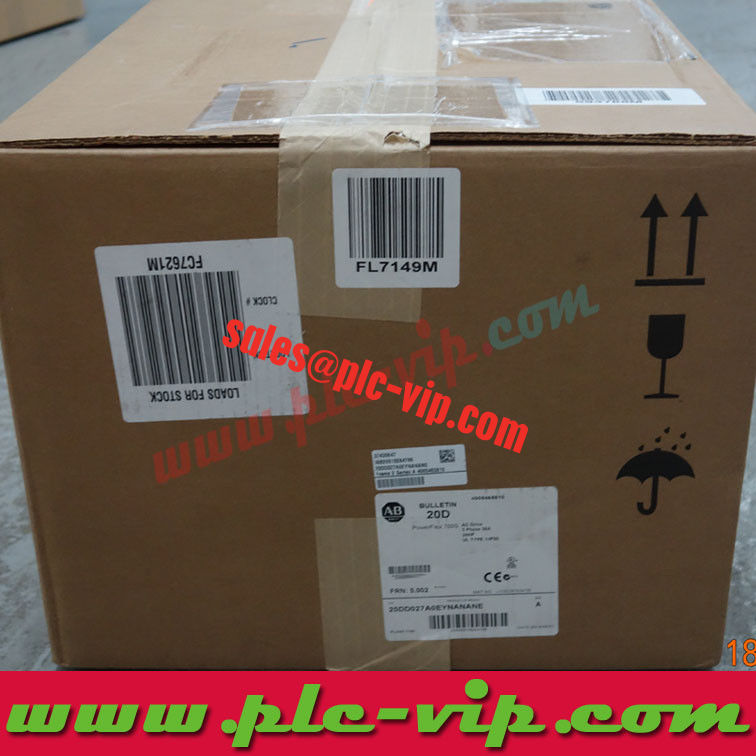
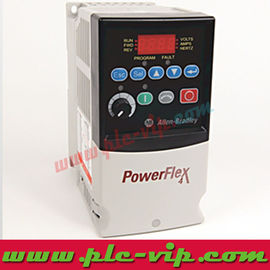
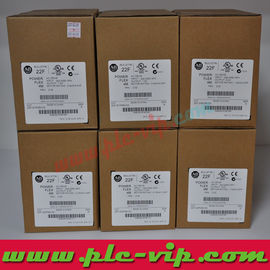
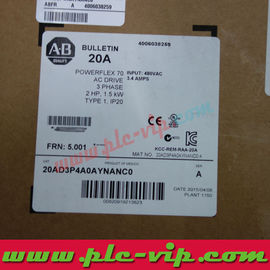
20BD027A0AYNAND0
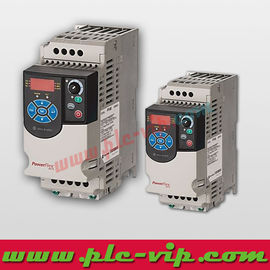
This page documents catalog number 20BD027A0AYNAND0, a PowerFlex 700 drive on the 480 V three-phase class: 27 A continuous normal-duty output, 20 HP normal duty, frame 2, enclosure A. The current, horsepower, frame, fuse and terminal figures are taken from the drive's published technical data for the 480 V class rather than from a nameplate reading.
Decode and published rating
| Field | Value |
| Catalog number | 20BD027A0AYNAND0 |
| Family (characters 1-3) | 20B - PowerFlex 700 adjustable frequency AC drive |
| Voltage class (character 4) | D - 480 V AC three-phase, frames 0 to 6 |
| Rating code (characters 5-7) | 027 - 27 A continuous, 20 HP normal duty |
| Frame size | 2 |
| Enclosure (character 8) | A - IP20, NEMA/UL Type 1 |
| Interface position (character 9) | 0 - carried in the string, not translated into a HIM part number here |
| Network position (character 10) | A - carried in the string, not translated into a communication option here |
| Brake IGBT (character 11) | Y - brake IGBT fitted |
| Internal braking resistor (character 12) | N - no internal resistor |
| Control (character 13) | A - Standard control, volts/hertz and sensorless vector |
Voltage envelope on this class
The 480 V class publishes a nominal motor voltage of 460 V, full power from 460 to 528 V and an operating range from 342 to 528 V. Rated current is available across the whole full-power range; below 460 V the output is linearly derated, which is the sentence that decides how a drive behaves on a site where a transformer tap leaves the line at 440 V.
The derating is arithmetic, and the drive table works the example itself: a 5 HP, 460 V motor on a 480 V drive fed at 342 V has 342 divided by 460, or 74.3 percent of nominal voltage, so its maximum power is 74.3 percent of 5 HP, or 3.7 HP at 44.6 Hz. A 20 HP unit on the same feed keeps that ratio, and the loss shows up as torque authority at the top of the speed range rather than as a fault.
Protection and the bill of materials
The 480 V class publishes protection as a floor and a ceiling per code rather than a single number: a dual-element time-delay fuse, a non-time-delay fuse, an inverse-time circuit breaker and an instantaneous-trip motor circuit protector each carry a minimum and a maximum, and the note under the table sets the NEC floor at 125 percent of motor full load amps. For this code the same row quotes a minimum enclosure volume of 7269 cubic inches for a combination controller, which is the volume a self-protected combination motor controller has to be installed inside.
The Type E combination controller is the device to check against the grounding system before it reaches the bill of materials. Bulletin 140M self-protected combination motor controllers are UL listed for 208 V wye or delta, 240 V wye or delta, 480 V/277 V and 600 V/347 V, and are explicitly not listed for use on 480 V or 600 V delta-delta, corner-grounded or high-resistance grounded systems. A 140M starter specified on a corner-grounded 480 V delta is a listing limit that surfaces at submittal, not at commissioning.
Line reactors for this code sit in the same 3 percent and 5 percent impedance tables for the class, with the input reactor sized on NEC fundamental motor amps and the output reactor on the drive rated output current. The pair is read off the row for this catalog number at the duty it will run, because the same catalog number appears twice in the table, once at normal duty and once at heavy duty.
Terminals and frame
On frame 2 the published power terminal block accepts 10.0 mm2 (8 AWG) maximum and 0.8 mm2 (18 AWG) minimum at 1.7 N-m (15 lb-in), and the shield terminal is common to frames 0 to 6 at 1.6 N-m (14 lb-in). The AUX terminal block for control power takes 1.5 mm2 (16 AWG) maximum and 0.2 mm2 (24 AWG) minimum on frames 0 to 4, and 4.0 mm2 (12 AWG) maximum at 0.6 N-m on frames 5 and 6.
The frame measures 222.0 x 342.5 x 200.0 mm and is published at 12.52 kg (27.6 lb) and 15.20 kg (33.5 lb) for the two frame variants. The weights include the HIM and the standard I/O, so a spare without either is lighter than the table figure.
Heat loss is published per rating rather than per frame size, and the split matters: the drive table lists an external figure, an internal figure and a total for this rating at full load, full speed and default carrier frequency, and the two are not interchangeable for cabinet sizing. External watts leave through the heatsink, which means outside the cabinet on an open/flange mount and inside it on a Type 1 mount, while internal watts always stay in the cabinet because they come from the control structure. A cabinet cooling calculation that adds the two without that split over-sizes the airflow on a flange mount and under-sizes it on a Type 1.
The enclosure character reads A, which the family defines as IP20, NEMA/UL Type 1, intended for conventional mounting inside or outside a cabinet, with a removable conduit plate. The IP54 stand-alone and the open/flange variants exist only on the largest frames of this family, so on a small frame the enclosure choice is Type 1 or nothing.
Duty, braking and what the string leaves open
The 27 A figure is the normal-duty rating. The same catalog number carries a lower heavy-duty rating in the drive tables, which is the ratio to check before a machine with high starting torque is matched to a code by horsepower alone. Character 11 reads Y, and the family notes that the brake IGBT is standard on frames 0 to 3 and optional on frames 4 to 6, so on frame 2 the fitted state recorded in the string is the one that governs.
Character 12 reads N for the internal braking resistor, a separate device from the brake IGBT and not a substitute for an external resistor on a duty that needs one. Regenerative energy on a 480 V class drive of this size is normally handled by an external resistor sized on the deceleration torque.
Carrier frequency is a derating input, not only a noise decision. The 480 V class publishes an ambient temperature and load table split by 2 kHz and 4 kHz carrier, and the ambient ceiling it allows falls as the carrier rises; the current a drive can deliver at 4 kHz is not the number printed in the continuous-current column. An application that picks 4 kHz for motor noise and reuses the normal-duty amps is the classic way to trip a drive in the first week.
Three characters are carried rather than translated: the interface position reads 0, the network position reads A, and positions 14 to 16 read ND0. This page does not turn them into part numbers, because the family option tables resolve them per code and a translation done from the string alone is the kind of guess that ends up in a wrong spare.
Related catalog numbers in this class: 20BD034A0AYNANC0, 20BD040A0AYNANC0.
No lifecycle statement beyond the frame availability note and no price is implied. The current, frame, fuse, reactor, terminal, dimension and weight figures are quoted from the PowerFlex 700 published technical data for the 480 V class.