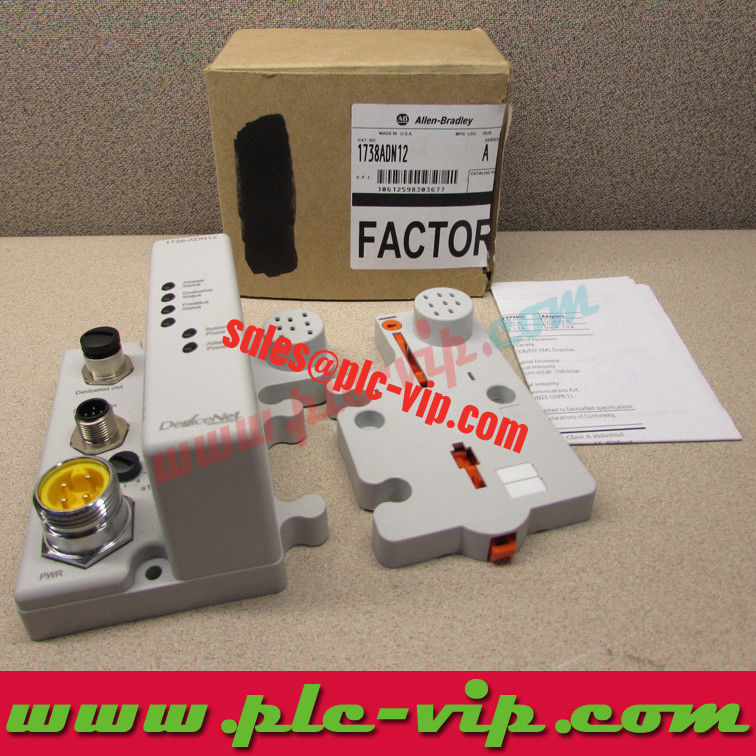
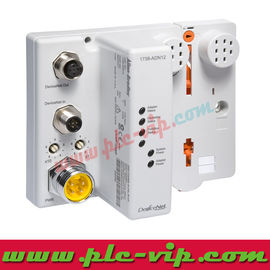
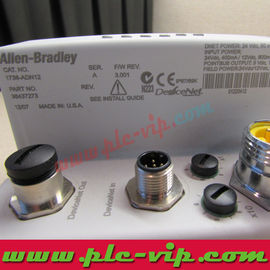
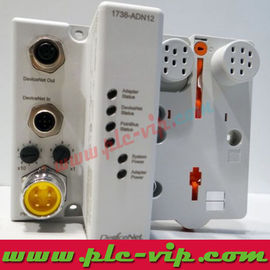
1738-ADN18
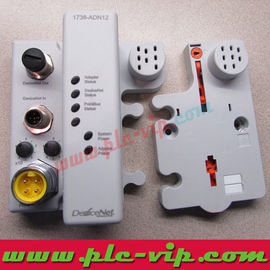
This page documents the 1738-ADN18, a DeviceNet adapter with M18 connectors in the ArmorPoint I/O family. The adapter is the network node of a backplane: it holds the MAC ID, the baud rate and the mapping that turns module positions into scanner data, and the figures below are the system specifications published for the ArmorPoint DeviceNet adapters.
Published adapter data
| Field | Value |
| Catalog number | 1738-ADN18 |
| Family | 1738 ArmorPoint I/O, DeviceNet adapter |
| Connectors | M18 for the DeviceNet drop and the field-power feed |
| Dimensions | 112 H x 72 W x 65 D mm (4.41 x 2.83 x 2.56 in.) |
| Field power bus | 24 V dc nominal, 10 to 28.8 V dc range |
| PointBus | 5 V dc, budgeted per module (75 mA digital and analog, 110 mA for 1738-SSIM23) |
| Isolation | 50 V rms continuous withstand, tested at 1,250 V ac rms for 60 s |
| Operating temperature | -20 to 60 degrees C (-4 to 140 degrees F) |
| Shock and vibration | Operating 30 g, non-operating 50 g; 5 g at 10-500 Hz |
| Maximum modules on a backplane | 63, reachable with additional 1738-EP24DC power modules |
The 18-millimetre shell is the middle size in this family and is chosen when the drop cable is heavier than an M12 body accommodates but the space does not take an M23 flange.
The 18 millimetre shell is the middle size in this family, chosen where the trunk cable is heavier than an M12 body accepts. It is a cable-side decision rather than a logic decision, because the adapter behind the shell maps the backplane the same way.
Backplane capacity and the two power budgets
A backplane tops out at 63 modules, and in practice that limit is reached through power modules inserted to keep the field budget inside the segment rather than through an adapter that runs out of addresses. Every digital and analog module draws 75 mA at 5 V dc from PointBus, the 1738-SSIM23 draws 110 mA, and that sum is what decides how many modules fit before another 1738-EP24DC goes in.
Field power is a separate budget at 10 to 28.8 V dc, and it is the one that fails first on a segment full of sensors. The adapter and the power modules feed the field side, PointBus feeds the logic side, and a segment planned on one of the two trips on the other at commissioning.
Addressing, baud rate and the subnet decision
The adapter holds the MAC ID for the drop and the baud rate for the network, and autobaud is a setting rather than a default that can be relied on. On the 1738-ADNX the adapter also runs a subnet behind itself, which is the architecture that lets modules off the backplane keep their own baud rate and MAC ID; it then builds a scanlist from what it finds and maps data along byte, word or double-word boundaries.
Auto Start Mode is the convenience that is easy to misread: while it runs, the adapter reports an auto-start state and refuses I/O allocation from a scanner, so the parameter has to be returned to a do-nothing value afterwards. A segment left in auto start is a segment a scanner cannot allocate, and the symptom looks like a network fault rather than a commissioning step that was not finished.
Environment and installation facts that repeat across the family
| Parameter | Value |
| Dimensions with base | 120 H x 72 W x 42 D mm (4.72 x 2.83 x 1.65 in.) for I/O modules; 112 H x 72 W x 65 D mm (4.41 x 2.83 x 2.56 in.) for the DeviceNet adapters |
| Enclosure rating | Meets IP65/66/67 when marked; the sealed housing needs no cabinet, though a plant with washdown or corrosive atmosphere can still require one |
| Operating temperature | -20 to 60 degrees C (-4 to 140 degrees F), IEC 60068-2-1 cold, 60068-2-2 dry heat and 60068-2-14 thermal shock |
| Storage temperature | -40 to 85 degrees C (-40 to 185 degrees F) |
| Relative humidity | 5 to 95 percent non-condensing, IEC 60068-2-30 damp heat |
| Shock and vibration | Operating 30 g, non-operating 50 g; 5 g at 10-500 Hz operating |
| Isolation | 50 V rms continuous withstand, tested at 1,250 V ac rms for 60 s |
| ESD and RF immunity | 6 kV contact and 8 kV air discharge, 10 V/m radiated RF from 30 MHz to 2,000 MHz, 10 Vrms conducted RF from 150 kHz to 80 MHz |
| Transient immunity | Plus or minus 3 kV at 5 kHz EFT on signal ports, plus or minus 1 kV line-to-line and plus or minus 2 kV line-to-earth surge |
| Emissions | CISPR 11 Group 1 Class A |
| Mounting | Mounted on a grounded metal plate with #8 (M4) screws; base torque 7.5 in-lb in aluminium and 16 in-lb in steel; the ground lug is also a mounting hole |
| Weight | 0.29 kg (0.64 lb) with base |
| Field power bus | 24 V dc nominal, 10 to 28.8 V dc range |
| PointBus current | 75 mA at 5 V dc for digital and analog modules, 110 mA for 1738-SSIM23 |
Mounting is part of the electrical path: the module sits on a base, the base is fixed to a grounded metal plate with #8 (M4) screws, and the ground lug is also a mounting hole. The conductive path therefore runs through the base and the plate rather than through the module, which is why a module swapped onto a dirty base measures as a missing earth and reads like an electronics fault.
The family is built so the module is the replaceable unit and the base stays on the machine. The keyswitch position on the base has to match the module class, and a module inserted one position off is not a wiring error that can be traced with a meter but a mapping error that appears as shifted channels. That is the difference between a field-wired rack and a sealed I/O system: there is no terminal strip to inspect, only the position and the adapter map.
Same class, other connector shells
The same electrical function is published under other strings in this family: 1738-ADN12, 1738-ADN18P, 1738-ADNX. A substitution between them is a change of shell and cord-set preparation rather than a change of channel behaviour, and the keyswitch position is what has to stay compatible with the base already on the machine.
A backplane in this family is commissioned in the order of the bases rather than by the wiring, and that is the difference between a field-wired rack and a sealed I/O system: there is no terminal strip to inspect, so the channel number a technician sees on the module face is derived from the position on the backplane and the mapping in the adapter. A module inserted one position off is not a wiring error that can be traced with a meter; it is a mapping error that appears as shifted channels.
The adapter is the only place the channel map exists. Modules publish channel counts and data bytes; the adapter publishes the order in which those bytes appear to a scanner, so a replacement module in the same position needs no map change while a module moved to a new position does.
A sealed block is not a substitute for a cabinet when the environment includes washdown or corrosive atmosphere. The IP rating covers the module and its mated connectors; it says nothing about the chemical resistance of the shell or the cable jacket.
The sealed housing is the reason this family exists. An IP67 module on a machine frame removes the cabinet from the field side of the design, and the price of that is that every environmental claim is made per module rather than per enclosure. The catalog number covered on this page is 1738-ADN18.
What this page does not claim matters as much as what it does. It states no cycle time, no maximum cable length and no network baud rate for this catalog number, because those belong to the segment and the adapter rather than to the module, and a figure of that kind copied into a page becomes a specification nobody can trace back to a publication. Where the source documents do fix a value - the channel count, the shell, the current limit, the isolation rating, the temperature window, the data size - it is on this page with the publication named.
No lifecycle statement and no price is implied. The electrical, environmental and data-map figures are quoted from the ArmorPoint installation instructions (1738-IN001 for dc outputs, 1738-IN002 for dc inputs, 1738-IN003 for analog inputs and the temperature input instructions) and the DeviceNet adapter user manual 1738-UM001.