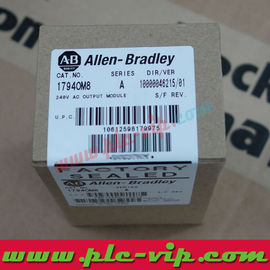
Allen Bradley PLC 1794-OM16 / 1794-OM16
-
-
Large Image :
Allen Bradley PLC 1794-OM16 / 1794-OM16
|
Product Details:
| Place of Origin: |
Made in SINGAPORE |
| Brand Name: |
PLC Module |
| Certification: |
All goods we supply are 100% original factory sealed with 1 year warranty! |
| Model Number: |
Allen Bradley PLC 1794-OM16 / 1794-OM16 |
Payment & Shipping Terms:
| Minimum Order Quantity: |
1 /PCS |
| Price: |
$199.00 (USD/PCS) |
| Packaging Details: |
100% original new |
| Delivery Time: |
IN STOCK; 4-6 weeks for ordering |
| Payment Terms: |
Paypal, T/T and Western Union. |
| Supply Ability: |
10 PCS |
|
Detailed Product Description
 FLEX I/O 1794-OM16 / 1794OM16 16-Point 240V AC Output Module
Category:
PLCs, Power Supplies & I/Os
Manufacturer:
Rockwell
Group:
PLC I/O
The 1794-OM16 switches 16 outputs at 240V AC — 500 mA per point and 4.0 A per module, for contactors, solenoids and lamps on a 220/240V control circuit.
It only mounts on the NEMA-style bases: the 1794-TBN, the fused 1794-TBNF and the coated 1794-TBNK, because the terminals have to carry 264V.
Product Specifications 1794-OM16 (PDF)
Application |
FLEX I/O 240V AC digital output |
Cat Num |
1794-OM16 |
Brand Name |
Rockwell |
Number of outputs |
16, nonisolated |
Output voltage |
159V AC min, 240V AC nom, 264V AC max |
Output current |
500 mA per output at 55 deg C |
Module current |
4.0 A total, 16 outputs at 250 mA |
Output surge |
7 A for 40 ms, repeatable every 8 s |
Voltage drop |
1.5V AC max at 0.5 A |
Leakage current |
2.5 mA max off-state |
Terminal base |
1794-TBN, 1794-TBNF, 1794-TBNK |
Operating temperature |
0...55 deg C |
Attribute values above are reproduced from the manufacturer's product data. For the authoritative technical record see Rockwell publications 1794-DU001 (module specifications) and 1794-SG002 (installation instructions). Certification details, with certificate and file numbers, are listed in the FAQ below.
Output characteristics
159...264V AC on-state, 240V AC nominal, 500 mA per output at 55 deg C.
4.0 A per module, which at 16 points means 250 mA average, so the 500 mA rating is not available on every channel at once.
7 A surge for 40 ms repeatable every 8 s, 1.5V drop at 0.5 A, which is what pulls in an AC contactor coil.
2.5 mA off-state leakage is the figure that decides whether a small relay will drop out.
Bases and voltage
Only the NEMA-style bases are listed: 1794-TBN, 1794-TBNF, 1794-TBNK.
The 264V terminal rating is what separates them from the 132V AC / 156V DC cage clamp family.
The fused base 1794-TBNF provides eight 5 x 20 mm fuses, a practical option for output protection.
<The 1794-TBNK adds conformal coating for the coated variant of the same base.
Isolation and heat
<250V continuous, Basic Insulation Type, type tested at 1250V AC for 60 s, field side to backplane.
<No channel-to-channel isolation, so all 16 outputs share the module reference.
6 W dissipation at 264V AC, 20.47 BTU/hr, the figure that goes into the enclosure thermal calculation.
0...55 deg C operating, narrower than the DC cards.
Application
220/240V AC contactor and solenoid groups in a FLEX I/O island.
Panels where the field circuit is already at 240V, avoiding a step-down.
Not a 120V AC card; the 1794-OA16 handles 120...132V AC.
Not for DC loads.
Where it fits
240V AC output islands on NEMA bases.
Fused variants where external fusing is not practical.
Not for 32 points; the 1794-OA16 stops at 16 as well.
Not for extended temperature.
FAQ — 1794-OM16
What voltage does the 1794-OM16 switch?
159...264V AC, 240V AC nominal.
What is the output current?
500 mA per output, 4.0 A per module.
Which bases are used?
1794-TBN, 1794-TBNF and 1794-TBNK only.
What is the surge rating?
7 A for 40 ms, repeatable every 8 s.
What is the off-state leakage?
2.5 mA maximum.
What is the operating temperature?
0...55 deg C.
Data sources. Technical values on this page come from Rockwell publication 1794-SG002 (FLEX I/O Selection Guide, digital AC output comparison). Any attribute the publication does not print is marked Not published rather than taken from a distributor page. Catalog number, packaging and stock status are the stock record of this listing.
1794-OM16: 240V AC output module, 16 non-isolated outputs
1794-OM16 is a FLEX I/O AC digital output module for the 1794 system, documented here from the Rockwell installation instructions for this module so that the voltage window, the current limits, the derating and the terminal base requirement are on one page.
| Specification | Value |
|---|
| Catalog number | 1794-OM16 |
| Function | 240V AC digital output module, 16 non-isolated outputs |
| Recommended terminal bases | 1794-TBN, 1794-TBNF, 1794-TBNK, 1794-TBNFK |
| Output voltage | 159V AC minimum, 240V AC nominal, 264V AC maximum at 47 to 63 Hz |
| Output current rating | 4.0 A maximum per module, 16 outputs at 250 mA |
| On-state current | 500 mA at 55 degrees C, 50 mA minimum per output |
| Load arrangement note | With 0.5 A outputs, alternate the wiring so that no two 0.5 A outputs are adjacent |
| Surge current | 7 A for 40 ms each output, repeatable every 8 seconds |
| Off-state leakage | 2.5 mA maximum |
| Isolation | 250V continuous, basic insulation, field side to backplane, type tested at 1530V AC for 60 s, no isolation between channels |
| Output signal delay | Half a cycle maximum, on to off and off to on |
| Flexbus current | 116 mA at 5V DC |
| Power dissipation | 6 W maximum at 264V AC, 20.47 BTU/hr |
| Fusing | Outputs are not fused; fusing is recommended, and external fusing is required if a fused base is not used |
| Terminal base load current | 10 A maximum for 1794-OM16 |
| Pilot duty rating | C300 |
| Temperature code | T4 |
| Keyswitch position | 8 |
| Dimensions and weight | 94 x 94 x 91 mm, 108 g |
| Operating temperature | 0 to 55 degrees C, surrounding air 55 degrees C |
| Wiring | 240V AC L1 to C-34, L2 common to B-16, daisy chain to the next base via B-33 and C-51; auxiliary terminal blocks distribute L1 and L2 to each channel |
| Source | 1794-IN123D-EN-P FLEX I/O 240V AC digital input and output modules |
Sixteen outputs at 250 mA each and a four amp ceiling per module is the arithmetic that catches a panel builder out. The per-point figure and the module figure are both real limits, and alternating the high current points so that no two are adjacent is a documented requirement rather than a suggestion.
The instructions state plainly that the outputs are not fused. A fused terminal base or external fusing is therefore part of the electrical design, and the ten amp terminal base load current is the number the common distribution has to be checked against.
This module is documented only on the TBN family of bases, and the 240 volt distribution runs through the base rather than to each point: line on C-34, common on B-16, and daisy chain links to the next base. Auxiliary terminal blocks are what make the per-channel distribution possible on that base.
An AC output module is specified on five lines: the voltage window, the per channel current, the module total, the derating against ambient temperature and the isolation between field and backplane. The table carries all five for this catalog number, and the notes explain which of them is the one that actually limits a panel.
An unfused output module is a design decision that the panel has to complete. The instructions say the outputs are not fused and recommend fusing, and the fused terminal base exists for exactly that, so a quotation without either the fused base or external fuses is an incomplete bill of materials.
A 240 volt output module is not a 120 volt module with a different label. The thresholds, the leakage and the terminal base family all move together, and substituting one for the other because the load is small is the kind of interchange that passes a bench test and fails an inspection.
Derating is written as a table of temperatures for a reason. Five hundred milliamps at fifty five degrees, seven hundred and fifty at thirty five, and a full amp on four non-adjacent outputs at thirty degrees are three different products on the same part number, and the cabinet temperature decides which one is being installed.
Terminal base choice is part of the electrical specification, not a mounting preference. The 240 volt module is documented only on the TBN family, and the auxiliary terminal blocks that distribute line and common to each channel are required rather than optional when that base is used.
Flexbus current is the load the module places on the adapter. Thirty two or eighty or a hundred and sixteen milliamps at five volts depending on the module, and a rail full of these still has to stay inside the adapter budget that was calculated before the modules were ordered.
Off-state leakage is what keeps an AC output honest. A triac or relay that leaks a couple of milliamps will hold a neon indicator faintly lit and will keep a small relay energised, and the field device has to be selected against that leakage rather than against the nominal voltage.
Line and common are distributed along the base rather than to each point. Line to one terminal, common to another, and daisy chain links to the next base is the documented topology, and a point wired directly back to the panel breakers instead of through that distribution is a departure from the drawing.
Spare parts practice for this family is about the terminal base and the coating, not the point count. A site that standardises on one base family can swap a module in minutes, while a mixed shelf of bases turns a ten minute repair into a panel modification.
Surge current is the cold-filament and contactor-inrush case. Seven amps for forty milliseconds repeated every eight seconds is a generous allowance, and a load that exceeds it will not fail immediately; it will fail after a season of switching.
Half a cycle of delay is the timing answer for a solid state AC output. At fifty hertz that is ten milliseconds and at sixty it is eight, which is invisible for a contactor coil and significant for a machine sequence that expects a discrete output to change within a scan.
An AC output module on a DC backplane is a translator, and the published table is the contract: the module accepts a logic command from the adapter and switches a line voltage circuit, and every electrical limit in that table exists because of the difference between those two worlds.
Isolation in this family is field to backplane, not channel to channel. Two hundred and fifty volts continuous with a type test in the kilovolt range protects the backplane, and it does not allow two different line circuits to be mixed on one module without thinking about what happens between their commons.
Pilot duty rating is the sentence that decides whether the module can drive a contactor directly. C300 is a published rating for control circuits, and a starter coil outside that rating needs an interposing relay, which is a component the bill of materials has to carry.
Provide fusing through the fused base or externally, distribute line and common along the base, and check the derating against the cabinet temperature before the load list is fixed.