|
Product Details:
Payment & Shipping Terms:
|
The 1794-IB16XT is the extended-temperature 16-point sinking input: the same 24V DC function as the 1794-IB16, rated -20...70 deg C and conformally coated.
It draws 3.0 mA at 24V instead of 8.0 mA, which is what allows the lower dissipation — 2 W at 31.2V against 6.1 W on the standard card.
| 1794-IB8 | 8-point 24V DC sinking input module | IN STOCK |
| 1794-IB16 | 16-point 24V DC sinking input module | IN STOCK |
| 1794-IB32 | 32-point 24V DC sinking input module | IN STOCK |
| 1794-IB10XOB6 | 10 inputs / 6 sourcing outputs, 24V DC combo module | IN STOCK |
| 1794-IB16XOB16P | 16 inputs / 16 protected sourcing outputs combo module | IN STOCK |
| 1794-IB16D | 16-point diagnostic sinking input module | IN STOCK |
| 1794-IB16XT | 16-point 24V DC sinking input, extended temperature | IN STOCK |
| 1794-IB10XOB6XT | 10 inputs / 6 sourcing outputs, extended temperature | IN STOCK |
| 1794-IA8 | 8-point 120V AC input module | IN STOCK |
| 1794-IA16 | 16-point 120V AC input module | IN STOCK |
| 1794-IC16 | 16-point 48V DC sinking input module | IN STOCK |
| 1794-IG16 | 16-point 5V DC TTL input module | IN STOCK |
| 1794-IH16 | 16-point 125V DC sinking input module | IN STOCK |
| 1794-IM8 | 8-point 240V AC input module | IN STOCK |
| 1794-IM16 | 16-point 240V AC input module | IN STOCK |
| 1794-IV16 | 16-point 24V DC sourcing input module | IN STOCK |
| 1794-IV32 | 32-point 24V DC sourcing input module | IN STOCK |
Application |
FLEX I/O-XT 24V DC sinking input |
Cat Num |
1794-IB16XT |
Brand Name |
Rockwell |
Number of inputs |
16, one group, nonisolated, sinking |
On-state voltage |
10V DC min, 24V DC nom, 31.2V DC max |
On-state current |
2.0 mA min, 3.0 mA @ 24V, 4.0 mA max |
Off-state voltage, max |
5.0V DC |
Off-state current |
1.5 mA minimum |
Isolation |
type tested 850V AC for 60 s |
Flexbus current |
30 mA at 5V DC |
Power dissipation |
2 W at 31.2V DC |
Operating temperature |
-20...70 deg C |
Attribute values above are reproduced from the manufacturer's product data. For the authoritative technical record see Rockwell publications 1794-DU001 (module specifications) and 1794-SG002 (installation instructions). Certification details, with certificate and file numbers, are listed in the FAQ below.
-20...70 deg C operating range and conformal coating to ISA/ANSI-71.040-1985 Class G3, as stated in 1794-IN124.
10...31.2V DC on-state at 3.0 mA nominal, 4.0 mA maximum, with 1.5 mA off-state minimum.
2 W dissipation and 30 mA Flexbus current, roughly a third of the standard module.
16 inputs, one group, nonisolated sinking, with 16 field-side indicators.
Inputs on A-0...A-15, supply on C-35...C-50, commons on B-17...B-32, on a 1794-TB3 or 1794-TB3S.
2-wire devices use input and supply; 3-wire devices add the common, as in the wiring table.
Daisy chain +V from C-51 to the next base's C-34 and common from B-33 to B-16.
The base still needs a coated or -XT partner for a fully rated island.
<Input 15 can provide a counter value in read word 2, with CR and CF bits in the write word.
Fast mode returns raw unfiltered data, standard mode returns filtered data.
Counter functions are unavailable with 1794-ASB or ASB2 adapters, stated in the documentation.
Filter time is set per group of inputs in the write word.
Outdoor cabinets and unheated rooms down to -20 deg C.
Panels with condensing humidity where the coating matters.
Not a substitute for a coated base; pair it with a K or XT base.
Not for 48V or 125V DC.
-XT islands built for extended temperature.
Cold-climate installations where a standard card would stop at 0 deg C.
Not for higher density; the 1794-IB32 carries 32 points.
Not the diagnostic card; the 1794-IB16D reports wiring faults.
What is the operating temperature of the 1794-IB16XT?
-20...70 deg C, with conformal coating.
What current does it draw at 24V?
3.0 mA nominal, 4.0 mA maximum.
How does it compare with the 1794-IB16?
It draws less current and dissipates 2 W instead of 6.1 W, and runs to 70 deg C.
Which bases are used?
1794-TB3 or 1794-TB3S, with a coated or XT base for a fully rated island.
Can input 15 count?
Yes, it can return a counter value when no 1794-ASB or ASB2 adapter is used.
What is the isolation rating?
Type tested at 850V AC for 60 s, field side to system.
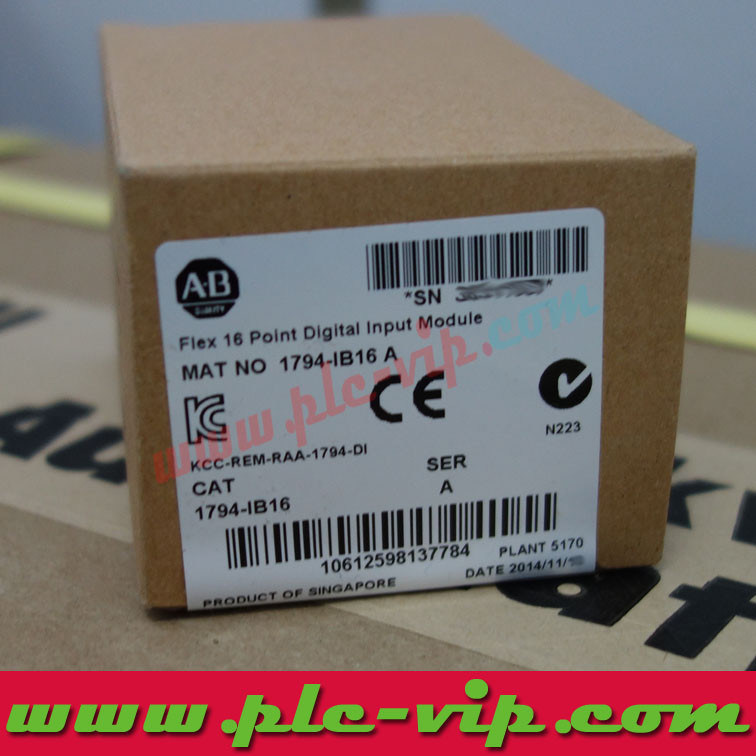
1794-IB16XT is a digital DC input with 16 inputs in the FLEX I/O range, rated for 24V DC, non-isolated. It mounts on the 1794-TB3, 1794-TB3S, 1794-TB3K, 1794-TB3SK terminal base unit, which is ordered separately and is the part that actually carries the field terminals.
| Attribute | Value |
| Catalog number | 1794-IB16XT |
| Module type | digital DC input |
| Points | 16 inputs |
| Electrical range | 24V DC, non-isolated |
| Terminal base unit | 1794-TB3, 1794-TB3S, 1794-TB3K, 1794-TB3SK |
| On-state input | 10V DC minimum, 24V DC nominal, 31.2V DC maximum, sinking |
| Off-state input | 5V DC maximum |
| On-state current | 2.0 mA minimum, 8 mA nominal at 24V DC, 5.0 mA maximum |
| Off-state current | 1.5 mA maximum |
| Input impedance | 4.6 kOhm maximum |
| Power dissipation | 6.1 W at 31.2V DC, per the IB16 entry of the comparison table |
| Operating temperature | -20 to +70 C, the extended temperature version of the 1794-IB16 |
| Dimensions | 46 by 94 by 53 mm, or 94 by 94 by 69 mm installed |
The XT suffix is the extended temperature build rather than a different circuit: the same terminal base list, the same field voltage, and an operating range that reaches 70 C instead of the 55 C of the standard version. Specifying XT and then derating the panel back to 55 C gives away the only thing that was paid for.
The D-shell bases, 1794-TB37DS and 1794-TB62DS, exist so a pre-wired cable can land on a connector instead of on screw terminals. They measure 127 by 94 by 69 mm with an expansion module installed, which is taller than the 94 by 94 by 69 mm envelope of the standard bases and has to be allowed for in the panel layout.
For a retrofit into an existing slice, the addressing is decided by position rather than by catalog number: FLEX I/O assigns the module its place in the rack by the order of the bases on the rail, so inserting a module in the middle shifts the addresses of everything to its right and requires the program to be re-checked.
FLEX I/O bases and modules are separate line items on a purchase order, and the price of getting that wrong is a second shipment: a module without its base cannot be installed, and a base of the wrong termination type cannot be reworked in the field because the module keys to the base family.
Any FLEX I/O position is a pair on the purchase order: one base, one module. Stocking modules without bases, or bases without the matching modules, produces a slice that cannot be commissioned, and the two part numbers are never interchangeable across the 8, 16 and 32 point families.
Mounting is a DIN rail operation on both parts and the order of assembly is base first, module second: the base slides onto the rail, its backplane fingers engage the neighbouring base, and the module is then pressed onto the base and secured. Removing a module does not break the backplane, which is why a failed slice can be swapped without rewiring the row.
Practical check before ordering: confirm the permitted terminal base for the module, confirm the conductor range and current capacity of that base against the field wiring schedule, confirm whether the location needs the conformal coated K variant, and confirm the operating temperature class against the panel interior rather than the room.
The Allen-Bradley Flex I/O 1794 modules category groups the other catalog numbers, options and spare parts in the same range.