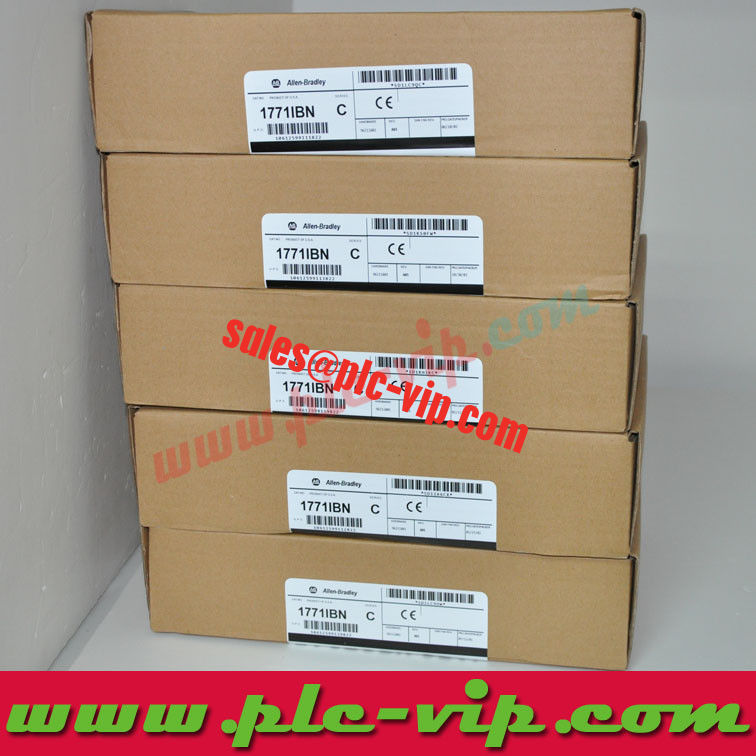
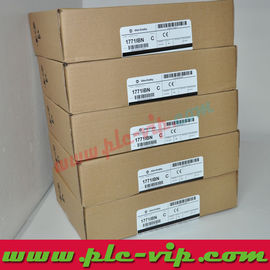
1771-IN Rockwell 8 Point 24 V AC Input Module
Category:
PLCs, Power Supplies & I/Os
Manufacturer:
Rockwell
Group:
Bulletin 1771 · PLC-5 input modules
1771-IN is a 8-point AC input module for the 1771 I/O chassis used by PLC-5 and PLC-2 processors. It is the 24 V AC input of the family, and its published data sheet is the most complete of the AC cards: 7 mA at 12 V AC, 18 mA at 24 V AC, 22 mA at 28 V AC, 10.5 V AC peak maximum off-state, 18 ms plus 10 ms delay on or off, 1500 V isolation between field and system, and 80 mA backplane current.
Field connections land on the 1771-WA wiring arm, the 10-terminal arm that swings up to the module so the arm can stay wired while the module is swapped.
Product Specifications 1771-IN (PDF)
Catalog number |
1771-IN |
Product type |
8-point AC input module |
Number of inputs |
8 |
Input signal |
24 V AC at 47-63 Hz, 12-28 V AC on-state |
Module series |
A |
1771 chassis compatibility |
Series A and B chassis |
Lifecycle status |
Discontinued |
Discontinued date |
Not published |
Replacement category |
Engineering Replacement |
UPC |
Not published |
Country of origin |
Not published |
Field wiring arm |
1771-WA, 10 terminal |
Attribute values above are reproduced from the manufacturer's product data. For the authoritative technical record see Rockwell publications 1771-TD041 (module specifications) and 1771-IN082 (installation instructions). Certification details, with certificate and file numbers, are listed in the FAQ below.
What the module does in a 1771 rack
1771-IN is a 8-point AC input module for the 1771 I/O chassis used by PLC-5 and PLC-2 processors. It is the 24 V AC input of the family, and its published data sheet is the most complete of the AC cards: 7 mA at 12 V AC, 18 mA at 24 V AC, 22 mA at 28 V AC, 10.5 V AC peak maximum off-state, 18 ms plus 10 ms delay on or off, 1500 V isolation between field and system, and 80 mA backplane current.
The slot it occupies is one 1771 slot, and the input image it claims is fixed by the module series: 8. That number decides how much of the processor input table the rack consumes, not how many wires the panel brings in.
Signal level is 24 V AC at 47-63 Hz, 12-28 V AC on-state. Nothing in the module is software configurable, so the field device has to match the printed range before the module is ordered.
Wiring, keying and the 1771-WA arm
Field connections land on the 1771-WA wiring arm, the 10-terminal arm that swings up to the module so the arm can stay wired while the module is swapped.
Keying bands in the chassis connector must line up with the slots on the module board. 1771 chassis are keyed per module type precisely so a 120 V AC module cannot be pushed into a slot wired for a 24 V DC module.
Backplane current comes from the chassis supply, so the load of every module in the rack has to be added up before a rack is repopulated with these cards.
There is no isolation between the individual input channels on this card, which matters when several 24 V AC circuits share the same transformer.
Chassis compatibility and addressing
Chassis compatibility is published per module series: Series A and B chassis. Series A modules fit the superseded 1771-A1, -A2 and -A4 chassis as well as the current A1B to A4B and AM1/AM2 chassis.
Some 32-point and isolated cards can only be placed under 1-slot or 2-slot addressing rules, so the addressing mode of the chassis has to be confirmed before a mixed rack is built.
Lifecycle and replacement
Rockwell lists 1771-IN as Discontinued, replacement category Engineering Replacement.
The published discontinued date is Not published.
The family replacement path is a 1756 or 1794 migration, which means the field wiring, the wiring arms and the addressing scheme all change. Buying the same catalog number is usually cheaper than re-terminating a panel.
The arm is the 1771-WA with 7 to 9 pound-inch screw torque, keyed between 4 and 6 and between 10 and 12.
Buying a used module
Ask for a photo of the label side and the wiring arm. A module removed without its arm has to be re-keyed and re-wired, which is where most of the cost of a used card actually sits.
Check the module series letter against the chassis series: an A-series card in an A1B chassis works, but the reverse combination is what produces "module not recognised" faults.
These are static-sensitive cards. A unit shipped loose without conductive foam is a risk, whatever the price.
FAQ — 1771-IN
How many inputs does 1771-IN have?
8, on the published 1771 data sheet.
What input signal does 1771-IN accept?
24 V AC at 47-63 Hz, 12-28 V AC on-state.
Which 1771 chassis will accept 1771-IN?
Series A and B chassis.
Is 1771-IN still available from Rockwell?
No. It is listed as Discontinued with replacement category Engineering Replacement.
What is the discontinued date of 1771-IN?
Not published.
Data sources. Point counts, input signal ranges and chassis codes come from the 1771 technical data sheets (1771-TD180 for DC, 1771-TD041 and 1771-IN082 for the 24 V AC module, 1771-IN046 and 1771-IN051 for analog); lifecycle dates, UPC and country of origin come from the Rockwell product page for the catalog number. Where Rockwell has withdrawn the catalog page, the field is marked Not published rather than guessed. Any attribute a publication does not print is marked Not published rather than taken from a distributor page. Catalog number, packaging and stock status are the stock record of this listing.
Where this 1771 module sits in the family: signal class, point count, one slot each
Forty-one 1771 input catalogues resolve into nine signal classes, and the class decides more than the part number does: it fixes which field voltages are possible, which module can be isolated, and - with the point count - how much of the processor input image the rack spends. The table below is the class view rather than a list of forty-one part numbers.
| Signal class | Catalogues and point counts in this class | Range printed for the class |
| 120 V AC / AC-DC | 1771-IA (8), 1771-IAD (16), 1771-ID (6, isolated), 1771-ID16 (16, isolated) | IA 87...138 V AC and 97...138 V DC; IAD and ID16 120 V AC; ID accepts 120 V AC or 120 V DC |
| 24 V DC, standard | 1771-IB (8), 1771-IBD (16), 1771-IBN (32), 1771-IQ16 (16, isolated), 1771-IQ (8, selectable) | IB 10...27 V DC (12...24 V nominal); IBD 10...30 V DC; IQ 5...30 V DC selectable; IQ16 24 V DC isolated |
| 24...48 V DC wide range | 1771-IH (8) | 24...48 V DC on one module |
| 48 V DC | 1771-IC (8) | 42...56 V DC, 48 V DC nominal |
| 24 V AC | 1771-IN (8), 1771-IND (16) | IN 24 V AC at 47...63 Hz, 12...28 V AC on-state |
| TTL | 1771-IG (8), 1771-IGD (16) | TTL level DC |
| Analog voltage / current | 1771-IFE, 1771-IFF (16 single-ended / 8 differential), 1771-IFMS (8), 1771-IL (8 fully isolated) | IFE voltage or current set per input by configuration jumper; IFF +1...5 / 0...5 / -10...10 V DC; IL adds +4...20 mA and 0...20 mA ranges with full isolation |
| Temperature | 1771-IR (6 RTD, 3-wire), 1771-IXE (8 TC/mV), 1771-IXHR (8 TC/mV high resolution) | RTD 3-wire; thermocouple and millivolt |
| Controller / driver logic | 1771-LC3B loop controller, 1771-IV driver logic | Analog loop control in one slot; driver logic level input |
Where this page sits: 1771-IN is the 24 V AC control circuit input in the 24 V AC class, with 8 points at 24 V AC at 47...63 Hz. Reading the class table under this paragraph is what stops a wrong order: the class decides which field voltages are possible at all, and the point count then decides how much of the input image the rack spends. The class is narrow on purpose - 48 V DC and 24 V AC each exist at eight points only, and the wide-range 1771-IH covers 24 to 48 V DC on the same eight channels rather than adding a second part number.
Three mechanical facts apply to every module in the table. Each occupies one 1771 slot in a PLC-5 or PLC-2 chassis, so the module count and the slot count are the same number. Field wiring lands on the 1771-WA 10-terminal wiring arm, which swings up to the module so the arm can stay wired while a module is swapped - that is the feature that makes a failed input module a five-minute replacement rather than a re-termination. And keying bands in the chassis connector must be set to match the module, because the chassis connector is the same shape for modules of different signal classes and only the keying stops a 120 V AC module being plugged into a slot wired for 24 V DC.
Two limits of the published data are left as gaps rather than filled. The withdrawn variant catalogues (1771-IA2, 1771-IADK, 1771-IBDK, 1771-IDK, 1771-IM and 1771-IXEK) no longer have a Rockwell catalog page, so their own point count and signal range are not published and this table quotes the base part instead. And the number of input-image words a module consumes is printed per module series in 1771-TD180 rather than in this summary, so the image budget for a rack has to be added up from that publication, not from the point counts here.
Product type, point count and signal range per the 1771 technical data sheets (1771-TD180 for DC, 1771-TD041 and 1771-IN082 for 24 V AC, 1771-IN046 and 1771-IN051 for analog) and 1785-SG001, as transcribed on this page.