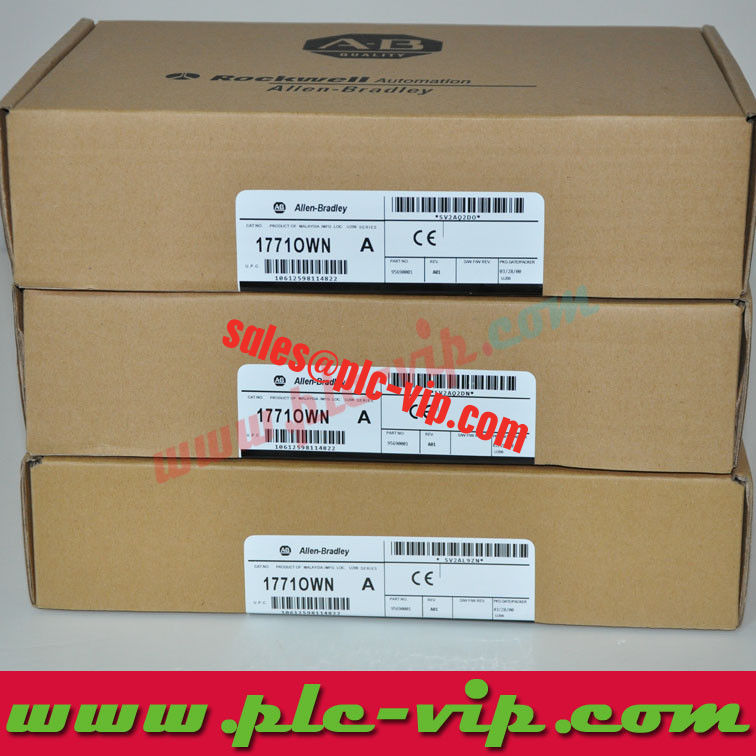
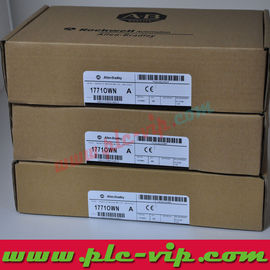
1771-IDK
This page covers catalog number 1771-IDK, the catalog number this shop lists as 1771-IDK, set against the published 1771-ID isolated AC/DC input module data. Where a suffix on this listing is not defined by the manufacturer, the page says so and prints the documented module data; no specification has been invented for the suffix.
Published data for the module behind this catalog number
| Specification | Value |
|---|
| Catalog number, module | 1771-ID |
| Inputs per module | 6, individually isolated |
| Input voltage range | 92 to 138V AC or DC, 47 to 63 Hz |
| Nominal input current | 8 mA at 120V AC, 8 mA at 120V DC |
| Input signal delay, AC | 24 ms ±10 ms, on or off |
| Input signal delay, DC | 10 ms ±4 ms turning on, 20 ms ±9 ms turning off |
| Maximum off-state current | 1.7 mA |
| Maximum off-state voltage | 45V AC peak, 55V DC peak |
| Power dissipation | 4.4 W maximum, 0.4 W minimum |
| Thermal dissipation | 15.0 BTU/hr maximum, 1.3 BTU/hr minimum |
| Backplane current | 74 mA |
| Opto-electrical isolation | 1500V AC rms |
| Operating temperature | 0 to 60 °C (32 to 140 °F) |
| Storage temperature | -40 to 85 °C (-40 to 185 °F) |
| Relative humidity | 5 to 95% without condensation |
| Conductors | 14 gauge stranded maximum, 3/64 in. insulation maximum |
| Keying | Between 4 and 6, and between 28 and 30 |
| Status indicators | Six red indicators, one per input |
| Driving from an output module | A 120V AC output module such as 1771-OA, 1771-OD or 1771-OP can drive the input terminals directly |
| Lifecycle | Discontinued 31 December 2025; replacement product 1756-IA16I |
| Technical data | 1771-TD019 |
What the published figures mean at the terminals
Fifteen hundred volts of opto-electrical isolation is a design figure, not an instruction to test at that level in service. A hipot applied across a working channel stresses the isolator and the field wiring together, and the published figure describes what the barrier survives rather than what maintenance should apply.
The four point four watt maximum against four tenths of a watt minimum is a published spread that tells an engineer the card is mostly dissipation when all six inputs are on. Six channels in a small cabinet is not a thermal problem on its own; it becomes one when the same enclosure carries several dense cards beside it.
Six inputs rather than sixteen is the defining published fact, and it is a consequence of isolation. Each channel carries its own opto-isolator and its own termination pair, so the card spends its area on separation rather than on density, and a panel that needs six independent signals gets six independent signals.
Nine to one hundred and thirty eight volts AC or DC is the published window, which accepts a 120 volt control circuit and a 24 volt one is outside it. That narrow window is why this card cannot be used as a general purpose input: it is a 120 volt device, published as such, and a 24 volt signal on it reads as nothing.
One point seven milliamps of maximum off-state current is the row that matters for sensor selection. Above that leakage, a two wire proximity sensor holds the channel on with no signal present, and the published bleeder table in the sensor interface manual exists to bring the leakage back under the threshold.
Isolation at fifteen hundred volts AC rms is published as opto-electrical, which is the figure that lets six field circuits at different potentials share one card. That is the whole purpose of this module compared with the sixteen point cards, and it is why a mixed panel often carries one of these beside a dense card.
The AC delay of twenty four milliseconds plus or minus ten is symmetric, on and off, while the DC delay is ten milliseconds on and twenty off. A user who swaps an AC sensor for a DC one on the same channel changes both the response and the asymmetry of the channel, which matters in a sequence but not in a slow interlock.
Six red status indicators are the only diagnostics on the faceplate. There is no module active light on this card, so a channel that never lights is either an input that never arrives or a card that is not being scanned, and the difference has to be found in the processor rather than at the module.
A 120 volt AC output module can drive these terminals directly, which is a published statement about the input's current draw rather than about convenience. Eight milliamps at nominal voltage is inside what the output can source, and a direct connection avoids an interposing relay that would otherwise add its own failure mode.
Keying sits between four and six and between twenty eight and thirty, which is a different pair from the sixteen point modules in the same family. A chassis repopulated from stores without moving the bands will refuse this card, and the refusal is the chassis working as designed.
The module is discontinued as of the end of 2025 with a replacement product named in the published lifecycle data. That makes this a page about keeping an installed base running rather than about specifying a new panel, and the rows that matter are the ones a substitute has to meet: voltage window, off-state current, isolation and delay.
A six point isolated input is a low density card with a high separation claim, and the published figures support that reading. Nothing on the page is about speed or density; everything is about what can be connected beside what without a shared reference.
Eight milliamps at one hundred and twenty volts is a substantial input current for a logic card, and it is the price of isolation per channel. It also means the field device has to be able to source or sink that current through a switch contact, and a small pilot device rated for a milliamp logic input will not survive this card's burden.
The other 1771 modules and PLC-5 chassis parts are collected in the PLC-5 category. This catalog number can be checked against the shop listing at 1771-IDK.
Where this 1771 module sits in the family: signal class, point count, one slot each
Forty-one 1771 input catalogues resolve into nine signal classes, and the class decides more than the part number does: it fixes which field voltages are possible, which module can be isolated, and - with the point count - how much of the processor input image the rack spends. The table below is the class view rather than a list of forty-one part numbers.
| Signal class | Catalogues and point counts in this class | Range printed for the class |
| 120 V AC / AC-DC | 1771-IA (8), 1771-IAD (16), 1771-ID (6, isolated), 1771-ID16 (16, isolated) | IA 87...138 V AC and 97...138 V DC; IAD and ID16 120 V AC; ID accepts 120 V AC or 120 V DC |
| 24 V DC, standard | 1771-IB (8), 1771-IBD (16), 1771-IBN (32), 1771-IQ16 (16, isolated), 1771-IQ (8, selectable) | IB 10...27 V DC (12...24 V nominal); IBD 10...30 V DC; IQ 5...30 V DC selectable; IQ16 24 V DC isolated |
| 24...48 V DC wide range | 1771-IH (8) | 24...48 V DC on one module |
| 48 V DC | 1771-IC (8) | 42...56 V DC, 48 V DC nominal |
| 24 V AC | 1771-IN (8), 1771-IND (16) | IN 24 V AC at 47...63 Hz, 12...28 V AC on-state |
| TTL | 1771-IG (8), 1771-IGD (16) | TTL level DC |
| Analog voltage / current | 1771-IFE, 1771-IFF (16 single-ended / 8 differential), 1771-IFMS (8), 1771-IL (8 fully isolated) | IFE voltage or current set per input by configuration jumper; IFF +1...5 / 0...5 / -10...10 V DC; IL adds +4...20 mA and 0...20 mA ranges with full isolation |
| Temperature | 1771-IR (6 RTD, 3-wire), 1771-IXE (8 TC/mV), 1771-IXHR (8 TC/mV high resolution) | RTD 3-wire; thermocouple and millivolt |
| Controller / driver logic | 1771-LC3B loop controller, 1771-IV driver logic | Analog loop control in one slot; driver logic level input |
Where this page sits: 1771-IDK is a withdrawn variant catalog in the 120 V AC / AC-DC class. Rockwell has taken its own catalog page down, so the point count and signal range printed for 1771-ID above are the figures to quote against it: 6 points at 120 V AC or 120 V DC. What the variant letter changes is not published, and the honest answer on a quotation is therefore that the base part 1771-ID is the reference and the variant letter is a packaging or documentation difference to be confirmed before a firm price is given.
Three mechanical facts apply to every module in the table. Each occupies one 1771 slot in a PLC-5 or PLC-2 chassis, so the module count and the slot count are the same number. Field wiring lands on the 1771-WA 10-terminal wiring arm, which swings up to the module so the arm can stay wired while a module is swapped - that is the feature that makes a failed input module a five-minute replacement rather than a re-termination. And keying bands in the chassis connector must be set to match the module, because the chassis connector is the same shape for modules of different signal classes and only the keying stops a 120 V AC module being plugged into a slot wired for 24 V DC.
Two limits of the published data are left as gaps rather than filled. The withdrawn variant catalogues (1771-IA2, 1771-IADK, 1771-IBDK, 1771-IDK, 1771-IM and 1771-IXEK) no longer have a Rockwell catalog page, so their own point count and signal range are not published and this table quotes the base part instead. And the number of input-image words a module consumes is printed per module series in 1771-TD180 rather than in this summary, so the image budget for a rack has to be added up from that publication, not from the point counts here.
Product type, point count and signal range per the 1771 technical data sheets (1771-TD180 for DC, 1771-TD041 and 1771-IN082 for 24 V AC, 1771-IN046 and 1771-IN051 for analog) and 1785-SG001, as transcribed on this page.