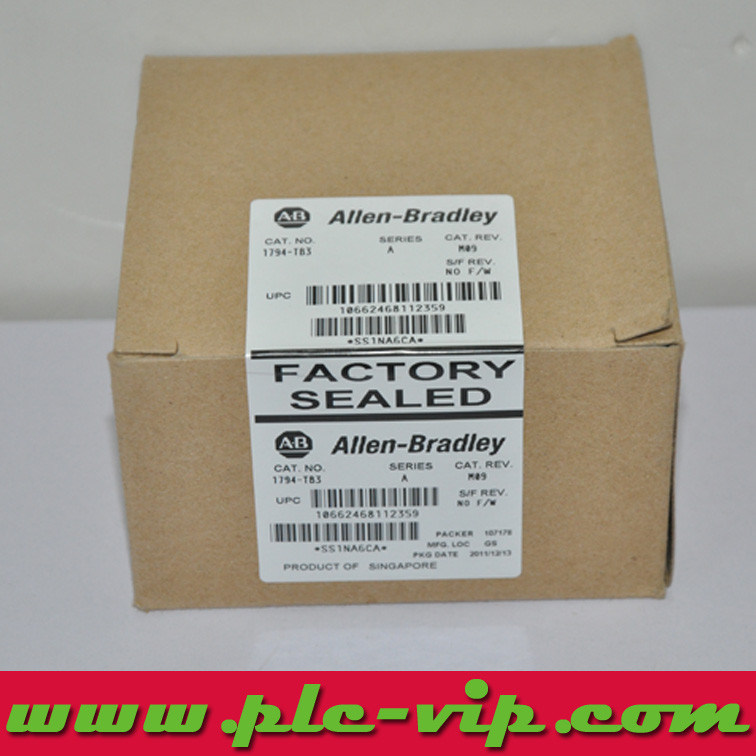
FLEX I/O 1794-TB3TK / 1794TB3TK Temperature Base, Coated
Category:
PLCs, Power Supplies & I/Os
Manufacturer:
Rockwell
Group:
PLC I/O
The 1794-TB3TK is the conformally coated temperature base — the 1794-TB3T with the K suffix, which is the coating used with -XT extended-temperature modules.
For a thermocouple island in a cold or condensing panel, the coating is the difference between a base that starts reliably and one that needs a heater.
| 1794-TB2 |
16-terminal cage clamp base, 2-wire, up to 132V AC |
IN STOCK |
| 1794-TB3 |
16-terminal cage clamp base, 3-wire devices |
IN STOCK |
| 1794-TB3S |
16-terminal spring clamp base, 3-wire devices |
IN STOCK |
| 1794-TB32 |
32-terminal cage clamp base for 32-point modules |
IN STOCK |
| 1794-TB32S |
32-terminal spring clamp base for 32-point modules |
IN STOCK |
| 1794-TB3T |
temperature base with two cold junction compensation sets |
IN STOCK |
| 1794-TB3TS |
spring clamp temperature base with CJC sets |
IN STOCK |
| 1794-TB3G |
grounded screw clamp base, 36 I/O, 10 chassis ground |
IN STOCK |
| 1794-TB3GS |
grounded spring clamp base, 36 I/O, 10 chassis ground |
IN STOCK |
| 1794-TBKD |
cage clamp base with 16 knife disconnects |
IN STOCK |
| 1794-TBN |
NEMA-style screw clamp base, up to 264V AC/DC |
IN STOCK |
| 1794-TBNF |
fused NEMA-style base, eight 5 x 20 mm fuses |
IN STOCK |
| 1794-TB37DS |
37-pin D-shell termination for digital and analog modules |
IN STOCK |
| 1794-TB62DS |
62-pin D-shell termination for digital and analog modules |
IN STOCK |
Product Specifications 1794-TB3TK (PDF)
Application |
FLEX I/O terminal base for temperature modules |
Cat Num |
1794-TB3TK |
Brand Name |
Rockwell |
Termination |
Cage clamp, 16 I/O, 10 common, 4 +V, 8 chassis ground |
Cold junction |
2 sets of CJC for temperature modules |
Wire size |
0.34...3.3 mm2 (22...12 AWG), 75 deg C or greater |
Current capacity |
10 A maximum |
Voltage |
Up to 132V AC / 156V DC |
Dimensions |
94 x 94 x 69 mm |
Operating temperature |
-20...70 deg C |
Attribute values above are reproduced from the manufacturer's product data. For the authoritative technical record see Rockwell publications 1794-DU001 (module specifications) and 1794-SG002 (installation instructions). Certification details, with certificate and file numbers, are listed in the FAQ below.
Coating
Conformal coating is the only difference from the 1794-TB3T; the terminal count, CJC sets and ratings are identical.
The K suffix is defined in the selection guide as the coated version of the standard catalog, for use with -XT modules.
-20...70 deg C operating range, unchanged, with the coating making cold-start condensation survivable.
94 x 94 x 69 mm — same footprint, so a coated base substitutes without changing the rail layout.
Temperature function
Two CJC sets for 1794-IT8 and 1794-IRT8 thermocouple mode, replaceable with the 1794-CJC2 kit.
16 I/O, 10 common, 4 +V and 8 chassis ground, with the ground terminals serving the 1794-IR8 and analog cards.
10 A current capacity and 22...12 AWG wire.
Up to 132V AC / 156V DC on the terminals with category 2 wiring.
Application
Coated thermocouple islands paired with -XT temperature modules.
Outdoor or unheated panels where condensation forms on the base at start-up.
Not a digital base: the terminal pattern and CJC sets are for temperature cards.
Not spring termination; the coated spring version is the 1794-TB3TSK.
Mounting
35 x 7.5 mm DIN rail with 25 mm air space, or the 1794-NM1 panel kit.
Zinc-plated, yellow-chromated steel rail for chassis grounding through the rail.
1492-EA35 rail locks in high-vibration installations.
One end cap per system, with bases plugging together to form the backplane.
Where it fits
Temperature islands in outdoor cabinets, -20...70 deg C with coating.
Paired with 1794-IRT8XT or 1794-IT8 in a condensing environment.
Not for general digital cards; the 1794-TB3K is the coated standard base.
Not for analog grounding; the 1794-TB3GK provides individual grounding.
FAQ — 1794-TB3TK
What does the K suffix mean on the 1794-TB3TK?
It is the conformally coated version of the 1794-TB3T temperature base.
How many CJC sets does it carry?
Two, for 1794-IT8 and 1794-IRT8 in thermocouple mode.
What is the operating temperature?
-20...70 deg C.
Are the CJC sets replaceable?
Yes, with the 1794-CJC2 kit.
What wire size does it accept?
0.34...3.3 mm2 (22...12 AWG), 75 deg C or greater.
Does it change the rail layout?
No; it is the same 94 x 94 x 69 mm footprint as the uncoated base.
Data sources. Technical values on this page come from Rockwell publication 1794-SG002 (FLEX I/O Selection Guide, terminal base comparison) and 1794-IN092. Any attribute the publication does not print is marked Not published rather than taken from a distributor page. Catalog number, packaging and stock status are the stock record of this listing.