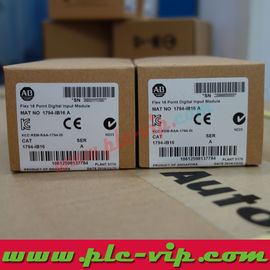
FLEX I/O 1794-IH16 / 1794IH16 16-Point 125V DC Input Module
Category:
PLCs, Power Supplies & I/Os
Manufacturer:
Rockwell
Group:
PLC I/O
The 1794-IH16 reads 16 sinking inputs at 125V DC, the station-battery voltage used in switchgear, substation and utility panels.
At 2 mA nominal and 60 k ohm input impedance, it presents almost no load to the station battery while still rejecting the leakage that would trip a 24V card.
Product Specifications 1794-IH16 (PDF)
Application |
FLEX I/O 125V DC digital input |
Cat Num |
1794-IH16 |
Brand Name |
Rockwell |
Number of inputs |
16, current, sinking |
On-state voltage |
90V DC min, 125V DC nom, 146V DC max |
On-state current |
1.0 mA min, 2.0 mA @ 125V, 3.0 mA max |
Off-state voltage, max |
20V DC |
Off-state current, max |
0.8 mA |
Input impedance |
60 k ohm nominal |
Isolation |
250V continuous, type tested 1706V DC for 60 s |
External supply |
90...146V DC |
Operating temperature |
0...55 deg C |
Attribute values above are reproduced from the manufacturer's product data. For the authoritative technical record see Rockwell publications 1794-DU001 (module specifications) and 1794-SG002 (installation instructions). Certification details, with certificate and file numbers, are listed in the FAQ below.
Input characteristics
90...146V DC on-state, 2.0 mA at 125V nominal, 1.0 mA at the 90V threshold and 3.0 mA at 146V.
Off-state below 20V DC with 0.8 mA maximum, a wide margin that suits a battery bus with charger ripple.
60 k ohm nominal input impedance limits drain on the station battery.
16 current-sinking inputs, one group, with 16 field-side indicators.
Isolation
250V continuous, Basic Insulation Type, type tested at 1706V DC for 60 s between field side and system.
No isolation between individual channels, so a common return is assumed.
<Class I Division 2 approval is listed for this module in the installation instructions.
Open-style enclosure, mounted inside a suitably rated panel.
Filtering
Selectable input filter 0.25...32 ms through two bit groups, one for inputs 0...11 and one for 12...15.
Filter time 0 is the 0.25 ms default; stepping up to filter 7 gives 32 ms for noisy contacts.
Filtering is configured in the module's output image word, not by wiring.
Keyswitch position 1 on the terminal base.
Application
Station battery status and breaker auxiliary contacts at 125V DC.
Substation and utility panels where 125V DC is the control standard.
Not for 48V DC; the 1794-IC16 covers that.
Not for AC control circuits; the 1794-IA16 is the 120V AC input.
Where it fits
125V DC switchgear islands with 1794-TB3 or 1794-TB3S bases.
Panels with very long DC runs where the current is deliberately small.
Not for extended temperature; 0...55 deg C.
Not for high-speed counting; the counter modules handle fast pulses.
FAQ — 1794-IH16
What voltage range does the 1794-IH16 accept?
90...146V DC, with 125V DC nominal.
What is the on-state current?
2.0 mA at 125V DC, between 1.0 and 3.0 mA.
What is the input impedance?
60 k ohm nominal.
What is the off-state limit?
20V DC maximum, 0.8 mA maximum off current.
What filter times are available?
0.25, 0.5, 1, 2, 4, 8, 16 and 32 ms, selectable.
What is the isolation rating?
250V continuous, type tested at 1706V DC for 60 s.
Data sources. Technical values on this page come from Rockwell publication 1794-IN118 (FLEX I/O 125V DC Digital Input Module). Any attribute the publication does not print is marked Not published rather than taken from a distributor page. Catalog number, packaging and stock status are the stock record of this listing.