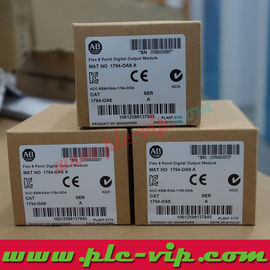
FLEX I/O 1794-OA8I / 1794OA8I 8-Point 120V AC Output Module
Category:
PLCs, Power Supplies & I/Os
Manufacturer:
Rockwell
Group:
PLC I/O
The 1794-OA8I shares the 1794-OA8 output stage and the same published ratings in 1794-SG002 Table 11, with the I suffix marking it as the isolated variant in the AC output line.
Choosing between them is a drawing decision, not a performance one: the electrical figures in the selection guide are printed as a single row for both catalogue numbers.
Product Specifications 1794-OA8I (PDF)
Application |
FLEX I/O digital output, 1794 terminal base |
Cat Num |
1794-OA8I |
Brand Name |
Rockwell |
Outputs |
8, AC |
Load voltage |
85V AC minimum, 132V AC maximum |
Output current |
5 mA minimum; 500 mA per channel at 55 deg C, 750 mA at 35 deg C |
Module current |
4.0 A maximum |
Off-state leakage |
2.25 mA maximum |
On-state voltage drop |
1.0V at 0.5 A |
Surge current |
7 A for 45 ms, repeatable every 8 s |
Isolation |
2150V DC for 1 s; 1250V AC for 60 s |
Power dissipation |
4.1 W (14.0 BTU/hr) |
Fusing |
1.6 A 250V slow-blow (Littelfuse 23901.6 or SAN-O SD6-1.6A) |
Operating temperature |
-20...55 deg C |
Attribute values above are reproduced from the manufacturer's product data. For the authoritative technical record see Rockwell publications 1794-DU001 (module specifications) and 1794-SG002 (installation instructions). Certification details, with certificate and file numbers, are listed in the FAQ below.
Same published ratings
85...132V AC load voltage, 500 mA at 55 deg C, 4.0 A per module and 5 mA minimum load are the figures published for both 1794-OA8 and 1794-OA8I.
2.25 mA leakage and 1.0V drop at 0.5 A are likewise common to the row, so the two cards behave the same way on the same load.
7 A for 45 ms every 8 s covers the inrush of the loads this class of card is intended for.
4.1 W dissipation and the -20...55 deg C range complete the shared row in the selection guide.
What isolation means here
The published isolation is field to system: 2150V DC for 1 s and 1250V AC for 60 s, tested on the module.
Read the datasheet before assuming channel separation. The selection guide gives one isolation figure per row, and a panel that needs individual channel isolation needs a different product, not a suffix.
Where isolation matters is between the control side and the mains side of the panel, which is what keeps a fault on a 120V load out of the FlexBus.
The isolation is type tested, not a routine production test on every channel; a field dielectric test on the terminals is a different exercise.
Fusing and load behaviour
1.6 A 250V slow-blow per output: Littelfuse 23901.6 or SAN-O SD6-1.6A, on a fused base or in the panel.
Minimum load 5 mA and 2.25 mA leakage set the boundary: a load too light for one and too sensitive for the other needs a bleeder resistor.
Inductive loads need suppression at the coil, or the output is switched off by the kick each cycle and fails early.
Lamp loads are handled by the 7 A surge, but a 120V filament draws ten times its steady current cold, so the lamp wattage belongs in the calculation.
Panel practice
Keep 120V output wiring in its own duct away from analog and network cable; every zero-crossing switching step is a small transient.
Label each output at the base and keep the fuse rating with the load schedule, because the fuse is protecting the triac as much as the wire.
Module replacement leaves the wiring because the field terminals sit on the base rather than on the card.
Verify the load before the card. A channel that does not switch is more often a blown fuse or an open coil than a failed output stage.
Installation
Keying, FlexBus connector, pin inspection, alignment, latch — the five insertion steps in 1794-IN093 apply to the AC cards as to the DC ones.
Remove field power before inserting unless the base and adapter publication allows removal under power.
-40...85 deg C storage, 5...95% RH non-condensing, 5 g vibration at 10...500 Hz and 30 g shock are the general environmental limits.
EMC compliance is IEC 61000-6-4, with 2 kV EFT on signal ports and 10 V/m radiated immunity from 80 to 6000 MHz.
FAQ — 1794-OA8I
How does the 1794-OA8I differ from the 1794-OA8?
The catalogue suffix marks the isolated variant; 1794-SG002 prints a single electrical row covering both part numbers.
What current can each output carry?
500 mA at 55 deg C per channel, 750 mA at 35 deg C, with 4.0 A for the module.
What is the minimum load?
5 mA per output; below it the triac may fail to latch.
What fuse is required?
A 1.6 A 250V slow-blow, Littelfuse 23901.6 or SAN-O SD6-1.6A.
What isolation is published?
2150V DC for 1 s and 1250V AC for 60 s, field to system.
Which temperature range applies?
-20...55 deg C operating, the same as the 1794-OA8.
Data sources. Technical values on this page come from Rockwell publication 1794-SG002 (FLEX I/O Selection Guide, Table 7 and Table 11) and 1794-IN093. Any attribute the publication does not print is marked Not published rather than taken from a distributor page. Catalog number, packaging and stock status are the stock record of this listing.
Choosing among the FLEX I/O AC and relay output modules
1794-OA8I is one of four AC and relay output modules on this site whose records can be set against each other row by row, and it is the low-voltage AC member of that group. The two tables below hold the four side by side as their records print them, because the differences that decide a purchase sit in the load window, the module ceiling and the temperature floor rather than in the channel count.
| Catalog number | Outputs | Load window as printed | Per-channel and module current | Isolation as printed | Fuse as printed |
|---|
| 1794-OA8I | 8, AC | 85 V AC to 132 V AC | 5 mA minimum; 500 mA per channel at 55 C and 750 mA at 35 C; 4.0 A per module | 2150 V DC for 1 s; 1250 V AC for 60 s | 1.6 A 250 V slow-blow |
| 1794-OA16 | 16, AC | 159 V AC to 264 V AC | 500 mA per channel at 55 C; 4.0 A per module, printed as 16 x 250 mA | 2600 V DC for 1 s | 2.5 A 150 V M02 |
| 1794-OM8 | 8, AC | not printed on the record | 500 mA per channel; 4.0 A per module | 250 V basic; 1250 V AC for 60 s | not printed on the record |
| 1794-OW8 | 8, Form A normally open relay, isolated | 2 A at 5 to 30 V DC, 0.22 A at 125 V DC, 2 A at 125 V AC, 2 A at 250 V AC | a contact rating rather than a channel current | 250 V basic relay to relay, to backplane and to power; 1500 V AC 60 s, 3250 V DC 60 s | 3.0 A 250 V slow-blow |
| Catalog number | Operating temperature as printed | Power dissipation | Leakage or off-state | Surge as printed |
|---|
| 1794-OA8I | -20 to 55 C | 4.1 W (14.0 BTU/hr) | 2.25 mA maximum | 7 A for 45 ms, repeatable every 8 s |
| 1794-OA16 | 0 to 55 C | 4.7 W (16.1 BTU/hr) | 2.5 mA maximum | 7 A for 40 ms, repeatable every 8 s |
| 1794-OM8 | 0 to 55 C | 5 W (17.1 BTU/hr) | 2.5 mA maximum | 7 A for 40 ms |
| 1794-OW8 | -20 to 55 C | 5.5 W at 31.2 V DC (18.8 BTU/hr) | 100 uA at 100 mV minimum load | 10 ms on and off delay, 1.2 ms bounce |
This is the low-voltage AC module of the group and the only one with two per-channel ratings: 500 mA at 55 C and 750 mA at 35 C. Multiply the second by eight channels and you get six amps, against a module ceiling of 4.0 A, so the 750 mA figure is only reachable by loading fewer channels. At 55 C eight channels at 500 mA land exactly on the 4.0 A ceiling, which is a module rated to its limit with no margin left for inrush on the first channel.
Fusing is where the four diverge most quietly: 1.6 A at 250 V on the OA8I, 3.0 A at 250 V on the relay module, and on the OA16 a 2.5 A 150 V fuse printed under a load window that reaches 264 V AC. The last of those is the record printing what it prints; a fuse rated to 150 V on a module whose published load window goes to 264 V AC is the kind of row a panel builder should query rather than copy.
What the four records do not settle between them: no terminal base compatibility row on any of them, no backplane current draw, no wiring diagram, no statement of which of them can share a base with which adapter, no lifecycle field on any of the four, and no fuse rating at all on the OM8. The load window on the OM8 and the 150 V fuse on the OA16 are the two rows to query before an order rather than after.
Source: the published rows of 1794-OA8I, 1794-OA16, 1794-OM8 and 1794-OW8 as printed on this site - output counts and types, load windows, per-channel and per-module currents, contact ratings, minimum load, on and off delay, bounce, contact resistance, switching frequency, mechanical life, fuses, isolation strings, external supply current, power dissipation, leakage, surge, and operating temperature. Rows a record does not print are marked as not printed rather than filled in; the 93 hour figure for the relay is the published 100,000 operations divided by the published 0.3 Hz.