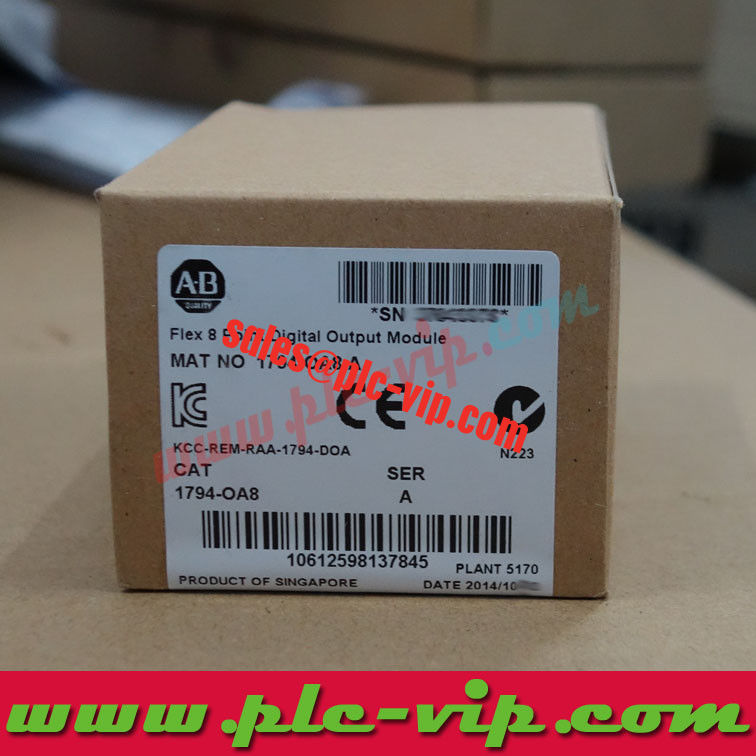
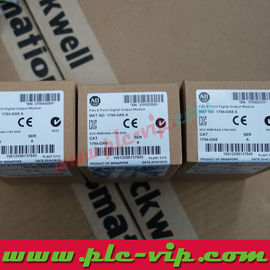
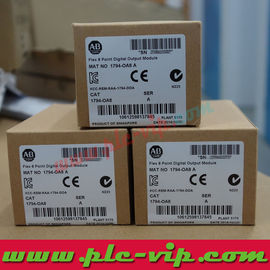
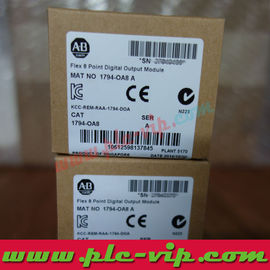
FLEX I/O 1794-OA8 / 1794OA8 8-Point 120V AC Output Module
Category:
PLCs, Power Supplies & I/Os
Manufacturer:
Rockwell
Group:
PLC I/O
The 1794-OA8 switches eight 120V AC loads from a FLEX I/O slot: triac outputs rated 500 mA at 55 deg C, 4 A for the module, with 1.6 A slow-blow fusing specified by Rockwell.
It is the card for a panel that already distributes 120V AC to its loads — solenoid valves, small contactors, lamps and fan starters — without adding a 24V interface layer.
Product Specifications 1794-OA8 (PDF)
Application |
FLEX I/O digital output, 1794 terminal base |
Cat Num |
1794-OA8 |
Brand Name |
Rockwell |
Outputs |
8, AC, triac |
Load voltage |
85V AC minimum, 132V AC maximum |
Output current |
5 mA minimum; 500 mA per channel at 55 deg C, 750 mA at 35 deg C |
Module current |
4.0 A maximum |
Off-state leakage |
2.25 mA maximum |
On-state voltage drop |
1.0V at 0.5 A |
Surge current |
7 A for 45 ms, repeatable every 8 s |
Isolation |
2150V DC for 1 s; 1250V AC for 60 s |
Power dissipation |
4.1 W (14.0 BTU/hr) |
Fusing |
1.6 A 250V slow-blow (Littelfuse 23901.6 or SAN-O SD6-1.6A) |
Operating temperature |
-20...55 deg C |
Attribute values above are reproduced from the manufacturer's product data. For the authoritative technical record see Rockwell publications 1794-DU001 (module specifications) and 1794-SG002 (installation instructions). Certification details, with certificate and file numbers, are listed in the FAQ below.
Output stage
Eight triac outputs over 85...132V AC, 5 mA minimum load and 500 mA per channel at 55 deg C, rising to 750 mA per channel at 35 deg C.
4.0 A is the module ceiling, so eight channels at rating are not simultaneous: the ambient derating and the module total have to be checked together.
2.25 mA off-state leakage is the figure that traps commissioning: a small relay or a neon lamp can hold on with 2.25 mA through it.
1.0V drop at 0.5 A removes about 4% of a 120V supply, which is inside the tolerance of a contactor coil but visible on a lamp.
7 A surge for 45 ms every 8 s covers an incandescent filament or a small AC coil, and the 8 s repeat rate is the limit, not the 45 ms duration.
Loads that behave
Minimum load 5 mA. Below that the triac may not latch, and the output reads intermittent rather than failed.
Leakage against the load. A 2.25 mA leakage into a 120V relay coil of a few hundred ohms can produce enough voltage to hold the armature.
A bleeder resistor across the load is the standard fix for both problems: it guarantees the minimum load and shunts the leakage.
Inductive loads need a suppression network at the coil; a triac without one is turned off by the inductive kick every cycle and eventually fails.
Transformer-primary loads are the worst case for inrush and should be switched by a relay output, not a triac.
Fusing
1.6 A 250V slow-blow is specified per output: Littelfuse 23901.6 or SAN-O SD6-1.6A, mounted on the fused terminal base or in the panel.
The fuse protects the triac as much as the wiring; a shorted load without it takes the output stage out and the module with it.
Slow-blow is deliberate. A fast fuse would open on a lamp inrush that the output can survive, so the rating follows the surge rating.
The fused base keeps the fuse at the terminal, which is the difference between a five-minute fuse change and a rewire of eight conductors.
Isolation and heat
2150V DC for 1 s and 1250V AC for 60 s are the published isolation tests between field and system.
4.1 W (14.0 BTU/hr) is the module dissipation, independent of the load current, because the loss is in the output stage and the gate drive.
-20...55 deg C operating range matches the DC output cards, so an island can mix AC and DC outputs at the same temperature.
The 500 mA at 55 deg C rating already includes the enclosure rise, which is why the same card publishes 750 mA at 35 deg C.
Base and installation
The AC output cards use the 1794 terminal bases with the fused variants where field protection is required.
Field terminals sit on the base, so a card replacement does not disturb the eight load circuits.
Keep the 120V AC output conductors apart from analog and communication wiring; triac switching produces a step at every zero crossing.
Keying must match before insertion, and the module is pressed in until the latch locks, with the FlexBus connector pushed fully left.
General environmental ratings apply: 5 g vibration at 10...500 Hz, 30 g shock, 5...95% RH non-condensing, IEC 61000-6-4 EMC.
FAQ — 1794-OA8
How many outputs has the 1794-OA8?
Eight 120V AC triac outputs, 500 mA per channel at 55 deg C, 4.0 A per module.
What is the load voltage range?
85V AC minimum to 132V AC maximum.
What fuse is specified?
A 1.6 A 250V slow-blow fuse, Littelfuse 23901.6 or SAN-O SD6-1.6A.
What is the off-state leakage?
2.25 mA maximum, which is why a bleeder resistor is often fitted across the load.
What surge can it carry?
7 A for 45 ms, repeatable every 8 s.
Is it isolated channel to channel?
No. Field to system isolation is 2150V DC for 1 s and 1250V AC for 60 s.
Data sources. Technical values on this page come from Rockwell publication 1794-SG002 (FLEX I/O Selection Guide, Table 7 and Table 11) and 1794-IN093. Any attribute the publication does not print is marked Not published rather than taken from a distributor page. Catalog number, packaging and stock status are the stock record of this listing.