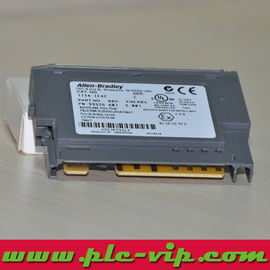
POINT I/O 1734-IR2 / 1734IR2 RTD Input Module
Category:
PLCs, Power Supplies & I/Os
Manufacturer:
Rockwell
Group:
POINT I/O Specialty Input Module
The 1734-IR2 reads two RTDs over a 0...600 ohm range at 16 bits, so one module covers every platinum, nickel and copper sensor a typical skid uses - 100 and 200 ohm Pt in both European and US alpha, 10 ohm Cu, and three nickel types.
That breadth is the point: one spare part replaces eight sensor-specific modules, and the 0.03 deg C per count resolution at 25 deg C is finer than the sensor's own tolerance in most process loops.
Product Specifications 1734-IR2 (PDF)
Input range |
0...600 ohm |
Resolution per count |
9.5 mohm, 0.03 °C (Pt 385 @ 25 °C), 0.05 °C at 77 °C |
Sensors supported |
100 ohm Pt alpha 0.00385 Euro -200...870 °C; 200 ohm Pt alpha 0.00385 Euro -200...596.6 °C; 100 ohm Pt alpha 0.003916 US -200...630 °C; 200 ohm Pt alpha 0.003916 US -200...583.4 °C; 10 ohm Cu alpha 0.00427 -200...260 °C; 100 ohm Ni alpha 0.00618 -60...250 °C; 120 ohm Ni alpha 0.00618 -60...250 °C; 120 ohm Ni alpha 0.00672 -80...320 °C |
Maximum overload |
No input protection |
Notch filter |
-3 dB at 13.1 Hz (50 Hz), 15.7 Hz (60 Hz), 26.2 Hz (100 Hz), 31.4 Hz (120 Hz), 52.4 Hz (200 Hz), 62.9 Hz (240 Hz), 78.6 Hz (300 Hz), 104.8 Hz (400 Hz), 125.7 Hz (480 Hz) |
Number of inputs |
2 single-ended, non-isolated |
Resolution |
16 bits |
Absolute accuracy |
0.1% full scale @ 25 °C |
Accuracy drift with temperature |
30 ppm/°C |
Conversion type |
Delta Sigma |
Common mode rejection |
120 dB |
Normal mode rejection |
100 dB |
Input update rate |
40 ms @ 50 Hz notch, 33 ms @ 60 Hz (default), 20 ms @ 100 Hz, 17 ms @ 120 Hz, 10 ms @ 200 Hz, 8 ms @ 240 Hz, 7 ms @ 300 Hz, 5 ms @ 400 Hz, 4 ms @ 480 Hz (per module) |
Step response |
60 ms @ 50 Hz, 50 ms @ 60 Hz, 30 ms @ 100 Hz, 25 ms @ 120 Hz, 15 ms @ 200 Hz, 13 ms @ 240 Hz, 10 ms @ 300 Hz, 8 ms @ 400 Hz, 6 ms @ 480 Hz (per channel) |
Data format |
Signed integer |
Calibration |
Factory calibrated |
Terminal base |
1734-TB, 1734-TBS, 1734-TOP or 1734-TOPS |
Terminal base screw torque |
0.8 Nm (7 lb-in) |
Keyswitch position |
6 |
POINTBus current, max |
220 mA @ 5V DC |
Power dissipation, max |
1.0 W |
Thermal dissipation, max |
3.3 BTU/hr |
Isolation voltage |
50V continuous, Basic insulation, I/O to system, type tested 1600V AC for 60 s |
External DC power |
None required |
Dimensions, HxWxD |
56.6 x 12.1 x 77.5 mm |
Weight, approx |
36 g |
Attribute values above are reproduced from the manufacturer's product data. For the authoritative technical record see Rockwell publications 1734-IN011-EN-E (module specifications) and 1734-UM004 (installation instructions). Certification details, with certificate and file numbers, are listed in the FAQ below.
One module, eight sensor types
Platinum 100 and 200 ohm at alpha 0.00385 (European) and 0.003916 (US), copper 10 ohm at alpha 0.00427 and nickel 100, 120 and 120 ohm at alpha 0.00618 and 0.00672. Selecting the type in the module configuration applies the right linearisation, so the same physical module serves a European Pt100 on one channel and a US Pt100 on the other - useful when a line mixes imported and domestic instrumentation.
0...600 ohm is the range that matters
A Pt100 at 870 deg C is about 390 ohm, a Pt200 at 596 deg C about 400 ohm, and a 120 ohm
nickel sensor tops out near 200 ohm. The 600 ohm ceiling therefore leaves head room for lead resistance and for a 3-wire hookup's compensation, which is why the module does not clip at the top of a high-temperature Pt100 span.
No input protection - this is the one to watch
The specification says it plainly: maximum overload, no input protection. A 24V field supply touched to an RTD terminal, or a sensor replaced with the field power on, destroys the channel. That is a wiring-discipline requirement, not a datasheet footnote, and it is the reason these modules are usually fed from a dedicated instrument supply rather than the same 24V rail as solenoids.
Notch filter decides the update rate
40 ms per module at 50 Hz, 33 ms at 60 Hz by default, down to 4 ms at 480 Hz. Setting the notch to the local mains frequency rejects pickup at that frequency; raising it trades rejection for speed. A temperature loop never needs 4 ms, so leave the notch at 50 or 60 Hz and accept the slower, quieter reading.
Power and wiring
220 mA at 5V DC on the POINTBus - among the heavier specialty modules, which is why a rack full of them exhausts the adapter's 1 A budget. Dissipation is 1.0 W, isolation is 50V basic tested at 1600V AC for 60 s, no external DC supply is needed, and it fits TB, TBS, TOP or TOPS bases at keyswitch position 6.
Two channels, one conversion engine
The update rate is quoted per module, not per channel: both inputs share one conversion chain, so enabling the second channel does not halve the speed but it does mean both readings are taken within the same 33 ms window. For a dual-element redundant sensor that is an advantage; for two independent fast loops it is a limit worth knowing before the loop tuning starts.
FAQ — 1734-IR2
What RTD types does 1734-IR2 support?
100 and 200 ohm Pt at alpha 0.00385 (European) and 0.003916 (US), 10 ohm Cu at 0.00427, and 100, 120, 120 ohm Ni at 0.00618 and 0.00672, over a 0...600 ohm input range.
What is the resolution?
16 bits, 9.5 mohm per count, which is 0.03 deg C per count for a Pt 385 sensor at 25 deg C and 0.05 deg C at 77 deg C.
Is the input protected?
No. The module is specified with no input protection, so field power must never reach an RTD terminal - remove power before changing a sensor.
How fast does it update?
Per module: 40 ms at a 50 Hz notch, 33 ms at 60 Hz (default), down to 4 ms at 480 Hz. Step response per channel is 60 ms at 50 Hz and 6 ms at 480 Hz.
Which terminal base does it use?
1734-TB, 1734-TBS, 1734-TOP or 1734-TOPS, at keyswitch position 6, drawing 220 mA from the 5V POINTBus.
Data sources. Technical values on this page come from Rockwell publication 1734-IN011-EN-E (POINT I/O RTD and Isolated Thermocouple Input Modules, Series C) and 1734-UM004. Any attribute the publication does not print is marked Not published rather than taken from a distributor page. Catalog number, packaging and stock status are the stock record of this listing.