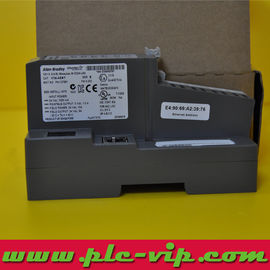
POINT I/O 1734-AENT / 1734AENT EtherNet/IP Adapter
Category:
PLCs, Power Supplies & I/Os
Manufacturer:
Rockwell
Group:
POINT I/O Communication Adapter
The 1734-AENT is the EtherNet/IP head of a POINT I/O assembly: one RJ-45 port at 10/100 Mbit, 63 expansion modules behind it, and a 5V DC POINTBus supply limited to 1.0 A.
Its own power dissipation is 5.2 W at 28.8V DC and it passes field power through at up to 9 A, so the adapter is the thermal centre of the assembly and the current budget for the whole slice stack starts here.
Product Specifications 1734-AENT (PDF)
Expansion I/O capacity, max |
63 modules |
Connections |
Up to 5 rack-optimized (digital) and/or enhanced rack-optimized (digital, analog, specialty) connections, 31 direct connections |
POINTBus output current, max |
5V DC @ 1.0 A |
Field power supply range |
10...28.8V DC @ 10 A in, 9 A out |
Input voltage rating |
24V DC @ 10 A, range 10...28.8V DC |
Field side power requirement, max |
24V DC @ 400 mA |
Inrush current, max |
6.0 A for 10 ms |
Overvoltage protection |
Reverse polarity protected |
Ethernet rate |
10/100 Mbit/s, half or full duplex |
Ethernet ports |
1, RJ-45 Category 5 |
Topologies |
Star, tree |
Network address |
3-position thumbwheel, 001...254, default 999 with DHCP enabled |
Power consumption, max |
10.4 W @ 28.8V DC |
Power dissipation, max |
5.2 W @ 28.8V DC |
Thermal dissipation, max |
17.75 BTU/hr @ 28.8V DC |
Module location |
Starter module, left side of the POINT I/O system |
Terminal base screw torque |
0.8 Nm (7 lb-in) |
Dimensions, HxWxD |
76.2 x 54.9 x 133.4 mm |
Weight, approx |
255 g |
Wire size |
0.34...2.1 mm2 (22...14 AWG) copper rated 75 °C or greater, 1.2 mm insulation max |
Operating temperature |
-20...55 °C |
Attribute values above are reproduced from the manufacturer's product data. For the authoritative technical record see Rockwell publications 1734-IN590C-EN-P (module specifications) and 1734-UM018 (installation instructions). Certification details, with certificate and file numbers, are listed in the FAQ below.
1.0 A of POINTBus current is the real limit
63 modules is the published maximum, but the adapter only supplies 1.0 A at 5V DC. Twenty analog or specialty modules can exhaust that before the module count is anywhere near 63, and the fix is not a bigger adapter - it is a 1734-EP24DC or 1734-EPAC backplane extension power supply part way along the stack. Do the arithmetic per module, not per rack.
Thumbwheel, DHCP and what 001 means
The switches default to 999 with DHCP enabled. Setting 001 assigns the address and forces gateway 0.0.0.0 with mask 255.255.255.0; 002 to 254 assigns the address with gateway 192.168.1.1. Thumbwheel addressing has no host name and no DNS, so a plant that relies on host names has to move to DHCP or static configuration in the controller instead.
Field power in, field power out
10...28.8V DC at up to 10 A in and 9 A out to the modules, with 400 mA taken for the adapter itself. The 1 A difference is deliberate headroom, not spare capacity to be used for a heater or a high-current output module - and the input is reverse-polarity protected but the supply must never be 120/240V AC.
Series matters
Rockwell states that only Series C POINT I/O modules work with the 1734-AENT adapter; Series A and B modules do not, with POINT Guard modules excluded from that restriction. An upgrade from an older DeviceNet assembly therefore drags a module-by-module series check with it.
Thermal centre of the assembly
10.4 W consumed, 5.2 W dissipated, 17.75 BTU/hr at 28.8V DC, in a 76.2 x 54.9 x 133.4 mm body weighing 255 g. The adapter sits at one end of the stack and its heat has to be given vertical clearance in the enclosure, which is why the installation instructions call for 25.4 mm of space between adjacent equipment for ventilation.
FAQ — 1734-AENT
How many I/O modules can 1734-AENT support?
Up to 63 expansion modules, but the adapter supplies only 1.0 A at 5V DC on the POINTBus. Add the 5V current of every module and insert 1734-EP24DC or 1734-EPAC extension power supplies if the total exceeds 1.0 A.
What is the field power capacity?
10...28.8V DC, 10 A in and 9 A out to the modules, with 400 mA for the adapter. Maximum input rating is 24V DC at 10 A and the input is reverse polarity protected.
How is the IP address set?
By a 3-position thumbwheel from 001 to 254, by DHCP, or from nonvolatile memory. The default is 999 with DHCP enabled; thumbwheel 001 forces gateway 0.0.0.0 and mask 255.255.255.0.
Does 1734-AENT work with Series A or B modules?
No. Only Series C POINT I/O modules work with the adapter, with POINT Guard modules excluded from that restriction.
How much heat does the adapter add to the enclosure?
10.4 W consumption and 5.2 W dissipation at 28.8V DC, 17.75 BTU/hr. Allow 25.4 mm of space between adjacent equipment for ventilation.
Data sources. Technical values on this page come from Rockwell publication 1734-IN590C-EN-P (POINT I/O EtherNet/IP Adapter 1734-AENT, Series C, December 2018) and 1734-UM018 (POINT I/O EtherNet/IP Adapter User Manual). Any attribute the publication does not print is marked Not published rather than taken from a distributor page. Catalog number, packaging and stock status are the stock record of this listing.
Where 1734-AENT sits in the POINT I/O line
The table reproduces the sibling list this page publishes, with each catalog number put in the class of module it is; the paragraph after it places this part in that ladder, and the arithmetic at the end uses this page's own POINTBus figure against the 1.0 A budget the adapters print.
| Catalog number | What the published line says | Class of module |
| 1734-AENT | EtherNet/IP adapter, 10/100 Mbit, 63 modules, 1.0 A POINTBus | Network adapter |
| 1734-ADN | DeviceNet adapter, 125/250/500 kbit, 63 modules | Network adapter |
| 1734-ADNX | DeviceNet adapter with Subnet scanner, node 0 on the subnet | Network adapter |
| 1734-ACNR | ControlNet adapter, redundant coax A/B, node 01...99 | Network adapter |
| 1734-APB | PROFIBUS DP adapter, 63 modules on one DP node | Network adapter |
1734-AENT is the EtherNet/IP adapter and the one the other adapters are measured against: 10/100 Mbit, 63 modules, 1.0 A POINTBus. Its field supply figures are the widest in the list - 10 A in and 9 A out at 10...28.8 V dc - and the 400 mA field-side requirement is the number to check against the 24 V supply, not the 10 A.
The budget the adapters themselves publish is 1.0 A of 5 V POINTBus and 63 modules. Those two limits do not meet: 63 modules at the lightest draw in this whole product line - 50 mA on the diagnostic input module - is 3,150 mA, which is 3.15 times the 1.0 A, so a full rack cannot be powered from one adapter at any module class. That is why the family carries expansion power supplies and why the 63-module figure is a slot count rather than a current plan.
The class column is the useful filter: within one page the list holds modules that look alike in a catalog and behave completely differently on a backplane, and the printed one-line description is the only place the difference appears.
What the printed data does not carry: no adapter page in this list states its own current draw on the POINTBus, and none prints a maximum backplane length or a cable type for the expansion link. The 1.0 A is an output rating, not a budget that already accounts for the adapter.
Source: Rockwell publication 1734-IN001 (POINT I/O module and adapter installation instructions) and the module specification tables published on these pages; the class column and the module count are read off the printed lines, not assumed.