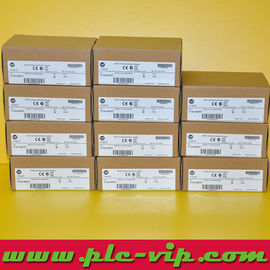
POINT I/O 1734-CTM / 1734CTM Common Terminal Module
Category:
PLCs, Power Supplies & I/Os
Manufacturer:
Rockwell
Group:
POINT I/O Terminal Module
The 1734-CTM is a terminal module, not an I/O module: it occupies one slot on the rail, draws no POINTBus current and provides a dedicated common (C) connection for field devices that would otherwise be crowded onto the module's own terminals.
It exists because 8-channel POINT I/O modules use every terminal for signal wiring, and the common has to come from somewhere - the CTM brings the field power bus common out to its own screw terminals at 2 A per point, 4 A per module.
Product Specifications 1734-CTM (PDF)
Function |
Common terminal module, distributes field power common to field devices |
Wiring base |
1734-TB, 1734-TBS, 1734-TOP or 1734-TOPS |
Not compatible with |
1734-TB3, 1734-TB3S, 1734-TOP3, 1734-TOP3S |
Keyswitch position |
5 |
Field power bus voltage range |
10...28.8V DC, 120/240V AC |
Field power bus output current, max |
2 A per point, 4 A per module |
Isolation voltage |
250V continuous, Basic insulation |
POINTBus current |
None |
Power dissipation |
None |
Indicators |
None |
Terminal base screw torque |
0.8 Nm (7 lb-in) |
Wire size |
0.25...2.5 mm2 (22...14 AWG) copper rated 75 °C or greater |
Dimensions, HxWxD |
56.6 x 12.1 x 77.5 mm |
Weight, approx |
30.9 g |
Enclosure |
None (open-style) |
Attribute values above are reproduced from the manufacturer's product data. For the authoritative technical record see Rockwell publications 1734-IN024 (module specifications) and 1734-UM001 (installation instructions). Certification details, with certificate and file numbers, are listed in the FAQ below.
What it does and what it does not do
The CTM taps the field power bus and reproduces the common conductor on its own terminals. It carries no I/O, has no indicators, draws no POINTBus current and dissipates nothing measurable. Treat it as wiring hardware with a keyswitch position of 5, which is what stops it being mistaken for a module during a slot audit.
2 A per point, 4 A per module
Each terminal is rated 2 A and the module total 4 A, so four field devices at 1 A can share one CTM but eight cannot. The common is a distribution point, not a power supply: the current still has to come through the adapter or an expansion power supply's field power bus, and the CTM's 4 A ceiling is where a densely wired machine cabinet runs into trouble.
250V basic isolation
The CTM is rated 250V continuous with Basic insulation, which is what allows it to sit on a rail next to 120/240V AC field power - the field power bus accepts 10...28.8V DC or 120/240V AC. That rating applies to the terminal module itself; the isolation of the assembly is set by the weakest module on the rail, not by the CTM.
Base compatibility
It fits 1734-TB, 1734-TBS, 1734-TOP and 1734-TOPS bases and is explicitly not compatible with 1734-TB3, 1734-TB3S, 1734-TOP3 and 1734-TOP3S. A panel built on TB3 bases cannot take a CTM, which is the kind of detail that surfaces only when the wiring is already cut to length.
12.1 mm of rail
56.6 mm high, 12.1 mm wide, 77.5 mm deep and 30.9 g - one slot, same as a module, at 0.8 Nm terminal torque and 0.25...2.5 mm2 conductors. Because it consumes no backplane current, an assembly can gain a CTM without recalculating the adapter's 1 A POINTBus budget; only the physical slot count changes.
CTM or VTM - common versus voltage
The CTM brings out C, the common conductor. The companion 1734-VTM brings out V, the voltage conductor of the field power bus, for field devices that need a fused or separately protected supply tap. A panel that needs both a supply tap and a return point therefore uses two slots, one VTM and one CTM, in that order along the rail, which is how the publication's wiring diagram lays them out.
FAQ — 1734-CTM
Is 1734-CTM an I/O module?
No. It is a terminal module that distributes the field power common to field devices. It has no I/O, no indicators, draws no POINTBus current and dissipates no power.
What is the current rating of 1734-CTM?
2 A per point and 4 A per module on the field power bus, at 10...28.8V DC or 120/240V AC.
Which terminal bases does 1734-CTM fit?
1734-TB, 1734-TBS, 1734-TOP and 1734-TOPS. It is not compatible with 1734-TB3, 1734-TB3S, 1734-TOP3 or 1734-TOP3S.
What isolation does the CTM provide?
250V continuous, Basic insulation type.
Does the CTM consume POINTBus current?
No, so adding one does not affect the adapter's 5V current budget - only the slot count.
Data sources. Technical values on this page come from Rockwell publication 1734-IN024 (POINT I/O Common Terminal Module and Voltage Terminal Module 1734-CTM, 1734-CTMK, 1734-VTM, 1734-VTMK). Any attribute the publication does not print is marked Not published rather than taken from a distributor page. Catalog number, packaging and stock status are the stock record of this listing.