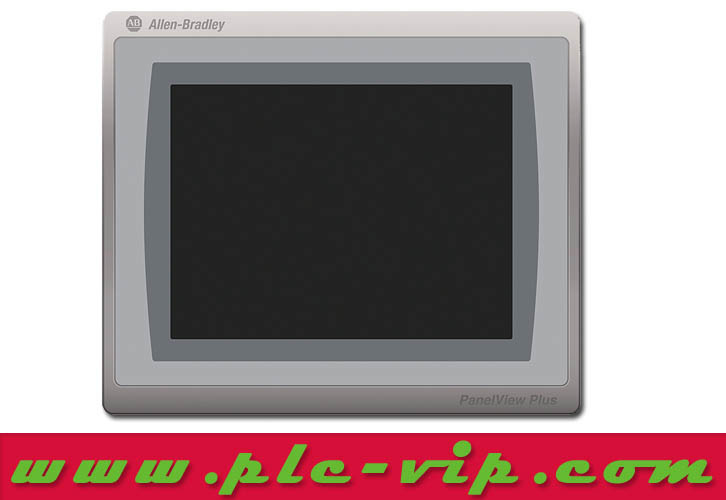
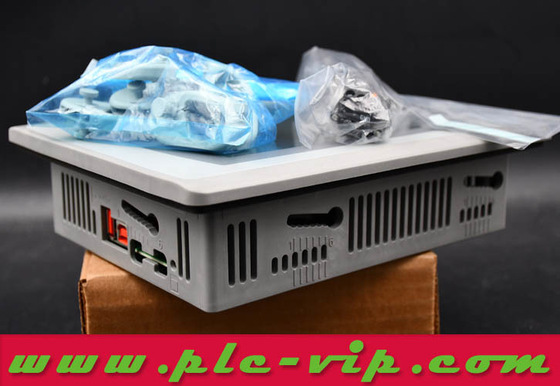
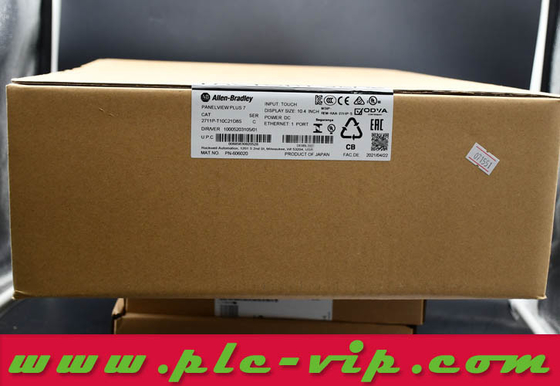
2711P-T10C21D8S-B
This page documents catalog number 2711P-T10C21D8S-B, the single Ethernet port model of the PanelView Plus 7 Standard 10 terminal, supplied as the Brandless variant. The attributes below are the ones the manufacturer publishes for this catalog number; no display contrast, brightness or processor figure is stated here because those are not published for this terminal.
Published specification
| Specification | Value |
|---|
| Display | 10.4-in TFT color display with touch screen, SVGA |
| Input power | 24V DC nominal, 18...30V DC, nonisolated power input |
| Ethernet ports | One RJ45 port, 10/100Base-T, Auto MDI/MDI-X, single Ethernet |
| Time synchronization | IEEE 1588 support for synchronization of network-connected devices |
| Operating system | Windows CE 6, Standard Model |
| Software | FactoryTalk View Machine Edition |
| Lifecycle status | Active, per the manufacturer product page |
| Safety limitation | Not to be used for emergency stops or other controls critical to the safety of personnel or equipment |
What the catalog number says
The catalog number decomposes into published attributes: 2711P is the PanelView Plus 7 family, T denotes a touch screen, 10 is the 10.4 inch display, C denotes a TFT color display, 21 or 22 selects one or two Ethernet ports, D denotes 24V DC input, 8S denotes the Windows CE 6 Standard Model, and a trailing B denotes the Brandless variant. The manufacturer's product data lists exactly those attributes, and this page relies on them rather than on a series brochure.
The display is published as a 10.4 inch TFT color display with a touch screen at SVGA resolution, and the touch input is the only operator interface on the standard model. A terminal without a keypad is a terminal whose entire operator interaction is defined by the screen layout, which puts the design decisions in the application rather than in the hardware.
Power is published as 24V DC nominal with an 18 to 30V DC input range, and the input is explicitly nonisolated. The range is wide enough to cover a nominal 24V supply with tolerance, and the nonisolated description is the part that decides wiring: the terminal's DC return is common with its internal reference, so the supply's return becomes part of the terminal's reference.
The safety notice in the installation manual is as much a specification as the voltage: the terminal must not be used for emergency stops or other controls critical to the safety of personnel or equipment, and separate hard wired devices that do not depend on solid state electronics are required instead. That sentence sets the boundary of what a PanelView is for.
IEEE 1588 support is published as a feature of the Ethernet port, and it is a statement about time synchronization rather than about motion control. A controller and a terminal that share a synchronized time base produce timestamps that can be compared, which changes what an alarm log is worth during a fault investigation.
Windows CE 6 and the Standard Model designation are published attributes of the 8S suffix, and they describe a platform with a defined feature set rather than an open operating system. The consequence is that the terminal's capability is fixed by its catalog number, and an application designed against a different suffix is an application that has to be checked rather than assumed.
This specific number carries the single port Ethernet configuration and the Brandless attribute, and those two positions are what distinguish it from the other 10.4 inch terminals in the same size.
Engineering notes
FactoryTalk View Machine Edition is published as the software, and the terminal is the runtime rather than the development environment. An application is built on a workstation and downloaded, which means the catalog number's operating system tier is a compatibility fact for the download rather than a development choice.
Panel mounting is published with cutout dimensions and mounting levers, and the 10.4 inch size has its own cutout. A panel built for a different size in the same family is a panel that cannot be adapted by changing the terminal, and the cutout is the number to check before the panel is cut.
The published warning against using the terminal for emergency stops is the sentence that keeps a machine compliant. A soft stop drawn on a touch screen is a soft stop that depends on an operating system, and the published text is unusually direct about not relying on it.
A nonisolated input and a single Ethernet port describe a terminal that is simple to wire and dependent on the panel's supply quality. That combination is why the published input range exists: it is the tolerance the product will accept, and it is not a margin to be consumed by a poor supply.
The 10.4 inch size sits in the middle of the family's range, and that is where most machine level HMIs land. The published attributes of this catalog number describe that mainstream case precisely, which is why the page is short on marketing and long on what the number means.
One Ethernet port is the published configuration of the 21 position, and it is a design decision rather than a limitation. A terminal with a single port connects to a switch or to a controller's port, and it does not participate in a ring, which means its network availability is the availability of the switch it hangs from.
Single port terminals are the normal choice for a machine level HMI, where the terminal talks to one controller on a local switch. The published Auto MDI/MDI-X behaviour removes the crossover cable question, which is a small convenience that stops being small when a panel is wired at night.
The absence of a second port means no Device Level Ring participation, so a ring topology in the panel is a ring that the terminal is not part of. A design that expects the HMI to survive a single cable break by ring reconfiguration is a design for the 22 position rather than this one.
A nonisolated 24V DC input makes the supply choice part of the installation rather than an accessory. The terminal's return is common with its internal reference, so a supply that is also feeding devices with a different reference is a supply arrangement that has to be checked against the published input description.
The 18 to 30V DC range is published as an operating window, not a transient tolerance. A panel whose 24V rail dips below 18V during a contactor drop is a panel where the terminal resets, and the published window is the number to compare against a measured dip rather than against a nameplate.
SVGA on a 10.4 inch display is a published combination, and the resolution is what decides how much information fits on a screen before an operator has to navigate. A faceplate designed at a higher resolution than the terminal supports is a faceplate that will be scaled, and scaled graphics are the usual reason a screen looks wrong on site.
Touch only is published for the standard model, and a touch screen in a washdown area is a screen with gloves, water and cleaning chemicals in its future. That is an installation question rather than a specification question, and the published enclosure and cleaning guidance lives in the installation manual rather than in the data sheet.
The Brandless attribute is published as a distinct orderable variant, and in the product data it is the only difference between this catalog number and its branded twin. Its practical effect is at the order line and at the machine's identity, not in the terminal's behaviour.
Lifecycle status is published as active, which in a family that has already been through several series letters means the catalog number can be ordered today and may change series later without changing its position in a panel. That is a procurement fact rather than a design one, and it belongs in the drawing's revision history.
A single port terminal has one cable, and one cable is one point of failure per HMI. In a plant with thirty machines, that is thirty single points, and the published ring support on the other variant is the only structural answer to it within the same product family.
The other PanelView terminals, accessories and replacement parts in this range are collected in the PanelView HMI 2711 category. This terminal can be checked against the shop listing at 2711P-T10C21D8S-B, and the related 10.4 inch catalog numbers are listed at 2711P-T10C22D8S-B, 2711P-T10C22D8S.