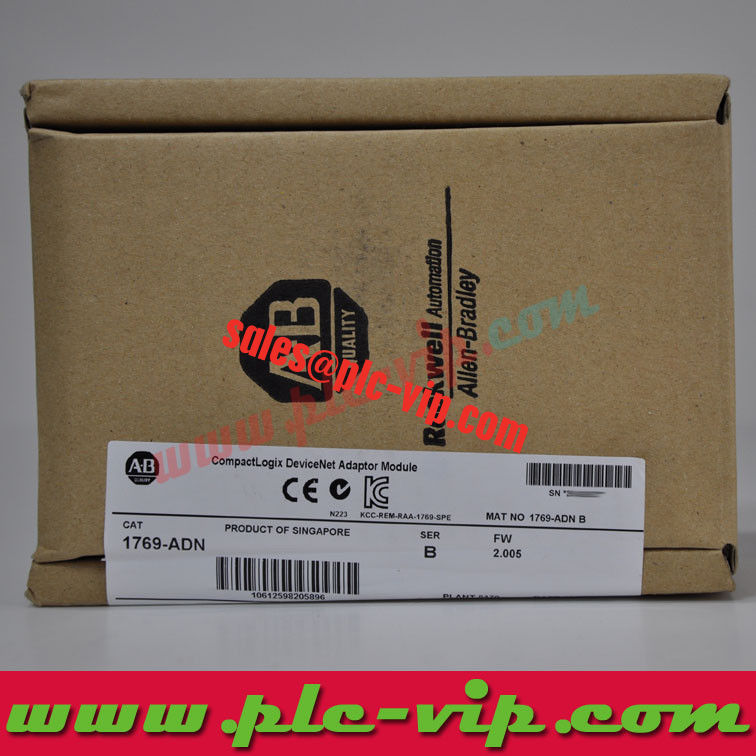
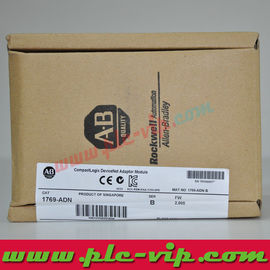
1769-ADN / 1769ADN Compact I/O DeviceNet Adapter
Category:
PLCs, Power Supplies & I/Os
Manufacturer:
Rockwell
Group:
PLC Module
The 1769-ADN is the DeviceNet adapter that turns a 1769 Compact I/O rack into a node on a DeviceNet segment: 90 mA at 24V DC, 4.7 W dissipated, T4A temperature code.
It is the part for putting I/O where the machine is and the controller somewhere else — a bank of 1769 modules in the field, with only a DeviceNet drop between it and the panel.
Product Specifications 1769-ADN (PDF)
Application |
DeviceNet adapter for 1769 Compact I/O racks |
Cat Num |
1769-ADN |
Brand Name |
Rockwell |
DeviceNet current range |
11…25V DC |
DeviceNet current draw |
90 mA @ 24V DC, Class 2/SELV |
Power dissipation |
4.7 W |
Isolation voltage |
30V, basic, DeviceNet to backplane |
Ports |
1 DeviceNet open-style 5-pin linear plug |
Connector torque |
0.56…0.79 N·m |
Wire |
802.3 compliant shielded or unshielded twisted pair |
Weight, approx |
0.280 kg |
Dimensions (H * W * D) |
118 * 50 * 87 mm |
Temperature code |
T4A |
Attribute values above are reproduced from the manufacturer's product data. For the authoritative technical record see Rockwell publications 1769-TD006 (module specifications) and 1769-SG001 (installation instructions). Certification details, with certificate and file numbers, are listed in the FAQ below.
Adapter behaviour
A rack, not a scanner. The ADN presents its 1769 I/O modules to a DeviceNet master as a single node's I/O table; the master owns the segment.
One drop, one rack. The rack is wired to the trunk through its 5-pin plug; the I/O modules behind it are ordinary 1769 modules with their own power supply.
90 mA at 24V DC. Between the SDN's 110 mA and the AENTR's backplane draw — the adapter's own contribution to the segment supply is modest.
T4A and the SDN comparison
T4A against T3C. The adapter carries a higher temperature code than the scanner, which matters in a classified installation where the rack sits inside the hazardous boundary.
Same 4.7 W dissipation. Both DeviceNet modules produce the same heat, so enclosure cooling does not change between the two.
Same physical package. 118 * 50 * 87 mm, 0.280 kg, one 5-pin open-style plug torqued to 0.56…0.79 N·m.
Cabling and isolation
11…25V DC segment supply. Outside that window the adapter will not hold its connection to the master.
802.3 twisted pair. Shielded or unshielded, with 1769 I/O racks needing their own 1769 power supply alongside the adapter.
30V basic isolation. DeviceNet to backplane, type tested at 710V DC for 60 s.
When a rack goes remote
Field-mounted I/O. A small 1769 rack at the machine beats pulling individual signal cables back to the panel.
Existing DeviceNet trunk. Where the segment already exists and a new I/O cluster is needed on it.
Not a substitute for AENTR. If the panel is being built on EtherNet/IP, 1769-AENTR is the adapter — 500 mA at 5V DC, 128 Logix connections, 96 TCP/IP.
Environment and certification
0...60 °C, 5...95% RH. 2 g vibration, 15 g operating shock, 6 kV contact and 8 kV air ESD immunity.
c-UL-us and CE. UL Listed industrial control and Class I Division 2, CE to EN 61326-1 and EN 61131-2, ODVA DeviceNet conformance.
1.16 N·m mounting screws. M4 or #8 hardware, DIN rail or panel mount.
FAQ — 1769-ADN
What does the 1769-ADN do?
It is a DeviceNet adapter that presents a 1769 Compact I/O rack as one node on a DeviceNet segment controlled by another master.
How much current does the 1769-ADN draw?
90 mA at 24V DC from the DeviceNet Class 2/SELV supply, with 4.7 W of dissipation.
What is the temperature code of the 1769-ADN?
T4A, one step higher than the T3C of the 1769-SDN scanner.
Does the 1769-ADN need a separate power supply?
Yes. The adapter is powered from DeviceNet, while the 1769 I/O modules behind it need their own 1769 Compact I/O power supply.
What connector does the 1769-ADN use?
One DeviceNet open-style 5-pin linear plug, torqued to 0.56…0.79 N·m on 802.3 twisted pair.
Should I use 1769-ADN or 1769-AENTR?
ADN for an existing DeviceNet segment; AENTR for EtherNet/IP, where it offers 128 Logix and 96 TCP/IP connections at 500 mA on 5V DC.
Data sources. Technical values on this page come from Rockwell publication 1769-TD007 (CompactLogix Communication Modules Specifications, publication 1769-TD007D-EN-P, May 2014), current Rockwell Automation documents. Any attribute the publication does not print is marked Not published rather than taken from a distributor page. Catalog number, packaging and stock status are the stock record of this listing.