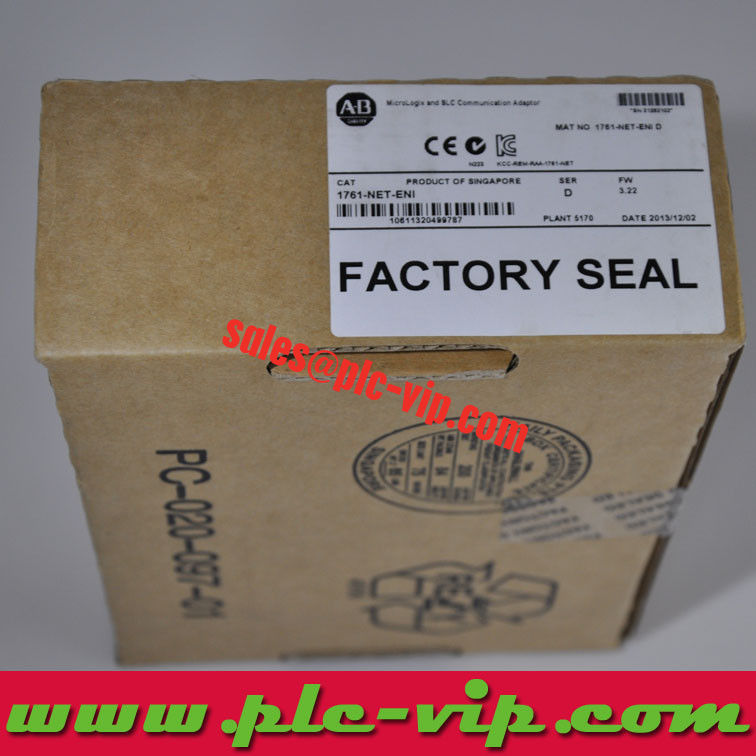
1761-NET-ENI Rockwell MicroLogix and SLC Ethernet Adaptor
Category:
PLCs, Power Supplies & I/Os
Manufacturer:
Rockwell
Group:
MicroLogix 1000 / 1761
1761-NET-ENI is the MicroLogix and SLC Ethernet Adaptor in the 1761 accessory family: EtherNet interface that gives a MicroLogix or SLC controller an Ethernet port through its RS-232 channel.
The adaptors were the way a MicroLogix 1000 or a fixed SLC 500 got onto a plant network before Ethernet was built into the controller. They are discontinued, but a large installed base still runs on them, and a spare is often the fastest way to keep a line talking to a SCADA node.
Product Specifications 1761-NET-ENI (PDF)
Catalog number |
1761-NET-ENI |
Description |
EtherNet interface that gives a MicroLogix or SLC controller an Ethernet port through its RS-232 channel. |
Class |
Signal converters |
Ports |
RS-232 8-pin mini DIN to RJ45 |
Mounting |
Panel or DIN rail, DIN rail power or 24V dc supply |
Isolation |
Communication side isolated from the controller supply |
Lifecycle status |
Discontinued June 30, 2017 |
Replacement category |
Engineering Replacement |
UPC |
Not published |
Publication |
1761-UM005 |
Attribute values above are reproduced from the manufacturer's product data. For the authoritative technical record see Rockwell publications 1761-UM005 (module specifications) and 1761-SG001 (installation instructions). Certification details, with certificate and file numbers, are listed in the FAQ below.
What the adaptor does
EtherNet interface that gives a MicroLogix or SLC controller an Ethernet port through its RS-232 channel.
The converter sits between the controller's RS-232 port and the network. It answers on the network side and polls the controller on the serial side, so the controller's own protocol and program are untouched — no ladder edit, no firmware change, just a node that appears on the network.
Ports and wiring
Ports: RS-232 8-pin mini DIN to RJ45. The serial side is an 8-pin mini DIN on the Ethernet adaptors, which is the same connector the MicroLogix 1000 programming port uses, so the cable that reaches the controller is the same class of part.
The unit is a panel or DIN rail device with its own supply. Keep the serial run short — these adaptors were specified for a cable at the controller, not for a long drop through a cabinet.
Isolation and network behaviour
The communication side is transformer-isolated from the controller supply, which is what allows an adaptor on a panel whose logic ground is not the same as the network ground. That isolation is the reason the part survives on machines where a bare serial-to-Ethernet bridge would not.
Throughput is bounded by the serial link, not by the network. An adaptor does not make a 1761-L32BWA into a fast Ethernet controller; it makes it reachable. Plan polling rates accordingly, especially where several clients read the same controller.
Commissioning and spares
Commissioning needs the adaptor's own configuration utility and the network parameters: IP address, subnet and, on the DeviceNet members, a node address and baud rate. Record those settings in the panel documentation — a replacement adaptor is useless without them, and the settings live in the adaptor, not in the controller.
A failed adaptor does not stop the machine. The controller keeps scanning its I/O and the local panel keeps working; only the network side goes dark. That makes a spare the cheapest fix, and it is why these parts are still traded.
Lifecycle and replacement
1761-NET-ENI was discontinued on June 30, 2017, with Engineering Replacement as the replacement category.
For a new installation the answer is a controller with Ethernet on board rather than an adaptor on an RS-232 port. For an existing panel the answer is usually a tested spare or a planned migration of the whole node.
FAQ — 1761-NET-ENI
What does 1761-NET-ENI connect?
EtherNet interface that gives a MicroLogix or SLC controller an Ethernet port through its RS-232 channel.
Which controllers does 1761-NET-ENI work with?
MicroLogix 1000, 1200 and 1500 controllers and fixed SLC 500 processors with an RS-232 port, per the adaptor's own user manual.
What ports does 1761-NET-ENI provide?
RS-232 8-pin mini DIN to RJ45.
Is 1761-NET-ENI still available from Rockwell?
No. Discontinued on June 30, 2017; replacement category Engineering Replacement.
Does 1761-NET-ENI need a separate power supply?
Yes, the adaptor is a panel or DIN rail device with its own supply.
Data sources. Port descriptions and class come from the Rockwell product page of the catalog number; network behaviour and commissioning practice follow the user manual for the adaptor family. Discontinued dates and replacement categories are from the Rockwell product page. Any attribute a publication does not print is marked Not published rather than taken from a distributor page. Catalog number, packaging and stock status are the stock record of this listing.