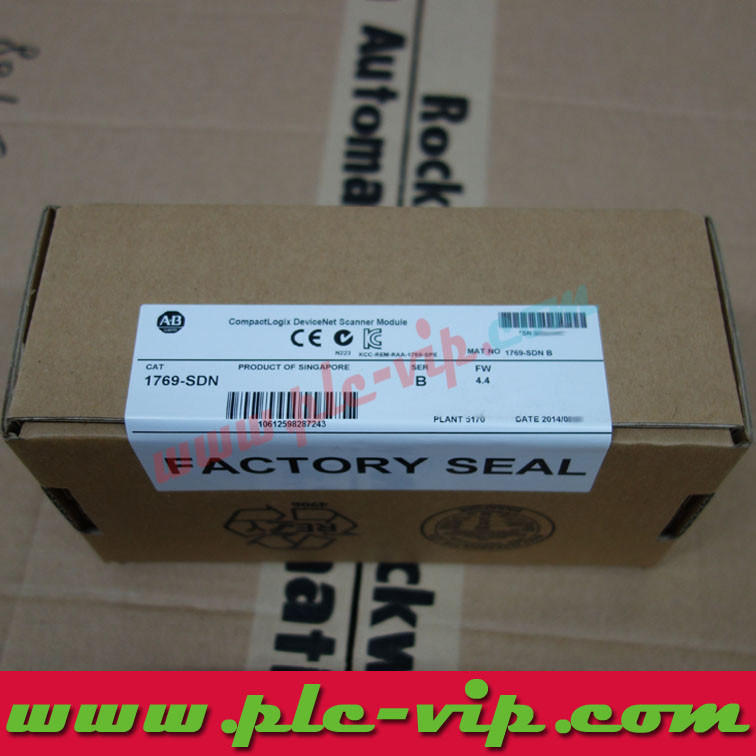
1769-SDN / 1769SDN Compact I/O DeviceNet Scanner
Category:
PLCs, Power Supplies & I/Os
Manufacturer:
Rockwell
Group:
PLC Module
The 1769-SDN is the DeviceNet scanner for the 1769 Compact I/O backplane: 110 mA at 24V DC from the DeviceNet supply, 4.7 W dissipated, one 5-pin open-style plug.
It is the module that lets a CompactLogix controller own a DeviceNet segment — the drives, the smart valves, the photoeyes that were wired to a DeviceNet trunk and are not going to be rewired.
Product Specifications 1769-SDN (PDF)
Application |
DeviceNet scanner for the 1769 Compact I/O backplane |
Cat Num |
1769-SDN |
Brand Name |
Rockwell |
DeviceNet current range |
11…25V DC |
DeviceNet current draw |
110 mA @ 24V DC, Class 2/SELV |
Power dissipation |
4.7 W |
Isolation voltage |
30V, basic, DeviceNet to backplane |
Ports |
1 DeviceNet open-style 5-pin linear plug |
Connector torque |
0.56…0.79 N·m |
Wire |
802.3 compliant shielded or unshielded twisted pair |
Weight, approx |
0.280 kg |
Dimensions (H * W * D) |
118 * 50 * 87 mm |
Temperature code |
T3C |
CIP Safety |
Not supported |
Attribute values above are reproduced from the manufacturer's product data. For the authoritative technical record see Rockwell publications 1769-TD006 (module specifications) and 1769-SG001 (installation instructions). Certification details, with certificate and file numbers, are listed in the FAQ below.
Scanner, not adapter
The SDN is the master. It scans DeviceNet devices and holds their I/O in the controller's tag database, so the controller sees a slave's inputs as ordinary tags.
The ADN is the adapter. 1769-ADN presents a 1769 I/O rack to another DeviceNet master; the two modules face opposite directions on the network.
110 mA at 24V DC, 4.7 W. The DeviceNet current is drawn from the 24V segment supply, not from the 1769 backplane, so the segment power budget has to carry it.
No CIP Safety here
The 1769-SDN does not support CIP Safety. Rockwell states it explicitly; safety over DeviceNet is not a path this module opens.
Safety I/O on CompactLogix goes over EtherNet/IP. 1734 POINT Guard I/O and 1791ES CompactBlock Guard I/O are the listed options for a GuardLogix system.
Consequence for a mixed line. Where a machine has both DeviceNet devices and safety devices, the two run on separate networks and separate modules.
Network and cabling
11…25V DC DeviceNet range. The segment's permitted supply window; outside it the scanner will not communicate reliably.
One 5-pin open-style linear plug. Connector torque 0.56…0.79 N·m — a spec that gets missed and is a common source of intermittent segments.
802.3 compliant twisted pair. Shielded or unshielded, with the segment's own terminators and taps; the scanner is one node on that trunk.
Power, heat and mounting
4.7 W dissipation. The dominant heat source in a 1769 bank that otherwise holds low-power digital modules.
30V basic isolation. DeviceNet to backplane, type tested at 710V DC for 60 s — basic, not reinforced.
118 * 50 * 87 mm, 0.280 kg. Mounting screws at 1.16 N·m with M4 or #8 hardware, DIN rail or panel.
Environment and certification
T3C temperature code. Lower than the T4A of the adapters, which matters when the panel is in a classified area.
0...60 °C, 5...95% RH. 2 g vibration, 15 g operating shock, 6 kV contact and 8 kV air ESD immunity, CISPR 11 Class A emissions.
c-UL-us and CE. UL Listed industrial control equipment and Class I Division 2, CE to EN 61326-1 and EN 61131-2, plus ODVA DeviceNet conformance.
FAQ — 1769-SDN
What is the difference between 1769-SDN and 1769-ADN?
The SDN is a DeviceNet scanner that owns a segment from the controller side; the ADN is an adapter that presents a 1769 rack to another DeviceNet master.
Does the 1769-SDN support CIP Safety?
No. Rockwell states that the 1769-SDN does not support CIP Safety; safety I/O on CompactLogix runs over EtherNet/IP.
What current does the 1769-SDN draw?
110 mA at 24V DC from the DeviceNet Class 2/SELV supply, with 4.7 W of power dissipation.
What DeviceNet voltage range does the 1769-SDN accept?
11…25V DC on the DeviceNet segment.
Which connector does the 1769-SDN use?
One DeviceNet open-style 5-pin linear plug, torqued to 0.56…0.79 N·m.
What is the 1769-SDN temperature code?
T3C, against T4A for the 1769-ADN adapter.
Data sources. Technical values on this page come from Rockwell publication 1769-TD007 (CompactLogix Communication Modules Specifications, publication 1769-TD007D-EN-P, May 2014), current Rockwell Automation documents. Any attribute the publication does not print is marked Not published rather than taken from a distributor page. Catalog number, packaging and stock status are the stock record of this listing.