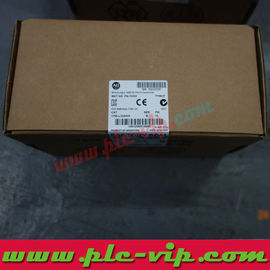
Allen Bradley PLC 1766-L32AWA / 1766L32AWA
-
-
Large Image :
Allen Bradley PLC 1766-L32AWA / 1766L32AWA
|
Product Details:
| Place of Origin: |
Made in SINGAPORE |
| Brand Name: |
PLC Module |
| Certification: |
All goods we supply are 100% original factory sealed with 1 year warranty! |
| Model Number: |
Allen Bradley PLC 1766-L32AWA / 1766L32AWA |
Payment & Shipping Terms:
| Minimum Order Quantity: |
1 /PCS |
| Price: |
$316.00 (USD/PCS) |
| Packaging Details: |
100% original new |
| Delivery Time: |
IN STOCK; 4-6 weeks for ordering |
| Payment Terms: |
Paypal, T/T and Western Union. |
| Supply Ability: |
10 PCS |
|
Detailed Product Description
 1766-L32AWA Rockwell MicroLogix 1400 32 Point Controller
Category:
PLCs, Power Supplies & I/Os
Manufacturer:
Rockwell
Group:
MicroLogix 1100 / 1763
1766-L32AWA is one of the 32-point MicroLogix 1400 controllers — the last MicroLogix family, and the only one still listed as Active Mature with a published five day lead time.
It carries three communication ports as standard: an isolated RS-232/RS-485 channel, a 10/100 Ethernet channel and a second non-isolated RS-232 channel. For a plant that wants a small controller on the network without a gateway, that is the whole argument for the 1400.
Product Specifications 1766-L32AWA (PDF)
Catalog number |
1766-L32AWA |
Description |
MicroLogix 1400, 20 digital 120V ac inputs, 12 relay outputs, 110/240V ac power |
I/O |
32 discrete points — 20 digital 120V ac inputs, 12 relay outputs |
Analog I/O |
None |
Power supply |
100…240V ac, 47…63 Hz |
Power consumption |
100 VA (130 VA for Series C) |
Inrush current |
120V ac 25 A for 8 ms, 240V ac 40 A for 4 ms |
Dimensions |
90 mm high, 180 mm wide, 87 mm deep |
Shipping weight |
900 g |
Communication ports |
Channel 0 isolated RS-232/RS-485, Channel 1 Ethernet 10/100, Channel 2 RS-232 |
Relay load limit |
1440 VA maximum controlled load |
Relay current |
2.5 A per channel, 8 A per group common (channels 8…11) |
Relay mechanical life |
20,000,000 cycles |
Terminal screw torque |
0.791 N·m |
Lifecycle status |
Active Mature |
Estimated lead time |
5 days |
UPC |
612598518098 |
Publication |
1766-UM001 |
Attribute values above are reproduced from the manufacturer's product data. For the authoritative technical record see Rockwell publications 1766-UM001 (module specifications) and 1766-UM001 (installation instructions). Certification details, with certificate and file numbers, are listed in the FAQ below.
I/O and analog
20 digital 120V ac inputs, 12 relay outputs.
No embedded analog I/O on this version. The 1766-L32AWAA is the analog variant of the same 120V ac input base, and 1762 expansion modules can add analog channels to this controller.
The Ethernet channel carries EtherNet/IP, Modbus TCP or DNP3 over IP, but only CIP explicit messaging — real-time I/O messaging over the network is not supported, so remote I/O is not an option here.
Communication detail
Channel 0 is an isolated combination RS-232/RS-485 port: DF1 full duplex and half duplex, DH-485, Modbus RTU master/slave, DNP3 slave and ASCII. A 1763-NC01 cable is what connects it to an RS-485 trunk without an AIC+.
Channel 1 is 10/100 Ethernet with an embedded web server for module information, TCP/IP configuration, diagnostics and a data table monitor. Channel 2 is a non-isolated RS-232 port for a second serial device.
Power and loading
100 VA (130 VA for Series C). Inrush is 25 A for 8 ms at 120V ac and 40 A for 4 ms at 240V ac.
Up to seven 1762 expansion modules can be connected, in any combination, within the controller's backplane supply budget — that limit is the practical ceiling on how far this controller can grow.
Relays
Relay contacts handle a maximum controlled load of 1440 VA, 2.5 A per channel and 8 A per group common on channels 8…11. Mechanical life is 20,000,000 cycles.
That is pilot duty, not motor duty. A contactor coil is fine; a motor directly is not, whatever the VA figure suggests.
Lifecycle
Active Mature with a published five day lead time — the controller can still be ordered new, which is why it makes sense to standardise on it for spares rather than chase used MicroLogix 1100 or 1500 hardware.
It has a built-in real-time clock, so time-stamped fault records work without an add-on module. The optional 1766-MM1 memory module adds a separate program back-up, not more memory.
FAQ — 1766-L32AWA
What I/O does 1766-L32AWA have?
20 digital 120V ac inputs, 12 relay outputs.
Does 1766-L32AWA have Ethernet?
Yes — a 10/100 Ethernet channel supporting EtherNet/IP, Modbus TCP and DNP3 over IP.
Is 1766-L32AWA still available from Rockwell?
Yes. Lifecycle status Active Mature, published lead time 5 days.
How many expansion modules fit on 1766-L32AWA?
Up to seven 1762 modules, within the backplane supply budget.
Does 1766-L32AWA have a real-time clock?
Yes, built into the controller.
Data sources. Input and output combination, dimensions, weight, power consumption, inrush, relay limits and analog ratings come from the 1766-UM001 general specifications table; lifecycle and lead time come from the Rockwell product page, which lists the model as Active Mature. Any attribute a publication does not print is marked Not published rather than taken from a distributor page. Catalog number, packaging and stock status are the stock record of this listing.
1766-L32AWA: MicroLogix 1400 controller, 120V AC inputs
1766-L32AWA is a MicroLogix controller, a self contained unit that combines the power supply, the processor, embedded I/O and the communication ports, so the figures below describe the whole assembly rather than a single card in a chassis. All values are taken from the Rockwell controller manual for this bulletin.
| Specification | Value |
|---|
| Catalog number | 1766-L32AWA |
| Input power | 100 to 240V AC at 47 to 63 Hz |
| 24V DC user supply | None on this variant |
| Embedded discrete inputs | 20 at 120V AC |
| Embedded discrete outputs | 12 relay |
| Embedded analog I/O | None |
| Communication ports | Port 0 RS-232/RS-485 8-pin mini-DIN, port 1 Ethernet RJ45, port 2 RS-232 9-pin D-shell |
| Dimensions H x W x D | 90 x 180 x 87 mm (3.5 x 7.08 x 3.43 in.) |
| Shipping weight | 900 g (31.74 oz.) |
| Power supply inrush | 120V AC: 25 A for 8 ms; 240V AC: 40 A for 4 ms |
| Power consumption | 100 VA, 130 VA on Series C |
| Relay life, mechanical | 20,000,000 cycles |
| Terminal screw torque | 0.791 N m (7.0 lb in.) rated |
| Mounting | Horizontal, 50 mm clearance on all sides |
| Source | 1766-UM001 controller user manual, general specifications |
The 120V AC input variant exists for panels that already switch line voltage. Twenty inputs at 120V AC and twelve relay outputs mean the controller can replace a bank of 120V relays without adding a 24V supply, and the absence of a user 24V output on this catalog number is part of that trade.
Because there is no internal 24V sensor supply, every field device has to be fed from the panel. That is a design constraint rather than a defect: it forces the sensor circuit onto the same protective device as the rest of the 120V control circuit, which is how many older machines were built anyway.
Three numbers decide most of the engineering on a controller like this: the input power and its inrush, because that sizes the supply and the protective device; the embedded point count and type, because that decides how many field devices are wired directly; and the clearance envelope, because that decides whether the unit fits the panel that already exists.
Battery low is a countdown, not a warning light to be noted. The published behaviour is that the controller keeps the program and the clock for about two weeks from the first indication, after which the data is at risk, so a spare battery in the cabinet is a maintenance item rather than an option.
Panel builders treat these units as a component with a fixed footprint, so the drawing set carries the dimensions and the clearance envelope rather than the mounting hole pattern alone. Getting that envelope wrong is discovered when the door will not close.
Inrush current is the number that trips a breaker on a cold morning. An AC powered controller that draws tens of amperes for a few milliseconds needs a supply and a protective device sized for that pulse, not for the steady state VA figure on the nameplate.
Mounting clearance is part of the thermal design. Fifty millimetres on every side is the published figure, and a controller bolted tight against a wireway will run hotter than the specification assumes, which shortens the life of the internal supply long before any I/O fails.
A MicroLogix controller is a complete package: power supply, processor, embedded I/O and communication ports in one housing that mounts on a DIN rail or a panel. Nothing here is a card in a chassis, so the specification table reads differently from an I/O module page: input power, embedded point count, communication ports and enclosure dimensions all matter at once.
The 24V user supply, where it exists, is for input devices only. Feeding output circuits from it is the mistake that destroys the internal supply, and the manuals state the restriction explicitly because the temptation is real when a panel has spare milliamps.
These controllers expand to the right through an expansion bus, and the expansion modules are the 1762 family rather than a second controller. Power budgeting therefore happens across the whole assembly, and the expansion cable and the end cap belong on the order with the first module.
The AC input version is chosen when the machine already switches 120V control circuits. It removes the need for a separate 24V sensor supply, but it also means every field device carries line voltage, so the wiring practice around the terminal block is the same as for a 120V relay panel.
Communication is built in rather than added: an Ethernet port for programming and messaging, plus serial ports that cover RS-232 and RS-485 without an external converter. On a retrofit this removes the gateway that used to sit in the panel, and it also removes the point of failure that gateway represented.
Operating temperature for this generation is quoted down to minus twenty degrees C, which is unusual for an AC powered device and relevant for outdoor cabinets and unheated shelters. The storage range is wider still, so a controller that has sat in a cold store can be energised without a warm-up ritual.
Relay outputs are the reason these controllers survive in mixed panels. A relay contact does not care whether the load is 24V DC, 120V AC or a small contactor coil, and the published pilot duty ratings are what a panel builder uses to decide whether a starter can be driven directly or needs an interposing relay.
The memory module is a removable program store, so a replacement controller can be commissioned without a laptop. It is a service part rather than an expansion part, and the procedure is to power down, transfer the module, and confirm the program and the recipe data before returning the machine to production.
Terminal torque is specified because a loose terminal block screw fails intermittently for months. The published value is the target for the rated screw, and a torque screwdriver is cheaper than the downtime caused by a high resistance joint that only shows up under load.
Size the supply and the breaker for the AC inrush, keep the 120V field wiring on the line side of the panel, and remember that every input here is a line voltage circuit.